Israel as a global geostrategic axis
Mamdani is the incarnation of the incestuous red-green union
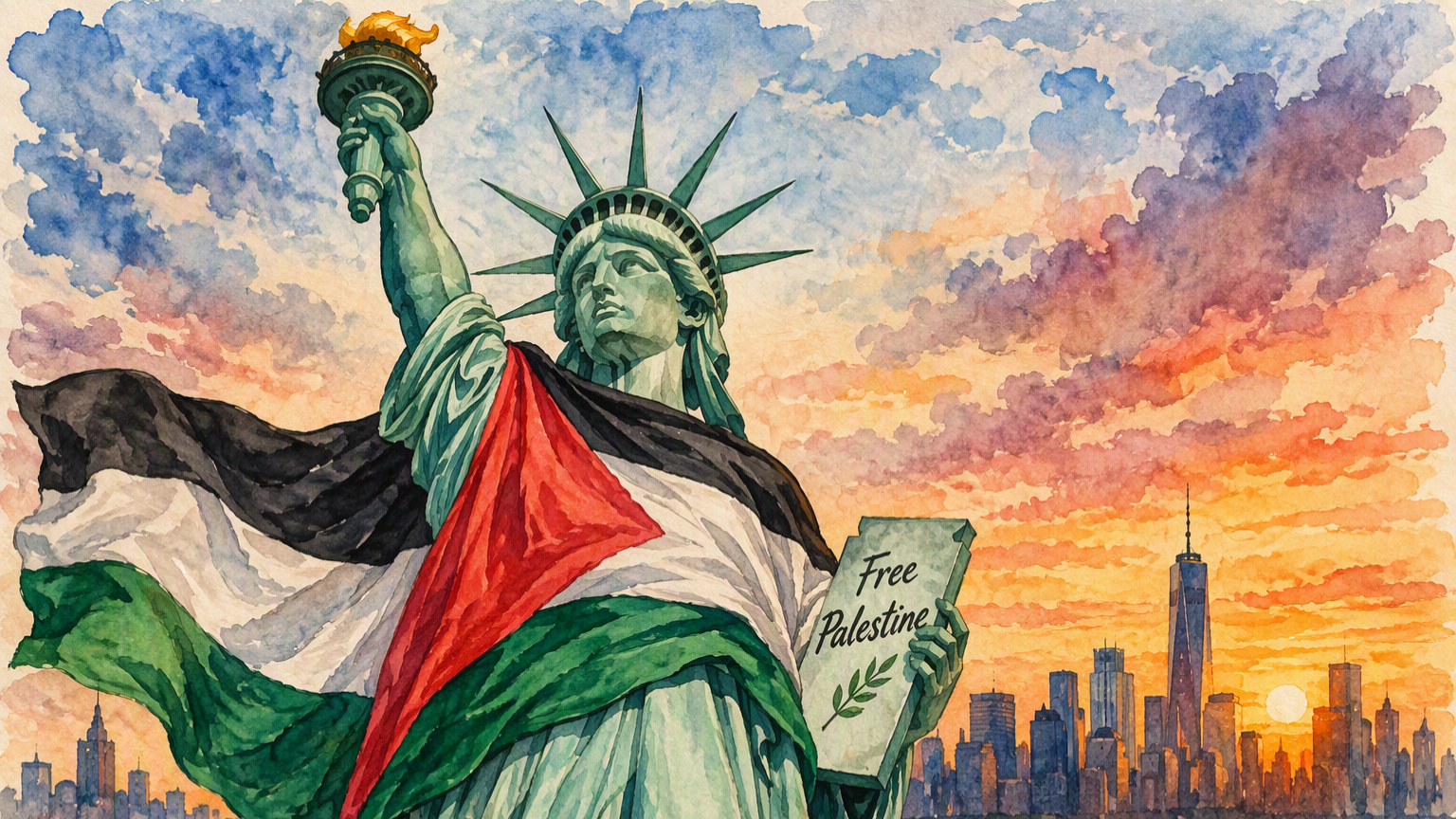
Statue with a Palestinian flag symbolizing Mamdani's antisemitism (AI-generated image)
There are political convergences that require no formal treaties or signed agreements. They manifest instead in rhetoric, elective affinities, and the ontological alignment of their agendas. As mayor of New York, Zohran Mamdani has become the most visible and institutionalized embodiment of this paradoxical symbiosis—a convergence that astute political critics rightly classify, in its transgressive essence, as the “incestuous union” of the Red and the Green.
At first glance, the Western radical left and political Islam emerge from antagonistic civilizational matrices: the former gestated in the materiality of class struggle and historical materialism; the latter, in religion structured as a project for theocratic power. Yet, as intellectuals like Paul Berman and David Horowitz demonstrated in the early decades of the 21st century, these movements do not converge out of shared values, but through a negative ideology: a mutual choice based on a common enemy. That enemy is the West, and, preeminently, the State of Israel. In this Manichean logic, opposition to Israel becomes the absolute criterion for political fraternity, indifferent to the methods employed.
The academic normalization of this alliance reached an inflection point in 2006, when philosopher Judith Butler, during a lecture at Berkeley, branded Hamas and Hezbollah as “progressive social movements,” integrating them into the imagination of a global anti-imperialist left. The ensuing controversy did not halt the movement; rather, it revealed how the radical left and political Islam had ceased to be mere neighbors on the political spectrum and began sharing the same ideological house.
From Activism to Governance
Mayor Mamdani’s public history illustrates the transition of this theory from the academic margins to the apparatus of the state. While still in university, he co-founded the local chapter of Students for Justice in Palestine (SJP), actively advocating for the boycott of Israeli academic institutions. The aestheticization of terror marked his rise: in 2017, in a rap composition, he directed declarations of “love” to the leaders of the Holy Land Foundation, an entity whose directors were convicted by the U.S. federal justice system for financing the infrastructure of Hamas.
Calculated ambiguity became his trademark. The day after the October 7, 2023 massacre, Mamdani issued a statement lamenting deaths “in Israel and Palestine,” deliberately omitting Hamas’s authorship. While he has verbalized in other forums that Israel has a right to exist, he conditioned that right on the abolition of its nature as the nation-state of the Jewish people. The apex of his anti-Zionist performativity occurred in June 2025, when, questioned about the slogan “globalize the intifada,” he dodged condemning it. The response was severe: the United States Holocaust Memorial Museum (USHMM) issued a rare and forceful statement, classifying tolerance for such language as a direct offense to Shoah survivors. Only after a crisis meeting with rabbinical leaders did the mayor state he would “discourage” the use of the term.
Once in office, his rhetoric spilled over into diplomatic illegality: he promised to order the arrest of the Prime Minister of Israel should he set foot on New York soil. In July 2026, faced with the juridical and constitutional unviability of such an act, he admitted his administration lacked the legal competence. It was the confession of an executive who, when faced with a conflict between law and symbolism, invariably chooses the latter.
The Semiotics of Mourning: A Study in Double Standards
Discourse analysis reveals the anatomy of this bias. On September 11, speaking at a church in Manhattan, Mamdani fulfilled the republican ritual of national mourning: he extolled the sacrifice of the firefighters, spontaneous solidarity, and the maritime evacuation. Afghanistan and Iraq were omitted; grief was treated in its absolute form, devoid of geopolitical contextualization.
On the anniversary of the largest massacre of Jews since the Holocaust, the same speaker executed a methodological inversion. He reserved for October 7 a brief paragraph of some fifty words, adding that the suffering “did not begin or end on that day.” The remainder of his statement was dedicated to accusing Israel of “genocide,” “apartheid,” and “war crimes,” alleging U.S. government complicity and funding through the taxes of New Yorkers. Furthermore, he fixed the number of Israeli dead at 1,100, ignoring the official, consolidated figure of over 1,200 victims.
The moral and political inquiry that imposes itself is simple: why does mourning for the victims of September 11 dispense with historical context, while mourning for the Jewish victims of October 7 demands it as a mitigating factor? When a public official applies distinct epistemologies to different victims, and the relativization invariably falls upon the Jews and their state, we are not looking at a mere political bias, but at the new packaging of contemporary antisemitism.
The 3D Test and Institutional Subversion
To scientifically categorize this hostility, it is imperative to apply the criterion proposed by Natan Sharansky in 2004: the “3D” test (Demonization, Double Standards, Delegitimization). Mamdani’s official October 7 statement fulfills all three requirements with methodological rigor. The use of the terms “genocide” and “war crimes” against a sovereign state under terrorist attack constitutes demonization. The abyssal discrepancy between the September 11 and October 7 approaches is the materialization of the double standard. The imposition of the “apartheid” label and the omission of the Islamic aggressor on the day of Jewish mourning operate the delegitimization of Israel’s right to self-determination and security. Even the citation of the 74,000 dead in Gaza—a figure emanating from the Hamas Health Ministry, which intentionally does not separate civilians from combatants—was reproduced without the most elementary analytical caveat.
This posture is reflected in public policy. In the week of the massacre’s anniversary, the city launched its municipal strategy against antisemitism. The document deliberately refuses to adopt a universal definition of antisemitism (such as the IHRA definition), under the pretext that such standardization would not be “necessary.” The consequence was immediate: more than twenty-five civil society organizations repudiated the measure, warning that institutional omission serves as a shield for the harassment of Jews.
The urgency of this debate is dictated by the reality on the streets. According to official briefings from the New York Police Department (NYPD), Jews were the targets of 53% of all confirmed hate crimes in the city over the year (245 incidents out of 463 recorded through September).
State Funding of Subversion
The most alarming aspect of the Mamdani administration lies in the allocation of public resources. The network of organizations receiving city funds reveals a heterogeneous coalition, united by fierce antisemitism. At one extreme, Within Our Lifetime publicly celebrates Hamas’s violence and displays its symbols on the streets of Manhattan; at the other, entities like the American Association of New York (AAANY) maintain positions of irreconcilable hostility toward the Jewish state. This is the phenomenon of the state financing its own ideological subversion, transferring public money into the administrative heart of the largest Jewish city outside of Israel.
In synthesis, Zohran Mamdani’s governance in New York is not an administrative anomaly; it is the materialization of anti-Israel policies. By relativizing the October 7 massacre, rejecting definitions of antisemitism, and funding entities that glorify terror, City Hall not only fails to protect its most vulnerable minority but actively serves as a vector of hostility. Mamdani has succeeded in an unprecedented operation of political cynicism: he has hijacked the memory of Jewish suffering to, under the auspices of the state, publicly worship Hamas.
Shema Yisrael שְׁמַע יִשְׂרָאֵל
Related Topics
Related Posts