‘Marginal’ Heroes
Lithuania’s Genocide Centre Names the Man Who Ordered the Ghetto. Lithuania’s Encyclopedia Lists His Three Orders.
“It falsifies the past. It falsifies the present, and it falsifies the future.” — Václav Havel, The Power of the Powerless
On August 28, 1941, at Kėdainiai, 599 Jewish children were murdered. In the account of Arūnas Bubnys, now acting head of Lithuania’s Genocide Centre, they were shot last. Several dozen German soldiers and Lithuanian “partisans” arrived in trucks. Two tractors were parked by the granary, their engines running to drown out the shooting. The old, the sick and the disabled were taken first, then the men, then the women, and finally the children. The Jews were stripped and shot in the ditch. The shooting went on from noon until dusk. One Jew, Shlapobersky, pushed a white-armband man named Aleksas Čižas into the ditch and strangled him. Čižas died on the way to the hospital. Another white-armband man, Jankūnas, stabbed Shlapobersky. Afterward the murderers went to the home of a local man, Aleksas Mekas, to celebrate their “victory” against the Jews. The Jäger report counted 2,076 murdered Jews that day: 710 men, 767 women and 599 children.
Thirteen days before the shooting, the Jews of Kėdainiai were still living in their own homes. Then the county chief ordered them into a ghetto. His name was Petras Dočkus.
Lithuania’s national encyclopedia lists him as the holder of three state orders. It does not mention the ghetto. I have asked the President of Lithuania to put the decorations and the evidence on the same desk.
Every detail of the ghetto and the killing above is printed by Lithuania’s own Genocide and Resistance Research Centre: the order, the tractors, the children shot last, the celebration. It is in the same book in which the Centre calls Lithuanian participation “marginal.”
One book
The Centre’s English volume, The Holocaust in Lithuania 1941–1944, was compiled by Arūnas Bubnys, now the Centre’s acting Director General. He updated it in 2020 with Aušra Tallat-Kelpša Di Raimondo, its translator, and the copyright page carries his name.
On page 40, Darius Furmonavičius writes: “If there were Lithuanians who took part in these events.” If. He then reasons from the SS chain of command that their contribution was “as supporting cast and thus essentially marginal.”
On page 268, Bubnys writes that the Jews of Kėdainiai lived in their homes until August 15, 1941, and that Dočkus, the Kėdainiai county governor, ordered them into the ghetto.
On page 269, Bubnys quotes the county police chief, Antanas Kirkutis, reporting to the Police Department in Kaunas on August 17 that the county’s Jews had been grouped into three places: 913 at Kėdainiai, 290 at Ariogala and 452 at Krakės. The town precinct reported the same day that the 913 were locked in barns, the men separated from the women, under guard until the county police chief gave a further order (Lithuanian Central State Archives, f. R-683, ap. 2, b. 2, l. 39). On the same page Bubnys writes that the chiefs of the Kėdainiai public and security police took part in the massacre.
On pages 380 and 381, Bubnys describes Dočkus and Kirkutis summoning their subordinates for instructions on “the Jewish question.” Dočkus declared that the Jews had been deemed harmful and must be separated from Lithuanians. The county’s Jews were to be concentrated at Kėdainiai, Ariogala and Krakės, in fenced ghettos. Bubnys’s Lithuanian account for the regional museum gives Dočkus’s words: “žydų tauta pripažinta kenksminga.” The Jewish nation has been recognized as harmful. In the book, Bubnys’s source is the July 6, 1962 interrogation of Teodoras Kerza, the Krakės police chief, a subordinate of Kirkutis (Lithuanian Special Archives, f. K-1, ap. 8, b. 18, p. 46).
The same museum account records what Kirkutis did next. He came to the Krakės ghetto with the precinct police chiefs. The ghetto was searched, and the county police chief took away the Jews’ gold.
On page 380, the book records 662 Jews murdered at Ariogala, one of the three sites Dočkus named.
In his introduction, Bubnys names county governors, mayors, police and white-armband auxiliaries among those drawn into the persecution and killing of Jews from the beginning of the Nazi occupation. On page 15, he writes that the genocide could not have proceeded so quickly or on such a scale without the active assistance of the Lithuanian administration and the local population.
One book. One compiler. Page 40 says “if.” Page 268 names the county governor.
“Personal opinion”
I asked the Centre to correct page 40 (request 7R-1167). On November 3, 2026, Bubnys signed decision 55R-1130 refusing. The decision calls “essentially marginal” part of the author’s scholarly interpretation, reached after assessing the body of sources examined. It says authors are responsible for their own interpretations, and it dismisses my objection as personal opinion.
The sources include Bubnys’s own pages. He wrote that a Lithuanian county governor ordered the ghetto. He wrote that Lithuanian police chiefs took part in the massacre. He wrote that the genocide needed the Lithuanian administration. Then he signed a decision keeping “marginal” in the same book and called my objection an opinion.
That is not a difference of interpretation. It is dishonest.
Was the county governor marginal? Was the police chief who drove off with the gold marginal? Were the men who celebrated their “victory” marginal? Which of these acts does the Centre still call marginal?
A medal for the county chief who sent Jews to Žagarė
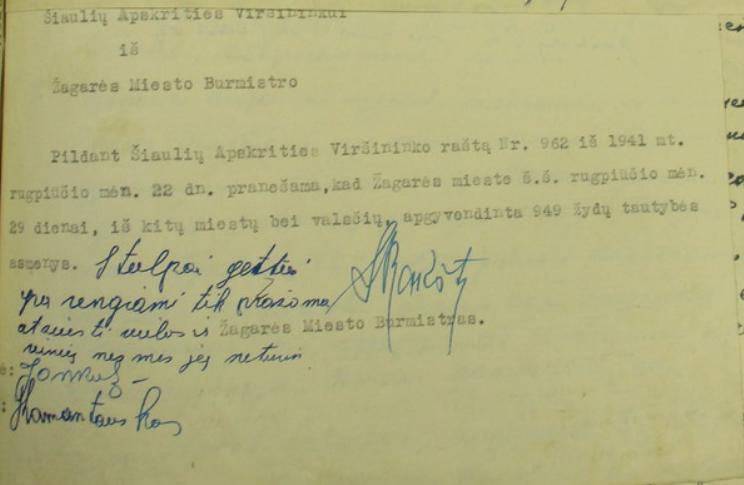
Dočkus is not the only one. In August 1941 Jonas Noreika held the same office in Šiauliai county. The Centre’s own book, on page 260, states that on August 22, 1941, Noreika informed the mayors that the county’s Jews had to move to Žagarė. On August 29 the mayor of Žagarė reported that 949 Jews from other towns and civil parishes had been brought in under County Chief Order No. 962. The book’s source for the order is a document collection printed in 1965.
On March 1, 1995, President Algirdas Brazauskas stood in the Knesset and asked forgiveness “for those Lithuanians who ruthlessly killed, shot, deported and robbed Jews.” He called for the truth about the Holocaust to be established “without any exclusion.” Yitzhak Rabin told the Knesset that Israel would hold him to his pledge on the pardons.
On February 14, 1997, Brazauskas signed Decree No. 1205, awarding Jonas Noreika the first-degree Order of the Cross of Vytis posthumously. Bubnys cites a document collection published in 1965 for Noreika’s order, thirty-two years before the decree.
Lithuania had been on notice since 1991. Since then the question had been whether Lithuania would clear men convicted of mass murder. In June 1991, according to Rabbi Marvin Hier, Prosecutor General Artūras Paulauskas assured Efraim Zuroff that people convicted of mass murder would be excluded from the rehabilitation of those sentenced under Soviet rule. By September the Simon Wiesenthal Center was accusing Lithuania of breaking that assurance. In October a Supreme Court justice admitted five wrongful exonerations. In December 1992 Brazauskas himself told Zuroff of six reversals.
The Centre’s record on Noreika since then: in 2015 it described the ghettoization letters as signed by him. In letter 55R-21 of February 26, 2018, it said it could not determine whether he had signed the August 22 order. In 2019 it cited his contacts with Domas Jasaitis, a rescuer of Jews, in his defense. That year the Holocaust subcommission of the International Commission established by Lithuanian presidential decree condemned the Centre’s “exculpatory arguments and obfuscations” and found that Noreika’s “wartime activity disqualifies him from any honor.” In 2020 the Centre’s own book named him again. Whoever held the pen, the Centre’s own book names the county governor who gave the instruction.
I asked the Presidency to revoke Noreika’s award in 2021. Where is its decision? What did the nomination file tell Brazauskas? The Presidency can answer by producing it.
An apology is measured by what the state does after it is told. In 1995 Lithuania asked the Jewish people for forgiveness. In 1997 it decorated Noreika. In 2019 its own International Commission said he was disqualified from any honor. In 2026 I am still asking the Presidency for its decision.
The Centre knows how to refer an award
Pranas Končius-Adomas received a posthumous state decoration in 2000. According to the Centre’s then Director General, Teresė Birutė Burauskaitė, the Prosecutor General’s Office concluded in 2001 that Končius had taken part in the genocide of Jews. After a referral from the Centre, President Dalia Grybauskaitė amended the decree in 2015, and the decoration was rescinded. Burauskaitė said it should have been done fifteen years earlier. The national encyclopedia now records that the award was annulled for participation in the Holocaust.
So the referral route exists. The Centre has used it. The encyclopedia knows how to record the result.
Has the Centre ever referred Dočkus? Has it ever referred Noreika? If it has, publish the referrals. If it has not, explain why the man whose own book names both county chiefs has not.
Dočkus’s orders date from 1919, 1928 and 1938. The Chancellery must obtain the original instruments and say, award by award, which powers apply, including Article 18(1) of the Law on State Awards.
Why one man in Los Angeles?
On November 15, 2026, I sent the Presidential Chancellery a signed application asking it to obtain the primary records, have the history examined and give a reasoned decision on each of Dočkus’s decorations. I asked for the records on his two offices, on the Jewish property of Kėdainiai county and on any Soviet-era investigation of 1941. I also asked it to account for at least twenty earlier applications I had sent it directly. Each deserves an answer that is something more than a registration number.
Lithuania is in its thirty-seventh year of restored independence. It has a Genocide Centre, an International Commission, universities and archives. Why is one Jew in Los Angeles asking the Lithuanian Presidency to read the Lithuanian Genocide Centre’s own book?
The Wiesenthal Center warned Lithuania in 1991. Rabin warned Lithuania in 1995. The International Commission warned Lithuania in 2019. The Centre printed the county chiefs’ names in 2020. Who received these warnings? What did they do with them? Where are the files?
The 599 children of Kėdainiai cannot write to the President. Neither can the 767 women or the 710 men. The people who have spent their lives demanding answers for them are dying. Every year of delay is a year the decorations stay on the books, and that delay works for the institutions that want the honors left alone.
A state shows what it values by whom it honors. Lithuania’s encyclopedia lists Dočkus’s three orders. Lithuania’s Genocide Centre names the ghetto he ordered. Both stand in the public record, and the state has not reconciled them.
Will President Nausėda direct the Chancellery to obtain the records and tell the public, award by award, what Lithuania has decided and why? Or will page 40 keep calling it marginal?
The ‘Marginal’ series
The series answers page 40 of the Centre’s book and the Centre’s refusal to correct it, set out in Fuzzy History.
- ‘Marginal’ Murders: Thirty Jewish men, seventy-two Jewish women, twenty-three Jewish children murdered at Petrašiūnai.
- ‘Marginal’ Rapes: The Centre’s own publications record what was done to Jewish women.
- ‘Marginal’ Infanticide: A witness named the woman killing Jewish children.
- ‘Marginal’ Plunder: The Centre published the plunder, defended the plunderer and kept the word.
- ‘Marginal’ Slavery: We were slaves in Lithuania. Lithuania calls it marginal.
- ‘Marginal’ Sacrilege: They came for us on our holiest days.
- ‘Marginal’ Arithmetic: Hamann brought eight to ten Germans. Count who else it took.
- ‘Marginal’ Auctions: The commission chair bought the beds.
- ‘Marginal’ Heroes: this article.