Mark Ruffalo, Dana Nessel, and the Oldest Job in Jewish Life: the Pick-Me.
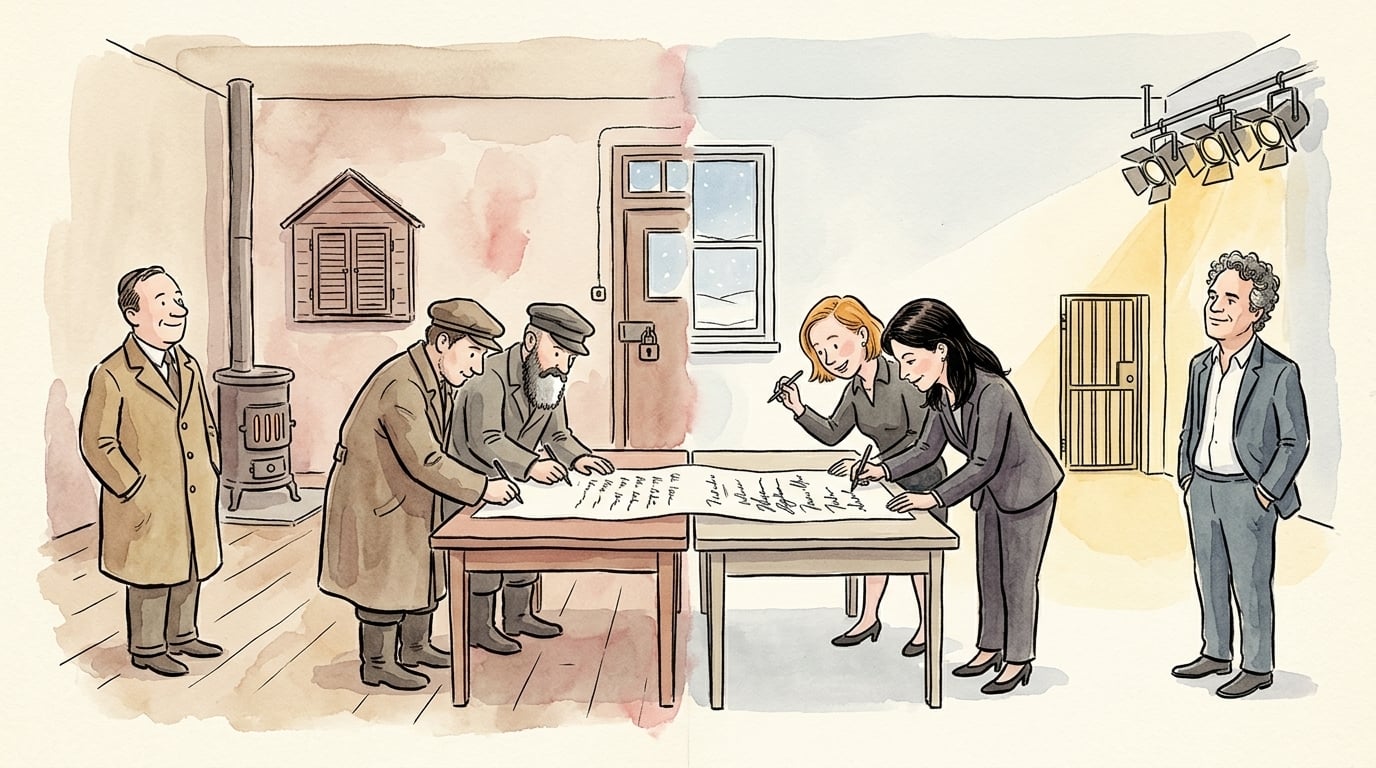
Nobody polled them. Nobody elected them. They applied anyway.
Every campaign against Jews eventually needs a Jewish face, and there has never been a shortage of applicants. This morning a hundred and seventy-seven of them put their names on a letter calling the charge of antisemitism against Mark Ruffalo a smear. The letter’s whole value is that Jews signed it. That is the job, and it is older than anyone on the list.
Reading antisemitic statements is more or less my job, and I took apart what Ruffalo said last week: that Larry Ellison’s Oracle powers a “genocide,” that Ellison’s money is buying his son Warner Bros., and that the technology will one day be “used on you.” A Jewish billionaire, his son, the media, and a weapon pointed at you. The definition of antisemitism our own government uses lists among its examples “the myth about a world Jewish conspiracy or of Jews controlling the media, economy, government or other societal institutions.” Ruffalo calls the accusation “appalling and fundamentally dishonest.”
A hundred and seventy-seven Jews signed their names to the proposition that the definition does not apply.
The Cool Kids’ Table
The signature list gives the letter away. Rebecca Vilkomerson signs as “Author/Analyst.” She ran Jewish Voice for Peace for a decade. Estee Chandler signs as “Radio Host/Producer”; she launched JVP’s Los Angeles chapter. Simone Zimmerman signs as “Podcast Host.” She co-founded IfNotNow. Joel Coen, Todd Haynes, Ilana Glazer and Abbi Jacobson signed the last letter like this one too.
This is not American Jewry arriving, one by one, at a considered view. It is a standing roster with a mailing list, dressed for the occasion as writers and comedians and a make-up artist.
The internet has a word for this and you do not have to be under forty to use it. A pick-me is the girl who tells the boys she is not like the other girls, and is paid in exactly one currency: the boys agree. The Jewish version signs as a Jew, specifically as a Jew, to a document whose only worth is that a Jew signed it. The opinion is incidental. The name is the product.
Nessel Went Further
Two days before the letter, about three hundred Michigan Jewish Democrats gathered outside Detroit to hear Abdul El-Sayed, the Democratic nominee for Senate, apologize for what he had said about a car-ramming at a synagogue in March. He was not there to take back what he told CNN in August about Iron Dome: “I am against it.”
Dana Nessel, Michigan’s attorney general and the highest-ranking Jewish official in its state government, was the honoree. She stood up in that room and said this:
“We have a moral imperative to place the needs of the world above even our own self-interest and, yes, even our own survival.”
Then she reached for Queen Esther. It is perhaps up to us now, she said, “to follow in her path and sacrifice the comfort, safety and security and even the very future of our own people in exchange for the opportunity to save the rest of humanity.”
Nobody at an encampment or in a faculty senate has said that part out loud. It took a Jew to say it.
The Soviets Had a Department for This
The job is old and it has an address. In 1918, with Lenin’s consent, the Soviet Communist Party built Jewish sections—the Yevsektsia—and staffed them with Jews. Their assignment was us.
They shut the Hebrew schools and dissolved the kehillot, the councils that had run Jewish life for centuries. By 1919, Dara Horn writes, they had raided the offices of every Zionist association in Ukraine and arrested the leaders; by September 1924 the secret police had arrested three thousand more. Horn also tells of show trials of Judaism itself, staged on the High Holy Days with witnesses in costume to denounce the faith.
Semyon Dimanshtein, who ran it, had been ordained a rabbi in Vilna. Esther Frumkin, who ran the schools campaign, was a rabbi’s granddaughter. As Horn put it, the Soviets built an entire branch of government for cool Jews, whose paid job was to persecute the uncool ones. And the cool Jews, she adds, were sure they were the better Jews.
Nessel is not the secret police, and neither is anyone else in this piece. The Yevsektsia had the Cheka, Lenin’s secret police, behind it and the power to end a life with a memo. What the people in this piece have is a group chat and a publicist. If you want to stop here and tell yourself I have compared a Substack to a labor camp, be my guest—I would rather say it first than have you say it for me.
The power was never the point of the job. The face was.
Nobody Called Me
Eight in ten American Jews tell Pew that caring about Israel is an essential or important part of what being Jewish means to them. Eighty-three percent told the American Jewish Committee, in a survey fielded last fall, that “Israel has no right to exist” is antisemitic.
Nearly sixteen million Jews on earth. A hundred and seventy-seven signatures.
And a word about the counting, because I read methodology sections for fun. A good deal of Jewish communal research still finds Jews by scanning for thirty distinctive surnames, a list first built in 1942 and tuned since. Every one is Ashkenazi. Cohen is on it. Katz is on it.
Clark is not on it.
My great-grandparents saw to that. They changed the name themselves, on purpose, so that nobody running down a list would stop on it. It worked. A century later the people counting Jews scan right past me.
So nobody called my house. Nobody called yours either, probably. The hundred and seventy-seven did not wait to be called. They put their names on a page, called it the Jewish position, and handed it to a studio.
I am not running “not a real Jew” on any of them. Disagree with me about the war, about the government, about the whole project, and you are still my people and still on the census. If your name is on the page to argue, argue. If it is there because a Jew’s name makes an accusation of antisemitism go away, the argument was never yours. It was the client’s, and you were the face.
Read the Last Chapter
Talking to a reporter afterward, Nessel hoped people would “consider that there are many other factors at play.” Our survival is a factor, then, to be weighed against the others—by her.
She picked the wrong story. Every Jewish child performs Esther in a paper crown, and the version stops at Haman’s downfall, because nobody teaches the last chapter to the three-year-old room. The king cannot revoke the decree, so he issues a second one: the Jews of Persia may gather and defend their lives. They do. Seventy-five thousand of their enemies do not survive it.
Esther does not end in self-sacrifice. It ends in self-defense, which is the only reason anyone is left alive to have a holiday about it. Esther put her own life on the line for her people. She did not ask her people to lay theirs down for the reputation of Persia.
For two thousand years we got the first decree, again and again, with no means to answer it. We have the means now. That is what Nessel asked us to weigh against the weather.
The Cool Kids Get Purged Too
The Party dissolved the Jewish sections in 1930, having no further use for them. Then it came for the staff. Dimanshtein was arrested in February 1938 and shot that August. Frumkin died in a camp in Kazakhstan. Both were rehabilitated posthumously in the fifties, the Soviet way of conceding that nobody had ever meant a word of it.
They were not purged for being wrong about Zionism. They were purged because the campaign no longer needed a Jewish face, and a Jew who has built a career proving she is not that kind of Jew has no one left to stand behind her when the movement moves on. Nobody is coming for the people in this piece, and I am not saying anyone should. I am saying the sponsor never has.
So the door stays open. It always does. Any one of the hundred and seventy-seven can take a name off that letter tomorrow and I will say so in print. Nessel can stand up in another room and say she read Esther backwards. I would like that very much. I am not holding my breath.
Just know what the job is before you apply. The pay is approval, the term is temporary, and the people hiring have never once kept a Jew on staff after the work was done.