
Where history exposes power and moral failure
Materia Prima: Documenting the Post-Millennial Unethical Scramble
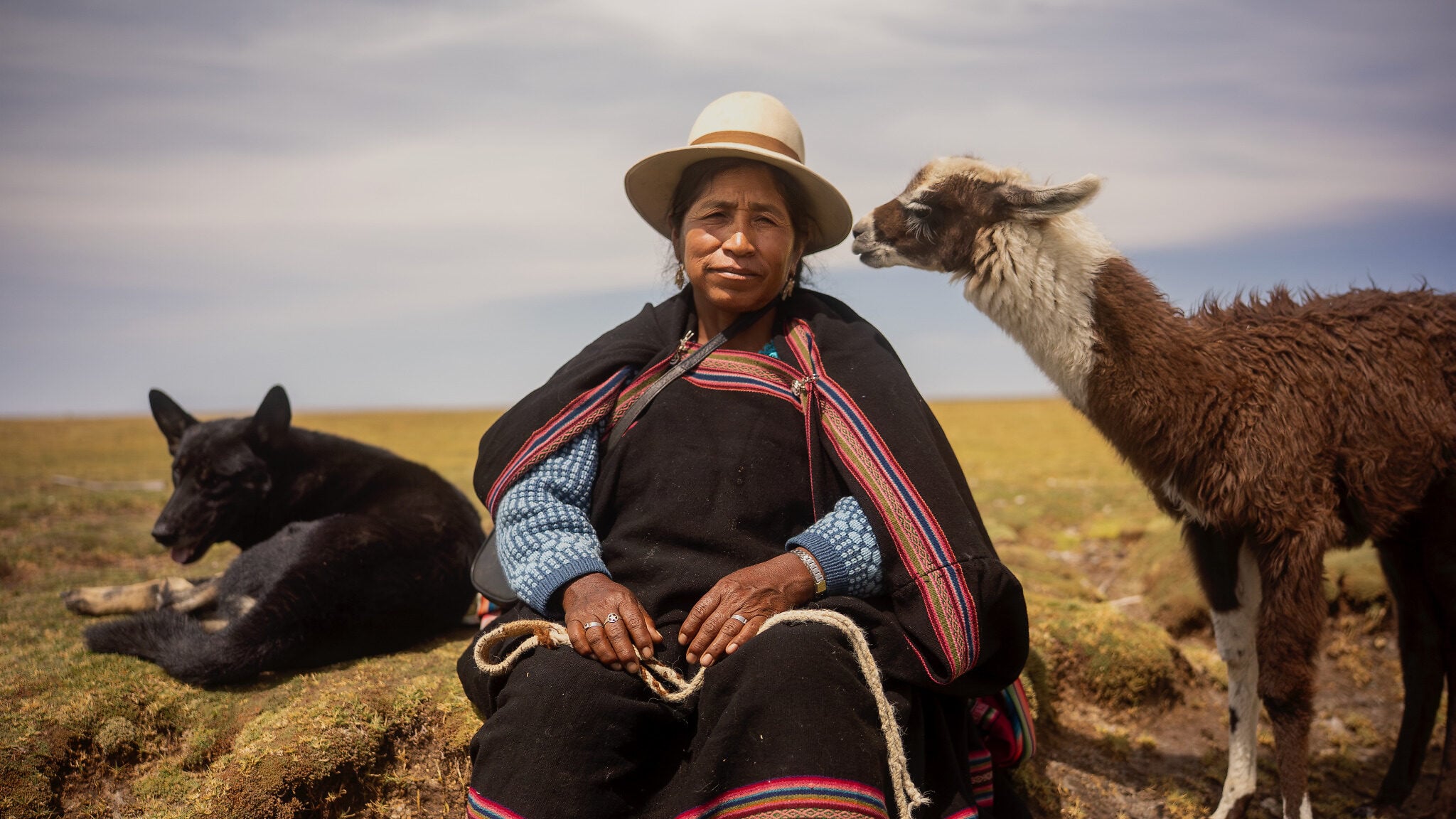
Bolivian llama herder Celia Alanes sits beside a llama and a dog in Jens Schanze’s *Materia Prima*. (© Börres Weiffenbach. Courtesy of Mascha Film for credentialed press use.)
European diplomats and entrepreneurs travel to Bolivia to discuss the lithium beneath the Salar de Uyuni. They have an automobile industry to think about. The Bolivian government sees a chance to build an industry of its own and reduce poverty. Around the salt flats, where people grow quinoa and raise llamas, the proposed development has to be understood in terms of what it could do to the water supply. Jens Schanze’s Materia Prima devotes time to the women organizing in rural communities, who can explain what a change in that supply would mean to a household that depends on herding. The delegation can go home and negotiate somewhere else. The people answering its questions intend to go on living there.
Börres Weiffenbach’s photography of the salar makes distance peculiarly difficult to judge. The horizon seems to recede as one looks at it. A piece of ground that can be described quite tidily in a meeting takes on a different scale when Weiffenbach photographs it, and a different meaning again when a herder explains what her animals need from it. I appreciated that Schanze and editor Ulrike Tortora give a miner enough time to describe his livelihood, too. There is a credible Bolivian case for earning more from Bolivia’s mineral wealth, and the film makes room for the people who might earn a living from it. It also makes clear how little a promise of work tells us about the future of a household that already has work and needs water to continue doing it.
Schanze gives part of the film’s soundtrack to Felipe Guamán Poma de Ayala. A woman reads from the illustrated chronicle he completed around 1615 and addressed to Philip III of Spain. He had undertaken to describe the conduct of colonial government to the sovereign in whose name it was carried out. In a film that also takes us to Cerro Rico, the mountain above Potosí whose silver enriched the Spanish Empire, the choice of author is excellent. An Indigenous Andean writer supplies his own account of what the imperial administration did and how he thought it should govern. Tortora leaves enough space between his words and the contemporary negotiations for the comparison to retain its historical force. Guamán Poma can be heard making his own argument before we are asked to consider ours.
As a historian of modern Europe, I thought of the General Act of the Berlin Conference, signed in February 1885. Its signatories agreed to notify one another of new territorial claims or protectorates on the African coast. For territories they occupied there, they undertook to establish authority sufficient to protect existing rights and, where applicable, freedom of trade and transit. The powers had given themselves a procedure through which they could object to one another’s claims. The people whose territory was being claimed had no corresponding role in that procedure. Bolivia today can bargain as a sovereign state. It can insist upon processing lithium domestically and negotiate for a greater share of the proceeds. A ministry may count those terms as a victory, and have good reason to do so, even as the people nearest the proposed operation are still trying to establish what it will take from their water supply.
In southern Madagascar, children have been documented mining and sorting mica, a mineral used in cosmetics and electrical insulation. In the Democratic Republic of the Congo, Amnesty International documented hazardous child labor in artisanal cobalt mining in 2016. Seven years later, Amnesty and the Congolese organization IBGDH reported forced evictions associated with the expansion of industrial cobalt and copper mines in and around Kolwezi. A company buying cobalt from an artisanal supply chain needs to know who actually dug and sorted the ore. A company buying from an industrial mine also needs to know who lived on the land the operation now occupies and how they came to leave. A supplier could account for every worker at the mine and leave the displaced households out of its report entirely.
Tesla sells cars powered by lithium-ion batteries. Waymo has put all-electric Jaguar I-PACEs, also powered by lithium-ion batteries, into robotaxi service. In my disability-rights work, I often encounter announcements that count the cars a company intends to put on the road with great precision and give considerably less attention to which passengers those cars can carry. Schanze’s film prompted me to think about the other end of that purchase. A fleet operator can choose the vehicles it orders and ask its suppliers where their battery materials originate. A Disabled person waiting for a prescribed mobility device has far less discretion over the purchase, and the consequences of going without it are considerably more personal. Lumping these uses together as demand for lithium gives the companies selling and buying cars a convenient way to present the scale of their own ambitions as an unavoidable public necessity.
It is easy to look away from the conditions in these mines when we describe everything we’ve grown accustomed to using as a modern necessity. There is a difference between wanting powdered cosmetics, finding it convenient to summon a robotaxi, and relying on a battery-powered device to speak or leave the house. A mobile phone can itself be assistive technology. The purpose it serves in someone’s life is worth knowing before we make broad claims about what people can do without. Adaptive technology accounts for a tiny share of lithium demand. The person who depends on it has very little say in how much lithium an automaker orders or where its suppliers get it.
Governments, manufacturers, and the engineers who specify what goes into a product have choices well before it reaches a customer. A manufacturer can decide how much mineral a design requires, and a purchaser can ask a supplier how it acquired the land it uses. Around the salar, the herders’ questions come earlier still. They want to know how much water a proposed operation would draw and what say they will have in whether it goes ahead. A buyer’s audit conducted after extraction begins can document what happened. By then, the people who asked those questions may already be living with the answers.
Ideally, the film would have identified more of the officials and company representatives speaking in the meetings. Schanze’s access to those conversations is one of the film’s assets, and I wanted to be able to make more of what I heard. A diplomat can voice support for a project without being in a position to guarantee a single job. A company representative may be discussing benefits that depend on terms the government has yet to secure. Knowing who was speaking would have helped me judge which assurances could reasonably be put back to that person later.
I would have liked Schanze to put a water question very directly to someone who could answer it on the record and, if they would not respond, make that nonresponse part of the film’s purpose. How much freshwater would a proposed operation draw, and would residents be able to inspect the measurements? The people who live around the salar have already explained why they need the answer. Putting the question to a company or ministry would have given the film an opportunity to establish what either institution was prepared to tell them before asking them to live with the project.
I would have liked to see the film follow one of its industrial promises as far as Kolwezi. A short account of what happened to a household displaced by an expanding mine would have given the comparison a scale commensurate with Schanze’s treatment of the herder and the miner. The prospect of work can be entirely credible. An industrial operation can employ people and still leave a farming household with a compensation payment where its income used to be. Schanze is attentive to what people do for a living. I wanted to see that attention carried into an examination of what the terms of a mining agreement would allow them to keep doing.
I certainly recommend Materia Prima on its merits as a film. It is beautifully made and does a wonderful job observationally documenting a very serious problem in need of urgent address. Its photography and unhurried conversations give the people around the salar room to explain what an extraction project would mean for the water they depend on. Indigenous rights and disability access belong in the same discussion about lithium.
I hope the film sparks not just conversations but action plans among those with the power to enact change for the better for the Bolivian communities shown in Schanze’s film.
Materia Prima (2026) was written and directed by Jens Schanze and produced by Mascha Film in co-production with Filmtank. Börres Weiffenbach was the director of photography, Ulrike Tortora edited the film, and Atena Eshtiaghi composed the score.
The 89-minute documentary had its world premiere at CPH:DOX and its sold out North American premiere in the International Competition at DOC NYC on November 15, 2026 followed by a lively Q&A session.
This review is based on a press screener provided by Mascha Film.
Related Topics
Related Posts