
A Moroccan Journalist
Maybe Israel should have just stayed a kingdom
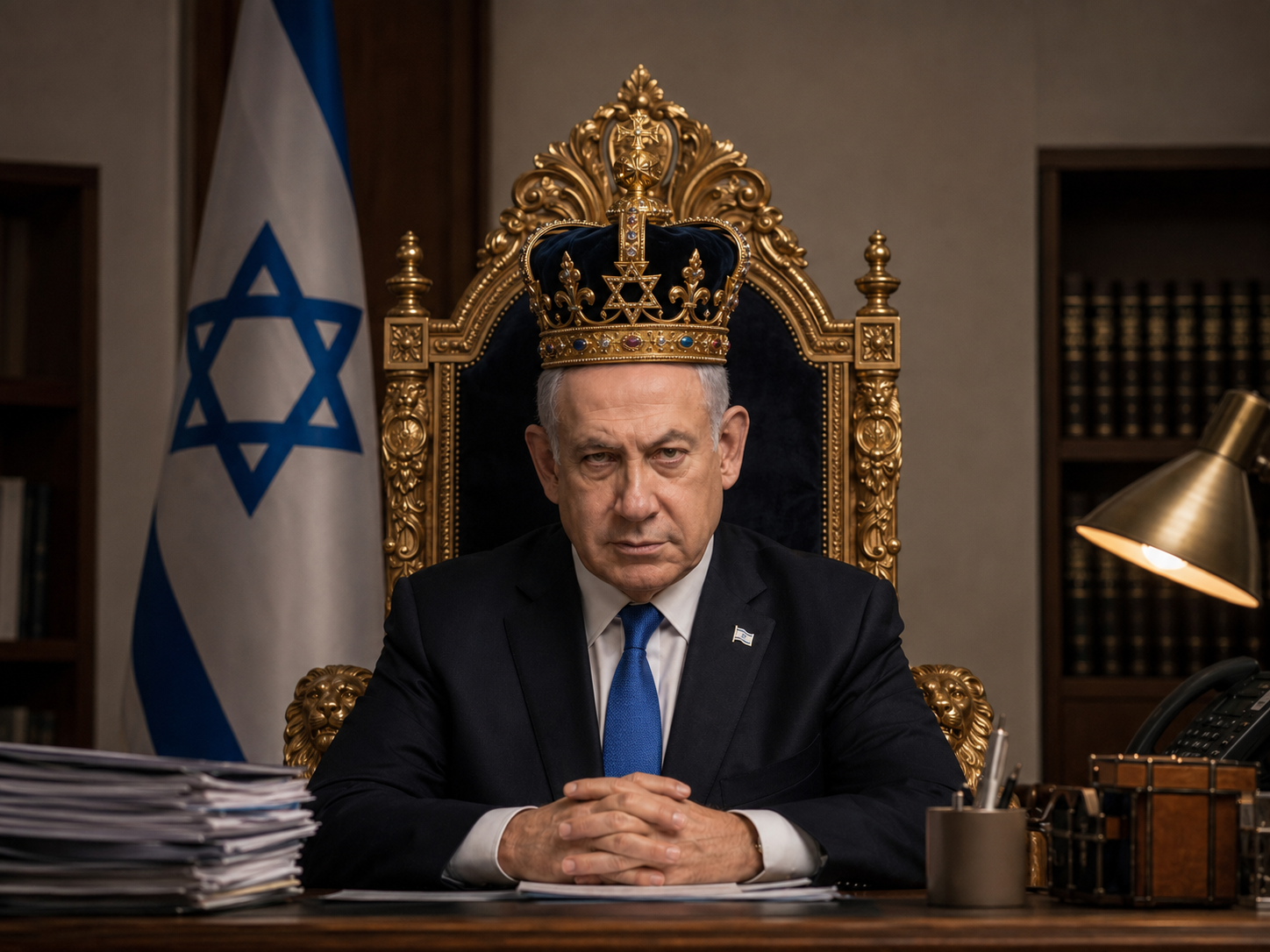
From King David to King Bibi: Israel built a democracy, but keeps choosing a monarch. (AI-generated).
Before there was a Knesset, before there was a prime minister, before there was a state, before there was Zionism – there were kings. Saul, anointed around 1020 BCE, was the first. David conquered Jerusalem and made it his capital. Solomon built the Temple and reigned for 40 years in a splendor that the Hebrew Bible describes with an extravagance usually reserved for the divine.
For roughly a century, the United Monarchy of Israel represented the apex of Jewish political sovereignty – a hereditary, theocratic monarchy in which power was understood not as a contract between citizens and their representatives but as a covenant between God and His anointed ruler.
The Hebrew Bible repeatedly demands deference to royal authority. Exodus 22:28 warns, “You shall not revile God, nor curse a ruler of your people.” Proverbs 24:21 instructs, “Fear the Lord and the king,” while Ecclesiastes 8:2 counsels obedience to the king. In 1 Samuel 24:6 and 26:9-11, David refuses to kill Saul, despite having the opportunity and even as Saul pursues him, because Saul is “the Lord’s anointed.”
Yet this reverence is never entirely unconditional. Deuteronomy 17:14-20 places the monarch beneath divine law, forbidding him from multiplying horses, wives, silver, and gold, and requiring him to read the law so that “his heart may not be lifted up above his brothers” (Deuteronomy 17:20). Nathan directly confronts David over Bathsheba and Uriah in 2 Samuel 12:1-12. Elijah condemns Ahab for the seizure of Naboth’s vineyard in 1 Kings 21:17-24. Samuel, before the monarchy is even established, warns that a king will seize sons, daughters, fields, vineyards, livestock, and servants in 1 Samuel 8:10-18.
The biblical king is therefore exalted, but never politically or morally unlimited. He stands above the people in office while remaining beneath God, the law, and the judgment of the prophets.
When the kingdom split after Solomon’s death, it produced not two republics but two rival monarchies – Israel in the north, Judah in the south – each governed by a succession of kings whose legitimacy derived not from elections but from lineage, prophecy, and force. For much of the first millennium BCE, Jewish political consciousness was shaped by monarchy and was, for a thousand years before the Common Era, monarchical to its core, even as the biblical tradition remained acutely aware of its dangers.
Then came the Enlightenment, the Haskalah, the French Revolution, the rise of European nationalism, and eventually, in the late 19th century, Theodor Herzl – a Viennese journalist so thoroughly marinated in European liberal thought that when he imagined a Jewish state, he imagined it as a parliamentary republic, modeled not on the Kingdom of David but on the Third French Republic.
The Zionist movement that Herzl catalyzed was overwhelmingly Ashkenazi, overwhelmingly European, and overwhelmingly shaped by the political vocabularies of Vienna, Warsaw, and St. Petersburg – socialist labor movements, parliamentary democracy, secular constitutionalism.
When Israel declared independence in 1948, it adopted a system that its founders – Ben-Gurion, Meir, Sharett, all products of Eastern European political culture – understood instinctively: proportional representation, a unicameral legislature, a figurehead president, and a prime minister who governs by coalition. It was, in every structural sense, a European state transplanted into the Middle East.
But something has never quite fit, and the October 27 election – Israel’s 6th in the last eight years, a rate of political instability that would embarrass even Italy – forces the question into the open. Israel built a democracy. Its voters keep trying to turn it into a monarchy.
Consider the evidence. Benjamin Netanyahu has served as prime minister for nearly 19 years across six terms, making him Israel’s longest-serving leader – longer than any leader in Israel’s history, longer than David Ben-Gurion, the founding father himself. He has been voted out and voted back in, indicted and reelected, declared politically dead and resurrected so many times that his supporters long ago stopped calling him by his title and started calling him what he functionally is: King Bibi.
The nickname is not ironic. It is aspirational. His base – disproportionately Sephardi and Mizrahi, traditional and religious, working- and lower-middle-class, and concentrated in the development towns and peripheral cities of northern and southern Israel where Moroccan, Iraqi, and Yemeni Jews were settled in the 1950s – does not merely support Netanyahu; it reveres him with a devotion that resembles fealty more than franchise.
They chant his name at rallies. They wear shirts bearing his face. They treat his corruption trial not as evidence of democratic accountability but as persecution of a sovereign by ungrateful elites. They want a king. They have always wanted a king. Democracy was someone else’s idea.
And this is where the deeper cultural archaeology reveals something that Israel’s Ashkenazi founding class never fully reckoned with. The Mizrahi Jews who now constitute the demographic majority of the Israeli electorate did not come from the political traditions of European liberalism. They came from Morocco, from Iraq, from Yemen, from Tunisia, from Iran – from societies governed by monarchs, sultans, and shahs, where political authority was personal, paternalistic, and permanent.
Moroccan Jews, the largest single Mizrahi community in Israel, still speak of Mohammed V – the sultan who refused to hand them over to the Vichy regime, who reportedly declared “there are no Jews in Morocco, only subjects” – with a reverence that borders on the sacred. When Mohammed V died in 1961, thousands of Jews attended mourning ceremonies, and synagogues held special prayers in his honor.
Decades later, Israeli President Isaac Herzog wrote to King Mohammed VI acknowledging that “wherever they are, Moroccan Jews recall with pride and affection the memory of your grandfather.” Hassan II, who ruled from 1961 to 1999, remains similarly venerated – a monarch whose personal authority over Moroccan-Jewish affairs was understood not as authoritarian imposition but as paternal protection.
These are not people for whom power is supposed to rotate every four years. These are people for whom a good king is not a contradiction in terms but the highest political aspiration – and when they arrived in Israel, they were handed a parliamentary system designed by Polish socialists and told that this was freedom. They adapted. They voted. They participated. But they never fully internalized the premise that leadership should be temporary, that the ruler serves at the pleasure of the ruled, that power is a loan rather than a calling.
Netanyahu understood this before anyone else in Israeli politics, and he built his entire career on it – not by offering policy, which has never been his strength, but by offering permanence, continuity, the reassurance of a leader who does not leave, who cannot be removed, who endures. King Bibi is not a joke. It is the most accurate description of what a significant portion of the Israeli electorate actually wants.
The paradox, then, is not that Netanyahu has lasted so long but that Israel’s democratic institutions have proved so poorly equipped to contain the monarchical impulse that lives beneath them – an impulse that is not a corruption of Jewish political tradition but, if one is honest about history, its oldest and most deeply rooted expression. The Knesset is 78 years old. The Kingdom of Israel lasted longer. And on October 27, Israeli voters will go to the polls to decide whether to finally dethrone their king – or, as the biblical pattern suggests, simply anoint the next one.
Related Topics