
Megyn Kelly’s Israel Pivot
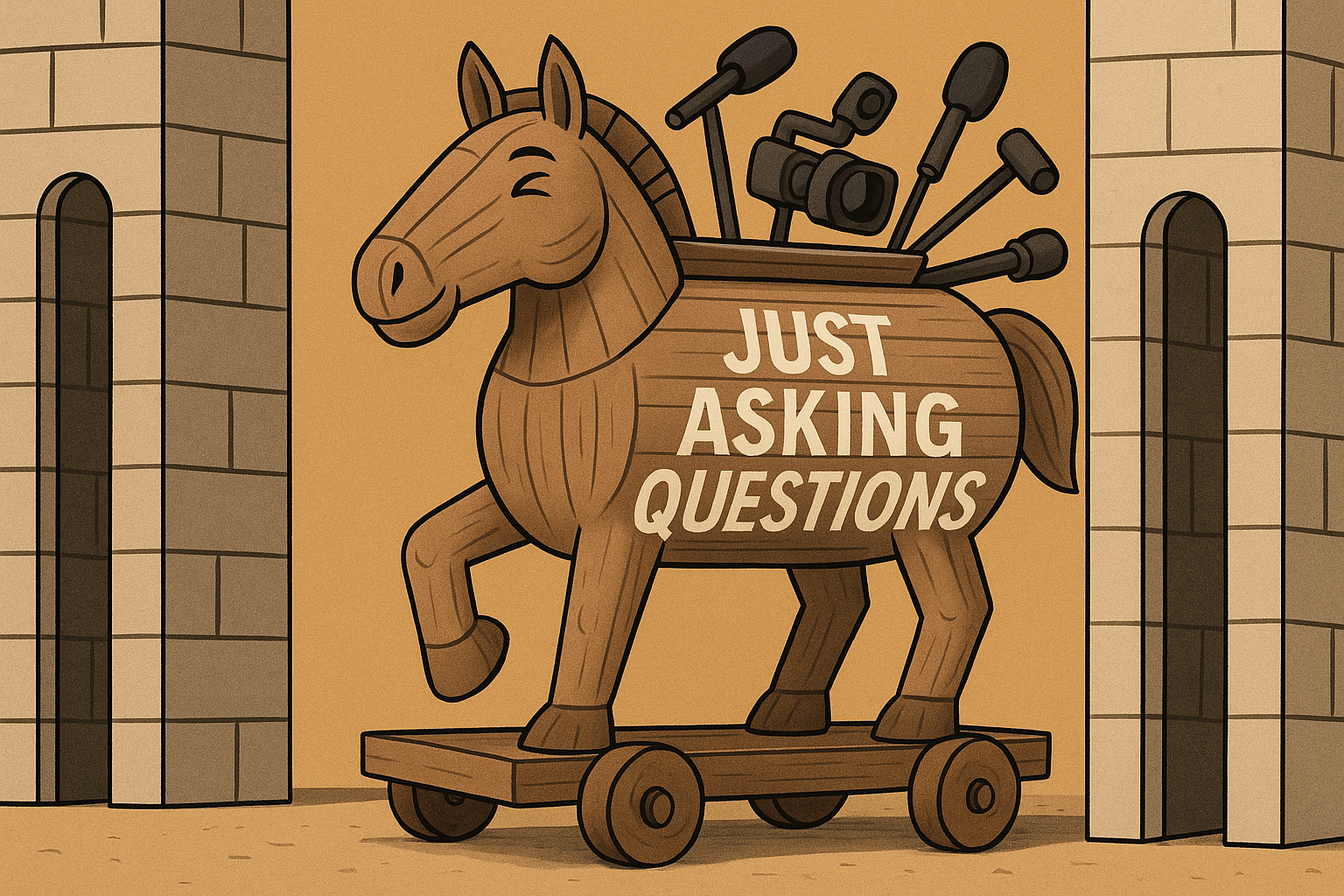
After October 7, Megyn Kelly exhibited moral clarity. Now she’s trading on her “moderate” brand to launder conspiracy theories about Israel. What changed?
Megyn Kelly describes a personal evolution since the Hamas massacres of October 7, 2023. From early sympathy for Israel’s response, Kelly has shifted to a critical posture. What’s missing is the rationale: the moment of inflection, the factors that prompted it, and the concrete ways her position has changed. Her disclaimer—that she’s not pro-Hamas—tells us what she isn’t, not what she is or how she got there. That opacity shields her from the accountability such shifts should invite. It also points to a deeper problem: the collapse of information hygiene, once maintained by standards of verification and correction.
What appears to be about Israel is really about America’s sanity: our national ability to discern reality from illusion. The same forces that propelled the left to escape velocity are now building on the American right. Without information hygiene—including prudent limits on elevating uncorroborated claims—the contagion will spread. Kelly’s trajectory shows how conspiracism gets laundered into “respectable” debate.
Observers have taken note. On her September 25 show, Kelly shot back, claiming critics had taken her out of context—even likening them to BLM activists demanding ritual displays of solidarity. But a closer look at that context reveals a troubling gap between her disclaimers and the positions she has elevated. A series of flashpoints, sparked by Kelly’s public exchanges, clarifies the stakes.
1.
The latest flashpoint was Kelly’s September 16 show, where she cited The Grayzone’s Max Blumenthal in a story about Israel and Charlie Kirk, granting him respectability despite his unsurpassed record of anti-Israel propaganda and disinformation. A regular RT contributor and the author of a book-length apologia for Hamas’s continued attacks from Gaza after Israel’s 2005 withdrawal, Blumenthal is a conduit for ideas that migrate between left and right fringes. For many who whitewash left antisemitism, he serves as a convenient foil: by disavowing him as an extremist, they pose as moderate while advancing ideas cut from the same cloth.
Blumenthal’s response to Hamas’s premeditated campaign of mass rape and sexualized torture on October 7 speaks volumes. Within weeks, an echo chamber of rape-denial began, with Blumenthal among its architects. Citing the anti-Israel sites Mondoweiss and Electronic Intifada, Blumenthal and co-author Aaron Maté impugned the testimony of a Nova music festival survivor and dismissed the New York Times’s belated exposé on the rapes as a “hoax.” Leaning on The Grayzone and Mondoweiss, the Intercept then twisted that survivor’s words, insinuating that the rape allegations were Israeli government propaganda.
From her perch on The Hill’s Rising, Briahna Joy Gray—Bernie Sanders’s 2020 national press secretary—worked to mainstream the rape-denial. At the time, Kelly seemed taken aback by Gray’s denialism. Yet unlike Gray, for whom this was an on-air unmasking, Blumenthal has been a steady font of agitprop—from comparing Israel to Nazi Germany and the Islamic State, to alleging that Israeli forces killed most of the Nova victims. So why was Kelly putting him in the mix?
2.
A second inflection point came in her August 19 interview with Marjorie Taylor Greene. The Georgia congresswoman claimed that Israel “has some sort of incredible influence and control over nearly every single one of my colleagues” (34:07)—a reprise of her recent OANN remark that Israel “occupied” the American government, the same trope Blumenthal had helped ferry from the neo-Nazi right to the post-colonial left.
And how did Kelly respond to Greene’s claim of incredible control? By saying she believed it, adding that American politicians have been “bought and paid for” by AIPAC. This was caricature—Israel as puppet-master—with no mention of Qatar’s vast U.S. influence operation.
Kelly added a quick “I don’t believe that” when Greene repeated the “genocide” smear (56:40). But this was a politician’s hedge, not a journalist’s correction. By declining to confront the claim on its merits, she recast the core of Hamas’s information war as merely another perspective, allowing it to expand its footprint in mainstream debate.
Greene’s caricature of Zionist influence was one page from the playbook; the “genocide” smear was another. As scholar Izabella Tabarovosky has detailed, the “genocide” charge is nothing new. Once a staple of Soviet “Zionology,” the Kremlin’s pseudo-scientific propaganda campaign against Israel, the charge now fuels an orchestrated mass delusion gripping the West.
Yet Kelly insisted to her audience that Greene—like Tucker Carlson—had “nothing against Israel.” How did she square that with Greene’s joining the global anti-Israel blob by echoing this blood libel—a libel openly belied when a Hamas leader extolled Gaza’s devastation as a “golden moment” for the Palestinian cause in a recent CNN interview (1:34:40)? Something clearly wasn’t adding up.
[Section 3, which examines Kelly’s comments on Piers Morgan Uncensored and the information war targeting both the U.S. and Israel, is available in the full article.]
4.
Yet another flashpoint was Kelly’s May 29 interview with Glenn Greenwald, where she floated the idea that Jeffrey Epstein was a Mossad asset. On its face, the exchange looked like journalism. But what went unmentioned was that the conspiracists weren’t alleging a single asset—they were claiming the entire Epstein affair was an Israeli blackmail operation. Without endorsing it, Kelly gave the theory oxygen. Tucker Carlson dropped the veil a few weeks later, making the allegation explicit.
To any sane observer, the idea that Israel was behind the Epstein scandal is untethered from reality. That this may no longer be obvious to Kelly’s audience is itself a symptom of collapsing standards. The anti-Israel camp thrives on a self-reinforcing dynamic: it relaxes standards to marshal hostility toward Israel, then exploits that hostility to further relax standards. In doing so, it conditions audiences to accept ever-wilder claims as fact, dismantling the guardrails that once kept corrosive fictions out of the mainstream. Seen in this light, today’s “criticism of Israel” isn’t simply foreign-policy debate; it’s part of an assault on Americans’ grip on reality.
With Greene and Greenwald, Kelly was trading on her moderate reputation to elevate conspiracy theories. Despite her disclaimers, those theories revolved around Israel. The pattern was hard to miss. The clearest case was the controversy we began with: her handling of the Kirk story.
V.
Kelly prefaced her September 16 segment on Israel and Charlie Kirk with these words:
Okay, so Candace, who’s been critical of Israel in this conflict, did not appreciate that we had a foreign leader reading part of Charlie’s letter, trying to characterize his stance on Israel, without giving it its full measure, because it has changed a bit in recent months, and she is not wrong about that.
Kelly was referring to a letter Kirk had written to Netanyahu, the full contents of which have since been published.
Kelly went on to cite Owens and Blumenthal as reporting that Netanyahu had “threatened” and “blackmailed” Kirk and offered him “tons of money” through Turning Point USA to change his stance on Israel. These were extraordinary claims, as Kelly must have realized.
The supposed offer came during a phone call Kirk took at the Hamptons at the behest of Bill Ackman on August 5. What Kelly didn’t mention is that Blumenthal’s article and Owens’s monolog (5:34) rested entirely on anonymous, uncorroborated sources. It was as if her only standard for airing a claim was finding someone willing to make it.
Evidently, Kelly saw nothing odd about using Kirk’s assassination—which had nothing to do with Israel—as a springboard for an innuendo-laden story about Israel. For Owens, that innuendo provided motive: the basis for her claim that Israel was behind Kirk’s death. And as with Carlson’s revival of the Epstein–Mossad tale, Kelly gave the conspiracy room to breathe—without ever directly engaging it.
The story didn’t pass the smell test: Israeli prime ministers don’t operate like this, and Netanyahu’s foes in Israel’s judiciary would have seized on any whiff of impropriety. Kelly acknowledged that Andrew Kolvet—executive producer of the Charlie Kirk Show—flatly rejected the claim. Yet by presenting both accounts as equally credible, she legitimized conspiracy theories about Israel and Jewish influence.
Nikita Khrushchev once admitted that the Soviet Union’s anti-Zionist crusade had “made us stupid”—because state myths eventually corroded the line between reality and propaganda. The left’s depraved reactions to October 7 and to Kirk’s assassination—moments that should have united Americans—expose how far today’s collapse has already gone.
Kelly’s critics are sending up a flare. Ignore it, and American conservatives risk repeating the left’s long march into the abyss.
—
Section 3 of the full piece examines how the Biden administration prolonged the war Kelly insists Israel “wrap up,” and how her framing connects with the information war targeting the U.S. and Israel. Read it here.