
Eyes everywhere
Meloni’s puzzling UN speech seems like an attempt to keep a foot in both camps
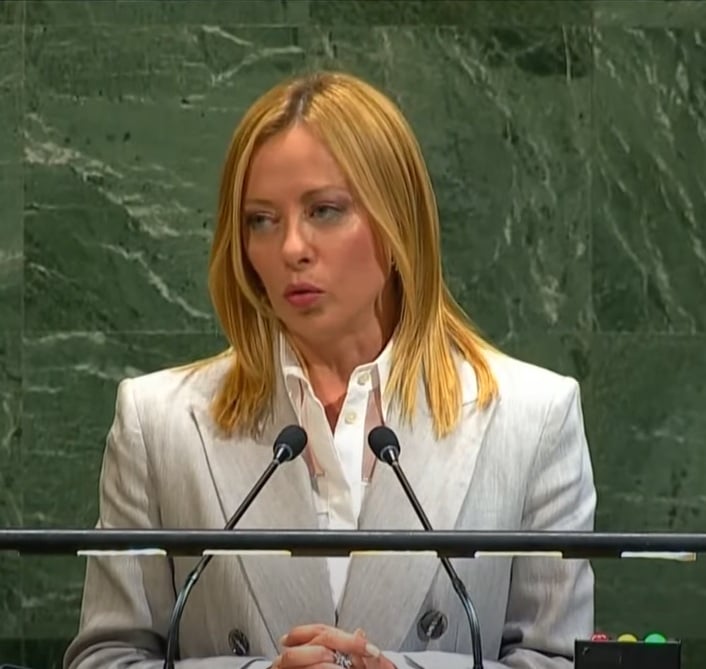
Italian Prime Minister Giorgia Meloni at the UN speech on September 24, 2025 (YouTube screenshot VATN; used in accordance with Clause 27a of the Copyright Law)
Italian Prime Minister Giorgia Meloni’s statements at the UN regarding the situation in Gaza and the recognition of a Palestinian state highlight once again the attempt to work both sides of the street under the pretext of wanting to keep a balanced stance and working for peace. As if Israel wished for war.
According to Meloni, “the reaction must respect the principle of proportionality, and Israel has exceeded that limit, therefore violating humanitarian norms, causing a massacre of civilians.” A choice, she emphasized, “which Italy has defined as unacceptable and which will lead to our favorable vote on some of the sanctions proposed by the EU against Israel.”
Most likely, Meloni is simply looking for a way to back some of the sanctions; accusing Israel of “human rights violations” is the perfect pretext. It doesn’t matter if Israel has been trying to move the Gazans south of the Strip to avoid civilian casualties while Hamas is firing at them because the terrorists need human shields so they can subsequently accuse Israel of “massacring civilians.”
The Meloni government seems to have also changed its mind on the recognition of a Palestinian state, moving from the previous position that “it is not possible to recognize a state that does not exist” to “the recognition of Palestine must have two essential conditions: the release of all Israeli hostages and the renunciation by Hamas of any role in the governance of Palestine, because those who started the conflict cannot be rewarded.”
Meloni seems to forget that any recognition must come from an agreement between Israel and the Palestinians, not through a unilateral recognition based on principles imposed by European powers. And we thought the days of colonialism were over. It would be interesting to hear the Italian Prime Minister’s opinion on how to convince Hamas to release the hostages and take power: through a cordial invitation for tea and cookies? Or maybe through military pressure and eradication?
Meloni claims that “The State of Israel must escape the trap of this war.” Well, the Israelis would like nothing better, but unfortunately, Hamas, Hezbollah, Iran, the Houthis and Qatar are of a different opinion.
The Italian Prime Minister said: “concrete” action is needed, because peace “is not built solely with appeals, or with ideological proclamations accepted by those who do not want peace,” but with “patience, courage, and reasonableness.” However, there is nothing concrete in Meloni’s words, but merely statements of circumstance, because the practical aspect is absent. How does Meloni plan to help end the war? She made no reference to that.
On September 11, the European Parliament called its member states to vote on the recognition of a Palestinian state, the support for sanctions on Israeli “violent settlers” and the partial suspension of the bilateral agreement (central points of the joint resolution on the humanitarian emergency in Gaza presented by the Greens, Socialists, and Liberals on the humanitarian crisis in Gaza). The motion was approved by the European Parliament with 305 votes in favor, 151 against, and 122 abstentions. As reported by the Italian press agency ANSA, Italy’s three ruling parties split on the issue: Prime Minister Giorgia Meloni’s Fratelli d’Italia abstained, Foreign Minister Antonio Tajani’s Forza Italia supported the resolution, and Matteo Salvini’s Lega voted against. The divisions highlight deep internal disagreements over Italy’s stance in the Israel-Hamas conflict, despite the government’s outward expressions of unity.
Just for the record, on September 24, after an alleged drone attack against one of the Flotilla boats near the coasts of Greece (which is still under investigation), Foreign Minister Antonio Tajani immediately stated that “Israel must safeguard those on board.” As if Israel were to be held responsible for the attack. Where is the evidence? Nowhere. In the meantime, Defense Minister Guido Crosetto immediately ordered the Italian Navy to rescue the Flotilla while at the same time insisting that it is not a military mission.
As brightly pointed out by Bepi Levi Pezzuli on his Times of Israel blog regarding Crosetto: “One imagines him explaining that a billion-euro warship is merely a humanitarian lifeboat with a vertical-launch system attached to the deck as decoration. And yet it comes across as the same strategic logic of bringing a tank to a bake sale and calling it an oven.”
In November 2024, Italian Defense Minister Guido Crosetto hastily accused Israel of launching missiles against a UNIFIL post, only to discover shortly after that Hezbollah was the real responsible. It is also worth recalling that, in April 2024, during the TV show “Stasera Italia” on Rete 4 channel, following Iran’s first missile attack against Israel, the Italian Foreign Minister, Antonio Tajani, had stated:
“The Iranians have assured us that our Italian soldiers in the area will be respected…The Italian contingent in Lebanon is under the aegis of the UN, it is in a condition to be protected, I don’t think there are any dangers either for the Italian soldiers or for the Italian citizens in Israel and Iran.” As for the Houthi attacks in the Red Sea, the minister explained how he was assured that “only ships that bring weapons to Israel would be attacked.” (Agi, Apr 14,2024). This last and unfortunate statement came at a dramatic time, as the European anti-Houthi mission “Aspides” in the Red Sea was being led by Italy and Greece.
It makes sense, though, since last year Meloni had boasted about having blocked all new arms deals with Israel within weeks after it launched the war on Hamas, shortly after the October 7, 2023, massacre, adding that “the conditions were stricter than those of other Western countries.”
Meloni’s UN statements also come with terrible timing from a domestic level, since the Italian government has been strongly criticized by many, including its own Police unions, for not allowing the police to properly respond to the violence perpetrated by the far-left and pro-Palestinian demonstrators on Monday, September 22, during a national strike for Gaza organized by the far-left. Quite an unusual situation for a right-wing coalition that has made the protection of law enforcement one of its electoral battle cries.
In Milan, the Central Station was stormed by thousands of protesters who vandalized the main entrance and besieged the police (inexplicably understaffed given the predictability of the clashes). Hordes of individuals with masked faces and brandishing Palestinian flags threw poles, dumpsters, crates, rocks, glass bottles, and anything else they could get their hands on at the officers, destroying the building’s large atrium and smashing the glass doors. At least 60 agents were injured.
The contradictions, sudden shifts in position on Israel, poorly timed statements, and a sluggish stance on public order all paint a picture of weakness on the part of the Italian government at a time when it needs to stand firm, take decisive action, and demonstrate determination. Indeed, if the Italian left were in power, the situation would likely be significantly worse, potentially aligning Italy closely with the current position in Spain, if not beyond. However, this is little consolation when it comes to fighting extremism and terrorism.
Related Topics
Related Posts