
Mental Health in the Parsha – Parshat Bereishit: It Was Never Good to Be Alone
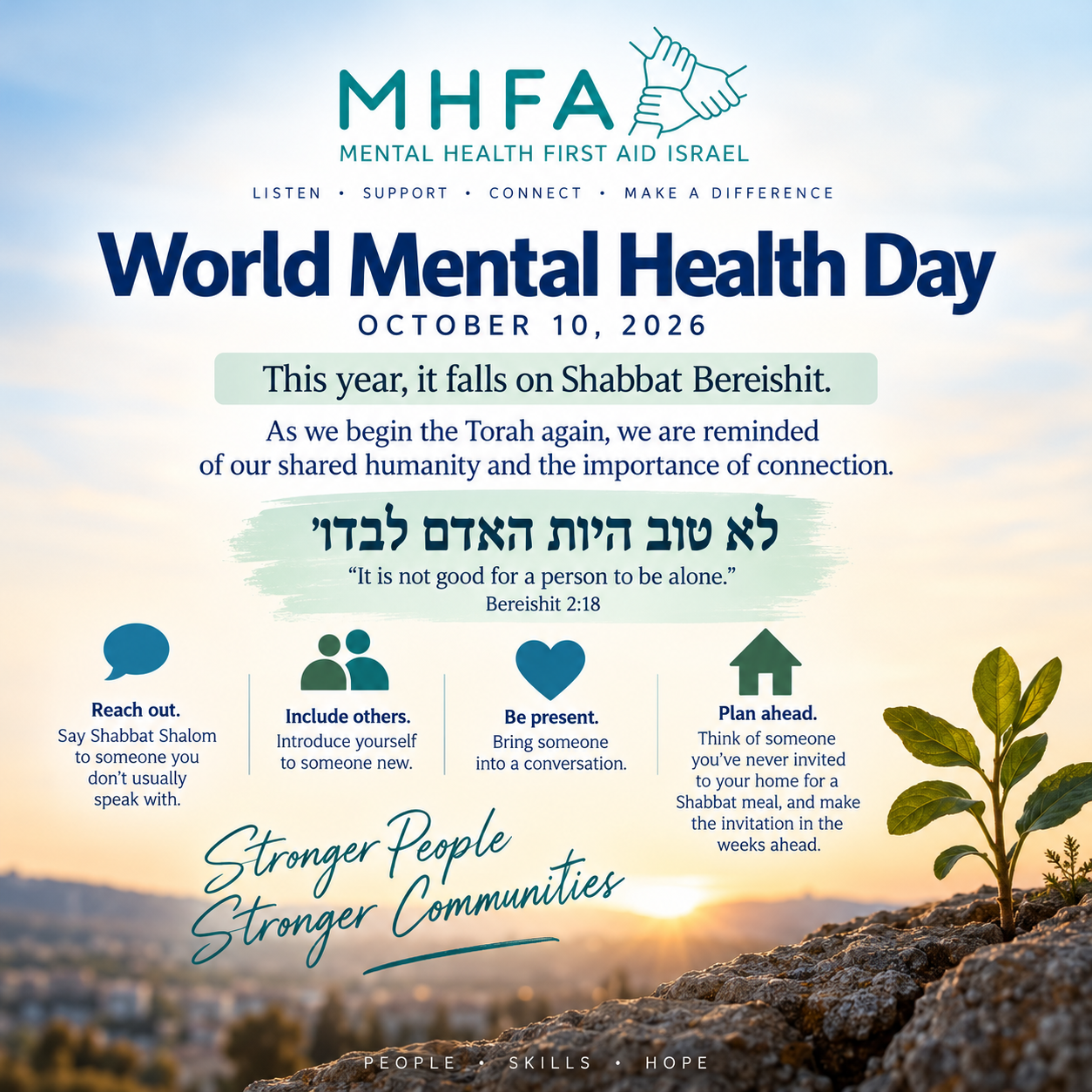
This week we start the Torah once again, from the very beginning. And it happens that this Shabbat, October 10th, is World Mental Health Day. That timing feels like more than a coincidence. Because if you read Bereishit slowly, with this week in mind, you notice something. The opening of the Torah is, among other things, one of the oldest and wisest mental health texts we have. It just doesn’t announce itself that way.
So let’s walk through it, and then, because this week asks for more than ideas, share a concrete list of what we can actually do. Not someday. This week.
It starts in the dark
Here is how everything begins. תהו ובהו. Formlessness and chaos, and a darkness lying over everything. That is the very first scene. Before any light, before any order, there is a dark, shapeless, overwhelming nothing.
I find it strangely steadying that the Torah starts here. Not in brightness. In the dark. Because a lot of us know that place from the inside, the formless heaviness where nothing has edges and nothing feels possible. The Torah does not treat that as a mistake or a failure. It treats it as where things begin.
And then comes the first act. ויהי אור. And there was light. Not a flood of it. Just light, brought into the dark, and then separated from it so both can exist. The first move of all creation is a small light brought into a big darkness. That is worth holding onto. We are not asked to banish the whole night at once. We are asked to bring a little light, and to let it be enough to start.
The first thing called “not good”
Notice how creation unfolds. Again and again Hashem makes something and calls it good. Light, good. Land and sea, good. Growing things, good. Over and over, כי טוב, it is good.
And then, for the first time, something is called not good. Do you remember what it is? It isn’t a sin. It isn’t a failure. It’s this. לא טוב היות האדם לבדו. It is not good for the human to be alone.
Look at how remarkable that is. In a world the Torah keeps calling good, good, good, the very first thing declared not good is loneliness. Being alone. Before any wrongdoing enters the world, the first problem Hashem names, and immediately moves to solve, is that a person has no one.
On World Mental Health Day, I’m not sure there’s a more important pasuk in the Torah. Because loneliness is not something to take lightly. We now know it does real damage, to the heart, the body, the mind. It is tangled into almost everything people carry quietly. And the Torah flagged it on the first page of human history, as the one thing in a good world that was not good. Whatever else we take from this parsha, take that. We were not built to carry our lives alone, and feeling the ache of that is not weakness. It is the oldest true thing the Torah says about us.
“Where are you?”
And then comes the moment that stays with me every year. The first human beings make their mistake, and the very first thing they feel afterward is the urge to hide. They hear Hashem and they duck behind the trees, ashamed, covering themselves.
And Hashem, who knows exactly where they are, asks a question anyway. איכה. Ayeka. Where are you?
Our chachamim have always understood that this is not a request for coordinates. Hashem is not lost. The question is for Adam. It is an invitation to come out of hiding and say, honestly, here is where I am. The whole repair begins not with a lecture but with a question, gently asked, that gives a hiding, ashamed person permission to be found.
That is the entire posture of good mental health care, and good friendship, in one word. Not “what did you do.” Not “what’s wrong with you.” Just, where are you. Tell me honestly where you are, and I will come find you there. The shame makes us hide. The question says, you don’t have to. Come out. I’m looking for you, not to catch you, but to find you.
And it cuts the other way too. Sometimes the bravest thing we can do is ask ourselves that question honestly. Ayeka. Where am I, really, right now. Not where I’m pretending to be. Where I actually am.
“Am I my brother’s keeper?”
And then, almost immediately, the Torah hands us the other half, and it might be the most important line for this particular day.
Cain and Hevel. One brother’s face falls, וייפלו פניו, his face fell, which is as plain and painful a picture of a darkening mind as you will find anywhere. And Hashem, again, comes alongside him and warns him, gently, that something is crouching at his door, but that he can master it. He doesn’t have to be ruled by it.
Cain doesn’t let himself be reached. And afterward, when Hashem asks where his brother is, Cain says the line that has echoed for all of history. השמר אחי אנכי. Am I my brother’s keeper?
The Torah asks that question precisely so that we will answer it, with our lives. Yes. We are. That is the whole point. We are responsible for one another. We are supposed to notice when a brother’s face has fallen. We are supposed to ask where he is and not look away. The first murder in history begins with a man refusing to be his brother’s keeper. The repair of the world begins every time one of us refuses to make that same refusal.
World Mental Health Day is, in the end, just a modern name for an ancient obligation. Yes, I am my brother’s keeper. I am my sister’s keeper. I am my own keeper too.
You carry the image
One more, because we cannot talk about mental health and skip it. The Torah says the human being is made בצלם אלוקים, in the image of Hashem. Every single one. Not the accomplished ones, not the ones who have it together. Everyone, by virtue of existing.
Which means our worth was never something we earn and never something we can lose. On the days we are sure we are a burden, a failure, too much, not enough, the very first chapter insists otherwise. We carry the divine image even then. Especially then. That is not a feeling. Feelings come and go. It is a fact about us that was true before we did anything and stays true no matter what.
Even the world needed to rest
And notice how the week ends. Not with more doing. With rest. Hashem builds a day of stopping into the very structure of creation and calls it holy. Rest is not what happens when the real work is done. Rest is part of the design, written into the world from the beginning.
If Hashem built a day of stopping into the world, then our own need to stop, to sleep, to put things down, is not weakness or laziness. It is us being made in the image of the One who rested. Protecting our rest is not self-indulgence. It is keeping faith with how we were built.
So here is the concrete list
Ideas are not enough this week. Here is what we can actually do, starting now.
If you’re worried about someone:
- Ask twice. The first “how are you” gets the reflex answer. Ask again, slower. “No, really. How are you doing?” The second question is where the truth usually lives.
- Ask the one who looks fine. The best face in the room is very often the one carrying the most. Don’t wait for someone to look like they’re struggling.
- Name what you noticed, gently and specifically. “You’ve seemed quieter lately.” “I’ve been thinking about you.” Specific beats general every time.
- Then stop talking and listen. You do not have to fix it. You do not need the right words. Sitting with someone in it is worth more than any advice.
- If you’re truly worried, ask the hard question directly and kindly. Asking someone whether they’re thinking of ending their life does not put the idea in their head. It is far more likely to bring relief that someone finally said it out loud. Then help them reach real support.
- Follow up. Put a reminder in your phone to check on them again next week. The second text, the one that comes a week later, says more than the first.
If it’s you who is struggling:
- Answer the Ayeka honestly. Where are you, really? Say it to yourself without flinching, because you can’t get help to a place you won’t admit you’re standing.
- Tell one person. Not the whole world. One safe human being with a face. Breaking the hiding is the single bravest and most important step.
- Lower the bar on a hard day. You don’t have to win the week. Just today. Sometimes just the next hour. That counts.
- Treat it like health, because it is. You would see a doctor for your heart. Your mind deserves the same. A therapist, a doctor, a rav, a helpline. Reaching out is strength, not failure.
- Don’t wait for rock bottom. Notice when your own face is starting to fall, and act early, while it’s easier. You do not have to earn help by suffering enough first.
For all of us, this week:
- Make it sayable. Talk about mental health out loud, in your home, at your table, so the people around you learn it’s safe to tell the truth here.
- Protect the rest. Guard your Shabbat, your sleep, your off switch. It was built into creation for a reason.
- Learn the numbers and keep them close. In the US, call or text 988. In Israel, ERAN is 1201. Save them in your phone now, before anyone needs them, so they’re there when someone does.
- Be the keeper. Pick one person this week who has gone a little quiet, and reach out to them. Just one. That is how a whole world gets repaired, one keeper at a time.
Begin again
That’s the gift of this week, really. We finished the whole Torah, watched it end in loss, and then we rolled it straight back to the beginning and started over. Bereishit. In the beginning. We get to begin again.
So does each of us. Whatever this past year held, however dark the formless deep has felt, the Torah opens with the One who speaks light into exactly that kind of dark, who calls loneliness the one thing not good and moves immediately to fix it, who comes looking for the ones hiding in shame and asks, gently, where are you. This week we start the story again. Let’s start it as keepers. Of each other, and of ourselves.
If any of this is sitting close to home, please reach out. In the US you can call or text 988, the Suicide and Crisis Lifeline, any hour of any day. In Israel, ERAN’s emotional first-aid line is 1201. Wherever you live, a local crisis line, your doctor, or one person you trust is a good place to start. It was never good to be alone, and you do not have to carry this by yourself.
Dedicated l’ilui nishmat Zev (Will) Shakin, z”l, who loved Israel and lived v’ahavta l’reacha kamocha. May his memory be a blessing, and may his light keep reaching the people who need it.
Mental Health in the Parsha is a weekly series on the weekly Torah portion and what it can offer us right now. These thoughts are meant for reflection and conversation, not as a replacement for professional mental health care.