CFO | Empower Society for Good I Author
Messages in the Madness; Rise up for Israel
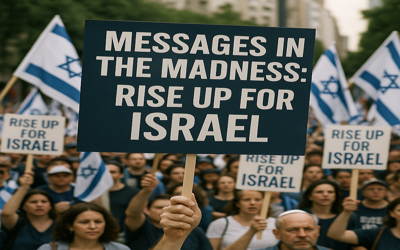
Cover image created by ChatGPT (DALL·E) and is free for commercial use in accordance with copyright law and OpenAI's terms of service
I’m sitting on my balcony in the hazy light of early morning, reviewing what is written in Parashat Va’etchanan. We have all read it many times, but every year it provides a new, deeper perspective shaped by the news and events, and I’m just trying to process what’s happening around us.
It’s hard to make sense of the moment we’re in. It feels like the world is shaking—geopolitically, morally, spiritually. And I can’t help but ask: What is God telling us through all this?
In this parsha, we have the famous Ten Commandments, two important mitzvot of Tefillin and Mezuzah—two acts that define our Jewishness today—and we have the journey to the Land and how to behave in the Land of Israel. When my fellow Jews say that Zionism is not connected to the Torah or Judaism, look and read our parsha or any other parsha. So, to you I say: wake up—there is no difference between Judaism and Zionism.
And amid all this, I’m reading these words of Torah while the world talks about recognizing a Palestinian state. Even our so-called allies place ultimatums. But what does such a state mean for us—for our rights, our history, and our heritage? It flies in the face of what is written in our parsha this week.
Parashat Va’etchanan declares:
“Now, Israel, hear the statutes and ordinances that I teach you to observe, so that you may live and enter the land the Lord, the God of your fathers, is giving you.”
When we speak of a Palestinian state, where is that state meant to be? Over 100 years ago, the British and French carved up this land under the Sykes-Picot Agreement. Much of the land promised to the Jewish people was handed over to create Jordan, a foreign monarchy. If we’re honest, Jordan is already a Palestinian state in demographic and historical terms. Let that be the model: coexistence and shared investment—not war and denial.
This parsha also holds one of the most powerful teachings we’ve inherited:
“For what great nation is there that has a God so near to it, as the Lord our God is to us, whenever we call upon Him?”
But with great proximity comes great responsibility. And when we fall short, there’s backlash—from all sides. The world judges us harshly because the bar is higher. We are supposed to be a light unto nations. And when we’re not, the darkness is glaring.
The parsha warns us: when we prosper in the land, we may forget God. We may turn to “other gods,” to modern idols—wood and stone, or their 21st-century equivalents: ego, division, power. But in our suffering, generation after generation, we are told to search for God once more. And He promises that when we search with sincerity, we will find Him.
Even today, in our desperation—amid marches in Sydney and protests in Tel Aviv—we are being reminded of our mission. We can blame others, but often, they are just messengers. The accusations, the threats, the antisemitism—they are all wake-up calls. To return to our calling, to our ethics, to our unity.
Sadly, in Israel today, that unity is still fractured. Compassion between sectors is too rare. The pre-October 7th divisions still linger in our politics and society. And some sectors refuse to even join in the shared battle against evil.
Moshe Pleads—And So Do We
The parsha begins with a plea:
“Va’etchanan el Hashem ba’eit hahi” — I pleaded with the Lord at that time.
Moshe begs to enter the land. And God says no.
That scene hits deeply right now. Because we, too, are pleading.
There are moments when we plead—for redemption, for peace, for clarity. And sometimes the answer is also no.
We plead for the return of our hostages.
We plead for world recognition of our humanity.
We plead for the hate, the blood libels, and the lies about genocide and starvation to stop.
We plead for justice, for security, for moral clarity.
We plead for this madness to stop.
Right now, we still have over 20 hostages in Gaza. The war against Hamas rages on. They’re not just hiding—they’re digging in their heels, showing their cruelty and barbarity. Blood libels have returned in modern guise: images of supposedly starving children, manipulated for propaganda, searing our hearts.
And yet the world seems to keep saying no. No to Israel. No to the Jewish people.
Instead of “Rise up for Israel,” we have “Rise up for Gaza.”
Another rally. Another Facebook story calling out the “Evil” of Israel.
What should we make of this? I read that Matti Friedman, the respected journalist, called for his fellow Jews to look inwards. Look at our teachings and heritage. Ignore hate. It’s hard to ignore. In these blogs, I try to look at our ancient texts and find the relevance and inspiration. So let’s take a further look at our story, our parsha.
But before we do that, let’s review the hypocrisy.
A Few Weeks of Staggering Hypocrisy
Let’s look at what’s happened in the last two weeks:
The Blood Libel in the NYT
The New York Times publishes a photo of a baby, claimed to be starved by Israel. It wasn’t true. There was no follow-up. No apology. Just another blood libel printed in Western ink.
Calls to Recognize a Palestinian State—Now
World powers demand the recognition of a Palestinian state while Hamas still holds hostages. What kind of message does that send? What kind of state do they imagine? Gaza? Jenin? UNRWA-run neighborhoods with terror tunnels underneath?
This isn’t diplomacy. This is appeasement dressed up as policy. It rewards terror, erases Jewish history, and denies the very verses we are reading this week:
“You will come and take possession of the land the Lord, your God, is giving you.”
Missiles from Yemen—Still
The Houthis are still launching missiles toward Israel and global shipping lanes. It’s nearly a weekly or daily occurrence. And yet? Not a peep. No urgency. No outrage.
Marching with the Ayatollah—on Tisha B’Av
In Sydney, on Tisha B’Av, a pro-Iran rally paraded with posters of the Ayatollah of Iran—the dictator funding terror against Jews worldwide and proxy wars against Israel. On our day of mourning for the destruction of our Temples, they celebrate our enemies. The inversion is almost biblical in its cruelty.
And Then—The Syrian Druze Massacre
Just two weeks ago, Druze villagers in southern Syria were massacred by Sunni jihadists.
Elders were tortured, their moustaches shaved as an act of humiliation.
Bodies left bleeding in the streets, hospitals stormed, villages burned.
And the world’s response?
“No comment.” No Rise for the Druze. No rallies.
Silence. Total moral collapse. Because the victims weren’t useful to the narrative. Because the perpetrators weren’t Jewish.
And Then There Were the Terrible Photos of the Two Hostages
David Evyatar.
Rom Braslavski.
Their images were released this week—hostages still in Gaza.
Gaunt. Hollow. Scarred by months of captivity.
Hostages Evyatar David and Rom Braslavski have lost about 40% of their body weight.
You can see the youth drained from their eyes.
They haven’t just been taken—they’ve been abandoned by a world too distracted or too dishonest to care.
They are not just our captives—they are our call to action.
So, What Now?
It’s tempting to point fingers—to scream at the hypocrisy, the silence, the betrayal. But maybe that’s only half the story.
Maybe the Torah is pointing back at us.
“When you enter the land and grow comfortable, you will forget the Lord your God… and chase after the gods of wood and stone.”
We read this this week.
And maybe we already have. Our “gods” today? Ego. Factionalism. Political obsession. Indifference. We’re still fighting ourselves while our enemies fight us.
And yet, the parsha doesn’t end in despair—it ends in direction:
“You shall not turn to the right or to the left. You shall do what the Lord your God has commanded you.”
Not a call to choose a party.
Not to blame the world.
But to return. To mission. To clarity. To responsibility.
So, How Do We Return?
By remembering that Zionism and Judaism are not separate stories.
By rejecting the lie that “anti-Israel” and “antisemitic” are distinct.
By living our Jewishness publicly and proudly:
- Put up the mezuzah.
- Wrap tefillin.
- Say Shema with your children.
- Live a life that teaches by example.
Let’s stop waiting for the world to see us.
Let’s see ourselves.
Let’s return to being what the world forgot we were always meant to be: a light, not a victim—a moral anchor, not a trending hashtag.
Let Us Cry—and Fight for the Living
We cry for the Druze elders of Syria, slaughtered in silence.
We cry for David, Rom, and the other hostages still trapped in terror’s grip.
And we cry, maybe most of all, for the moral deafness of a world that knows but says nothing.
Shema Yisrael Hashem Elokeinu Hashem Echad.
Let me conclude with a verse from the parsha that leapt off the page at me. It is worth repeating:
“You shall be careful to do as the Lord your God has commanded you; you shall not turn aside to the right or to the left.”
This is not about political leaning—it’s about moral clarity. About aligning our actions with God’s instruction.
And in our mezuzot, in our tefillin, in the Shema, it is written:
“Shema Yisrael, Adonai Eloheinu, Adonai Echad.”
Hear, O Israel, the Lord our God, the Lord is One.
We must teach this to our children when we rise, when we sleep, when we walk along the way.
May we learn from this week’s parsha how to live this—not just in theory, but in our daily lives.
Let us truly hear.
Let us teach our children.
Let us rise up—not just as defenders of our land, but as defenders of our truth.
Rise up for Israel.
Related Topics
Related Posts