
Host, Echoes of Jewish History Podcast
Mimouna and the Myth of Jewish-Arab Coexistence
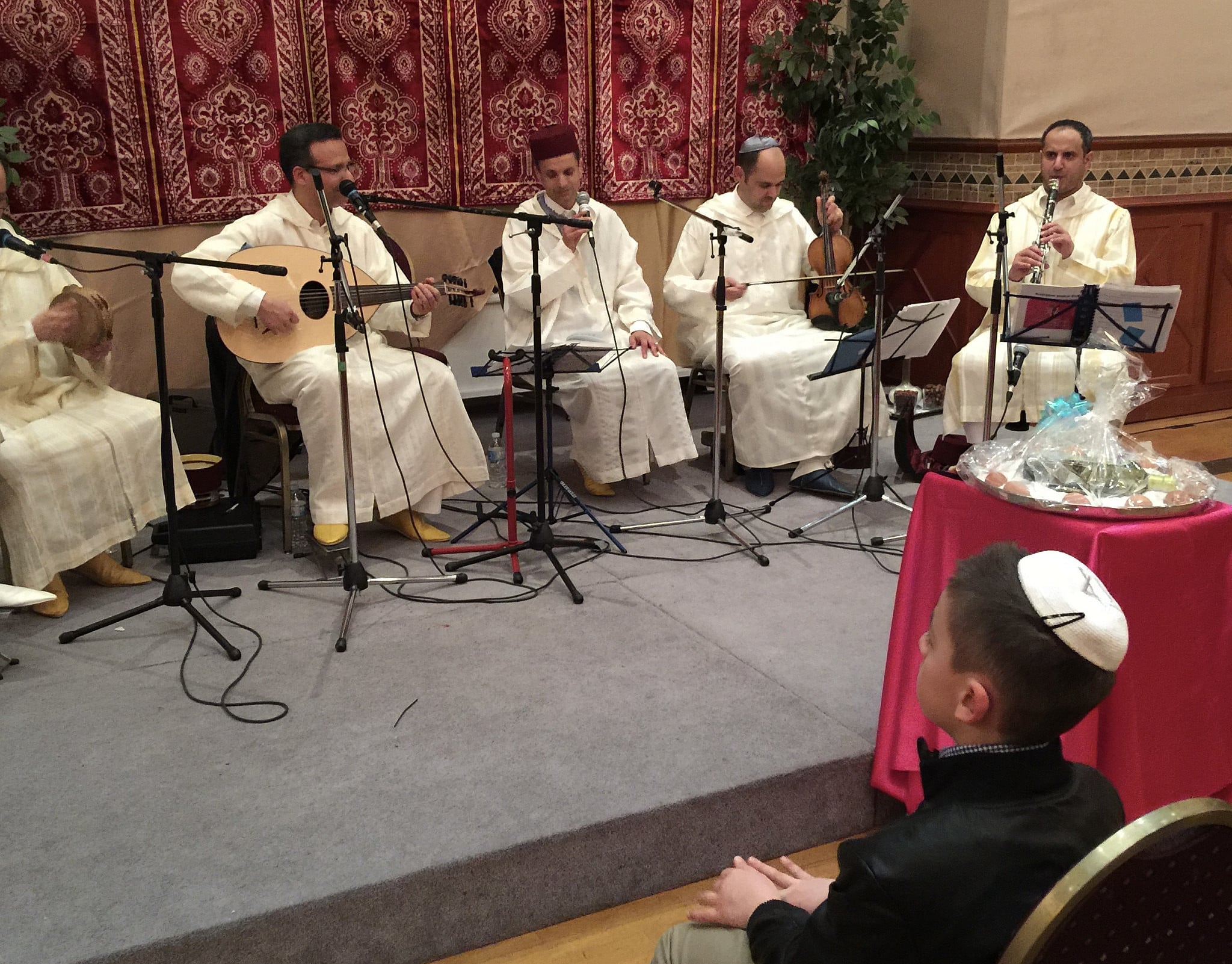
Mimouna celebrations at the Sephardic Kehila Centre in Toronto. (courtesy)
I first wrote about Mimouna in 2016, for the Canadian Jewish News. I described the cultural symbiosis between Jews and Arabs in Morocco. I meant every word. I return to the subject every few years because the holiday keeps demanding more honesty than I gave it last time.
Every year, at the close of Passover, Moroccan Jews celebrate Mimouna.
Doors are left open. Tables overflow with sweets – mufleta dripping in honey, pastries, dates, nuts, every symbol of abundance a household can offer. Guests move freely from home to home. And in its traditional form, Muslim neighbors would come to Jewish homes bringing flour and butter – a gesture both practical and quietly profound.
Eight years ago, I wrote that Mimouna offered a window into a “re-emerging cultural symbiosis that once existed between Jews and Arabs in Morocco.” I wrote about 700 years of Judeo-Arabic cultural exchange on the Iberian Peninsula. I wrote about Jews and Arabs celebrating “the cultural links that united them.”
I wasn’t wrong. But I wasn’t telling the whole story either.
And after October 7, I can no longer leave the rest unsaid.
There is a narrative – persistent, seductive, and politically useful – that holds up Jewish life in the Arab and Muslim world as proof of a natural harmony between Jews and their neighbors. Morocco is its favorite exhibit. Mimouna is its favorite photograph.
In this narrative, tensions between Jews and Arabs are modern, artificial, imported: the product of Zionism, colonialism, or Western interference. The real history, we are told, was coexistence. If we could only return to it, peace would follow.
It is a powerful story. It is also, in its popular form, a myth.
Not because coexistence didn’t happen – it did.
Not because the cultural exchange wasn’t real – it was.
But because the narrative systematically edits out everything that complicates the picture, and in doing so, turns history into ideology.
I wrote in 2016 that “at no point in history was Morocco an interfaith utopia.” I treated it as a qualifier before returning to celebration. I should have made it the argument.
Because the facts are not mild.
In 1033, the Banu Ifran tribe massacred over six thousand Jews in Fez – women captured, property looted, a community shattered. In 1465, a revolt against the Marinid sultan turned into a pogrom; accusations against a Jewish vizier became the pretext for killing nearly the entire Jewish community of Fez. In 1727, the death of Sultan Moulay Ismail plunged Morocco into instability during which Jewish communities were attacked and destroyed. In 1790, Sultan Mulay al-Yazid – described in sources as harboring intense hostility toward Jews – ordered massacres in Tetuan, Marrakesh, Fez, and Meknès. And by the mid-fifteenth century, the mellah system had taken root in Fez, confining Jews to walled quarters that made their subordinate status visible and permanent across Moroccan cities.
These were not interruptions to coexistence. They were part of it.
Jews in Morocco occupied an ambiguous position – at times serving as court viziers, diplomats, and royal financiers, protected and even elevated by the rulers they served. And yet always subject to a status that made their security conditional on the will of those same rulers. When that will held, there was warmth, exchange, even Mimouna. When it collapsed, there was violence.
The coexistence was real. So was its fragility.
What the popular narrative does is take the warmth and present it as the whole truth, while burying the fragility in footnotes. It is not a lie. It is something more dangerous – a selective memory that feels like history.
“There are no Jews in Morocco. There are only Moroccan subjects.” I quoted Mohammed V’s statement in my 2016 article as a symbol of coexistence. I still admire it. But I read it differently now.
You do not declare inclusion where exclusion is unthinkable.
The statement was noble precisely because the alternative existed.
After October 7, the myth of natural Jewish-Arab harmony did not just feel incomplete. It felt dangerous.
Because that myth has been doing real political work. It has been used to suggest that the conflict between Israel and its neighbors is an aberration – that beneath the violence lies a deeper, more authentic coexistence waiting to be restored. It has been used to imply that Jewish insistence on sovereignty, security, and self-defense represents a departure from a supposedly shared past.
October 7 was carried out by people shaped by their own narrative – one in which Jews have no legitimate presence, no legitimate history, no legitimate claim to safety anywhere in the region. That narrative and the interfaith utopia myth are mirror images. Both replace history with a story someone wants to be true.
The answer to a false narrative is not a counter-myth.
It is honesty.
None of this diminishes Mimouna. Quite the opposite.
The holiday is most powerful when understood for what it actually was – a moment of genuine human connection inside a world that did not guarantee it. The flour and butter brought by Muslim neighbors meant something precisely because it was not required. The open doors meant something because they could have been closed.
Warmth that exists despite structural inequality is not trivial. It is, in some ways, more remarkable than warmth sustained by stable conditions.
But we honor it honestly, or we do not honor it at all.
I wrote in 2016 that Mimouna carried “a message of coexistence and mutual respect.” I believed it then. I still believe coexistence is possible between peoples with deep and entangled histories.
What I no longer believe is that it emerges from myth.
It emerges from the harder work of seeing history clearly – the warmth and the violence, the open doors and the locked quarters, the flour and the pogroms – and choosing, with full awareness of all of it, to build something better.
That is a more demanding form of hope than nostalgia.
But it is the only kind that holds.