


CEO of Time to Stand Up for Israel
Misery Metrics: Gaza Edition
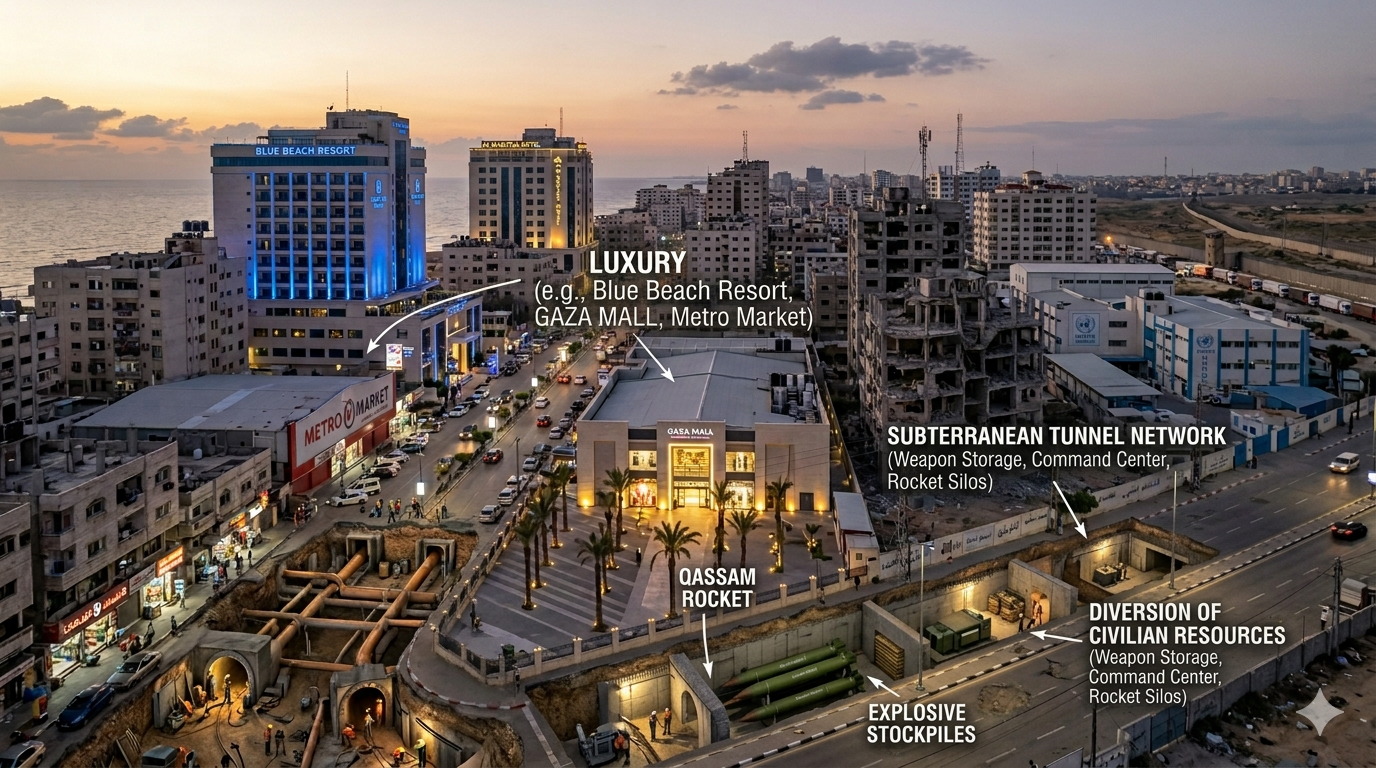
Photo Credits: Sabine Sterk ( AI)
If the situation were not so serious, it would be very funny.
Having advocated for Israel for more than a decade, I became very familiar with the narratives promoted by Gaza’s Arab leadership, activists, media outlets, and supporters around the world. These narratives were often presented without context and frequently accepted without scrutiny.
Before 2023, Arab governments, media outlets such as Al Jazeera, activists, diplomats, and advocacy groups relied on a remarkably consistent set of themes to describe Gaza to the international community. Following the implementation of the land, air, and sea blockade by Israel and Egypt in 2007, Gaza was increasingly portrayed not as a conflict zone but as a permanent humanitarian catastrophe.
The most prominent slogan was that Gaza was “the world’s largest open air prison” or even a “concentration camp.”
The argument was straightforward. Roughly two million Palestinians were supposedly “trapped” in a tiny territory with no control over borders, airspace, or territorial waters. Israel was portrayed as the prison warden, exercising complete control over movement and commerce while denying Palestinians their basic freedoms.
The second pillar of the narrative focused on economic deprivation.
The world was repeatedly told that Israel was deliberately impoverishing Gaza. Stories about calorie calculations and food imports were presented as proof that Israel intended to keep Gaza on the edge of starvation without quite crossing the line into famine. Unemployment figures were cited endlessly as evidence of economic suffocation.
The third pillar concerned infrastructure.
Viewers were shown reports about water shortages, electricity cuts, sanitation problems, and warnings that Gaza would soon become “unlivable.” A 2012 United Nations projection that Gaza might become unlivable by 2020 was quoted repeatedly.
The fourth pillar was legal and military.
Every military confrontation was framed as collective punishment. The language of international law dominated discussions. Israeli airstrikes were presented as evidence of systematic oppression, while terms such as “mowing the lawn” were used to portray Israel as conducting recurring military campaigns with no intention of pursuing a political solution.
The overarching message was clear. Gaza was not suffering from a natural disaster or temporary crisis. It was supposedly the victim of a deliberately engineered humanitarian catastrophe.
For years I challenged these claims with facts.
Because while the world was being told that Gaza resembled a concentration camp, a very different reality existed on the ground.
Before October 2023, Gaza and the Palestinian controlled areas of Judea and Samaria, commonly called the West Bank, contained luxury hotels, beachfront resorts, modern shopping centers, international franchises, telecommunications companies, banks, investment firms, universities, and thriving commercial districts.
Among the luxury hotels operating before the war were the Millennium Palestine Ramallah, Palestine Plaza Hotel, Caesar Hotel, Jacir Palace Hotel, Assaraya Palace Hotel, Grand Park Hotel, Al Mashtal Hotel, Blue Beach Resort, Roots Hotel, and Commodore Hotel Gaza.
There were modern commercial centers, including Rawabi City, Bethlehem Mall, Gaza Mall, Metro Market Complex, and various beachfront commercial developments.
International brands such as KFC, Pizza Hut, Cinnabon, Costa Coffee, Samsung, Huawei, and Toyota were present. International hotel groups, investors, banks, and technology companies operated throughout Palestinian controlled territories.
The list extended to telecommunications giants, major banks, United Nations agencies, international NGOs, multinational corporations, development funds, pharmaceutical companies, and real estate projects.
Israel facilitated the daily entry of 800–1,200 trucks carrying aid and commercial goods into the Gaza Strip, whereas very little aid entered from Egypt.
For such a small territory, the level of international investment and foreign assistance was extraordinary
That is why many people found comparisons to concentration camps not merely inaccurate but offensive.
Why was a security barrier built?
Because Israel suffered years of terrorist attacks, including suicide bombings and other acts of violence. Israel built a security fence and barrier system in response. Egypt also constructed substantial border fortifications along its frontier with Gaza.
Yet despite the conflict, Israel continued to supply electricity, facilitate the transfer of goods, coordinate medical treatment, and allow humanitarian assistance to enter Gaza. Thousands of Gazans received medical treatment in Israeli hospitals over the years.
Had Gaza’s leadership prioritized peaceful development over conflict, the territory could have become the Singapore of the Middle East.
Instead, billions of dollars in aid flowed into Gaza while rockets were manufactured, tunnels were constructed, and weapons were acquired.
Then came October 7, 2023.
The deadliest massacre of Jews since the Holocaust.
Israel responded with a military campaign aimed at removing Hamas from power.
And suddenly the narrative changed.
The same Gaza that had supposedly been an open air prison and a concentrationcamp was now described as a thriving civilian paradise destroyed by Israeli aggression. The previous claims were quietly forgotten. The concentration camp rhetoric faded into the background. A new accusation emerged: Genocide.
Then came claims of mass starvation.
Yet even here, many questions remain.
The population of Gaza grew from 350.000 in 1967 to 2.300.000 in 2026, tge worst Genocide ever.
Gaza has long struggled with obesity rates that would be difficult to reconcile with popular images of chronic famine. Various studies before the war found adult obesity rates ranging from approximately 20 to 30 percent, with childhood overweight and obesity rates also significant.
Nevertheless, much of the world continues to accept every new accusation with little skepticism.
Facts become secondary. Narratives remain supreme.
And now comes the latest sign that things may be returning to normal.
Today I saw a LinkedIn post once again describing Gaza as an open air prison.
Hurray.
The old slogan is back.
Which means the old cycle is back as well.
The luxury hotels, shopping centers, international businesses, foreign investments, aid organizations, and billions in international support will once again disappear from public discussion.
Western taxpayers will once again be asked to open their wallets.
And once again they will be told that the people receiving some of the largest per capita aid flows in modern history are helpless victims with no responsibility for their own circumstances.
The story changes.
The slogans change.
The accusations change.
But one thing never changes.
The bill always arrives in the West.
Related Topics