Geopolitical Analyst: Bridging Somaliland & Israel to the world
Mogadishu Escalates Against the UAE as Somaliland Widens Its Partnerships
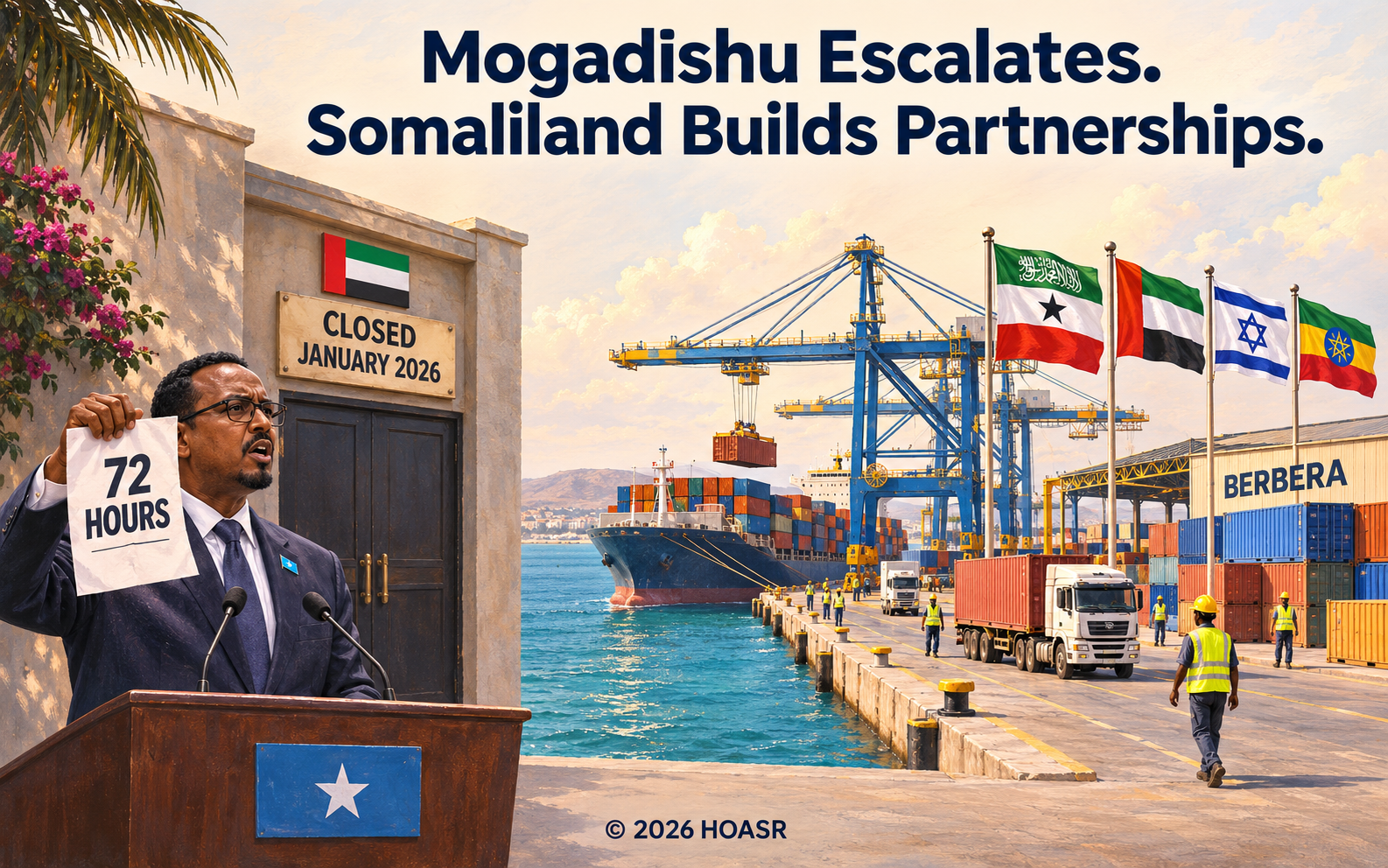
Mogadishu’s expulsion order meets Abu Dhabi’s account of an embassy already closed, while Somaliland expands its partnerships around Berbera. Editorial illustration © 2026 HOASR.
An expulsion with an empty embassy
Hassan Sheikh Mohamud’s government gave the UAE ambassador 72 hours to leave Somalia on 19 November. Abu Dhabi replied that its embassy in Mogadishu had closed and its diplomats had left in January 2026.
The departure order had arrived roughly ten months after the departure. It is a remarkable opening to a diplomatic offensive intended to demonstrate who is in charge. The cabinet order Abu Dhabi replies
What is the dispute behind that diplomatic exchange? Mogadishu wants foreign governments to accept its authority over relationships it struggles to control. Somaliland is expanding those relationships in its own name.
The latest developments have brought a further difficulty for Hassan Sheikh. The Gulf Cooperation Council’s secretary general has publicly condemned the Somali officials attacking the Emirates. The president’s appeal to regional solidarity has met regional solidarity with the country he is denouncing. The Gulf response
The cabinet decision went beyond an ambassador’s departure. Somalia recalled its envoy from Abu Dhabi for consultations and instructed its foreign ministry to take its accusations to foreign governments and international organizations.
It also warned people cooperating with what it called Emirati aggression. The published account stopped short of announcing a complete severance of diplomatic relations. Its practical importance lies partly in the campaign it now authorizes against UAE partnerships abroad. Somalia’s decisions
Abu Dhabi answered that Somalia’s leadership was dragging domestic struggles for power into relations between the two countries. It also took care to address Somali residents and visitors in the UAE, saying it valued those ties.
That reassurance will matter to families and businesses whose livelihoods cross the Gulf. The Emirates is telling them that its quarrel with Hassan Sheikh’s government need not become a quarrel with them. UAE statement
Neither government’s account settles every allegation. But the disagreement over whether there was still an embassy to expel changes the political meaning of Thursday’s announcement.
A government presenting a dramatic new penalty owes its public an explanation of what the penalty actually changes. An embassy closed months ago offers very little scope for a hurried departure scene.
The Gulf has answered back
On 19 November, GCC Secretary General Jasem Mohamed Albudaiwi condemned what he described as irresponsible statements and misleading media campaigns by Somali federal officials against the UAE.
He defended the Emirates’ contribution to regional stability and said the Gulf states rejected campaigns targeting a member. This was an institutional response from the GCC’s leadership, published in Riyadh, with considerable political weight for Mogadishu.
It complicates the idea that Hassan Sheikh can count on Gulf disagreements to deliver automatic support against Abu Dhabi. Saudi Arabia and Qatar have interests of their own, as do the other GCC members. A relationship with Somalia gives them reasons to remain engaged with Mogadishu.
It gives Hassan Sheikh no guarantee that they will follow him into each confrontation he chooses. The Gulf response should prompt harder questions about the diplomatic judgement behind his latest move. Read the GCC statement
Somaliland issued its own formal response on foreign relations. The ministry rejected Mogadishu’s claim to speak for Somaliland or restrict its dealings abroad and traced its position to Somaliland’s independence on 26 June 1960. This goes further than the earlier defense of UAE-funded roads, schools and port infrastructure.
Hargeisa is now addressing every foreign partner that might receive an objection from Somalia and setting out the basis on which it says those partners can deal with it directly. Full ministry statement Read Somaliland’s response.
Meanwhile in Sydney, Mohamed Hagi, Somaliland’s Ambassador to Israel, identified Ethiopia as central to Somaliland’s economy and India as a prospective manufacturing and trading partner. He linked safer shipping through the Gulf of Aden to Berbera’s commercial prospects, while warning that confrontation between Israel and Türkiye would further destabilize the region.
His remarks clarify Hargeisa’s position: Somaliland wants Israeli cooperation on maritime security while seeking trade with countries across the Indian Ocean. Summit report and embedded video The Jerusalem Post
How the Partnership Grew Under Earlier Presidents
The UAE’s relationship with Somali leaders began long before the current crisis. During Sharif Sheikh Ahmed’s transitional presidency, Gulf diplomacy was part of the effort to reconnect Somalia with outside partners.
Under Hassan Sheikh’s first administration, from 2012 to 2017, Abu Dhabi became more involved in military training and security assistance. A UAE foreign-ministry statement later referred to a military cooperation agreement signed in November 2014.
The security partnership developed beside a separate Emirati commercial strategy. In September 2016, Dubai-based DP World secured a long-term concession from the Somaliland authorities to develop and operate Berbera. The port offered access to Gulf of Aden shipping and a possible trade corridor toward Ethiopia.
Meanwhile, Abu Dhabi supported the federal security institutions in Mogadishu while also building commercial relationships with authorities outside Mogadishu’s control. This arrangement would repeatedly test the limits of the relationship.
Farmajo, the Gulf Crisis and the $9.6 Million Seizure
The first major breakdown came during Mohamed Abdullahi Farmajo’s presidency. When Saudi Arabia, the UAE, Bahrain and Egypt imposed air and sea embargo on Qatar in 2017, Somalia officially adopted neutrality, while its leadership was viewed as having close links with Doha and Ankara.
Some Somali regional administrations took positions closer to Abu Dhabi and Riyadh. Gulf rivalry was now intersecting with disagreements inside Somalia’s federal system, rather than remaining a distant foreign-policy question.
The ports became a flashpoint in March 2018. Somalia’s parliament moved against DP World’s Berbera (Somaliland) and Bosaso (Puntland) agreements, asserting federal authority over foreign investment.
Somaliland rejected the move and continued with its own agreement. The dispute was already showing what today’s crisis would make even clearer: Mogadishu could denounce a port arrangement without necessarily bringing the port operator to a halt. The parliamentary vote was documented by Anadolu Agency.
In April 2018, Somali officials seized approximately $9.6 million from an Emirati aircraft at Mogadishu airport. Abu Dhabi said the funds were for Somali troops and military training; Somali authorities questioned the transaction.
Relations deteriorated and the UAE suspended its military training mission. The dispute lasted for years, until Prime Minister Mohamed Hussein Roble apologized in January 2022 and the money was subsequently returned. VOA’s account traced that reversal.
Hassan Sheikh’s Second Presidency: Reconciliation, Then Reversal
Hassan Sheikh returned to office in May 2022 with the relationship already moving toward repair. His government went further: Somali and Emirati defence ministers signed a new military and security cooperation agreement in Abu Dhabi in January 2023.
The agreement specifically covered counterterrorism, according to Somalia’s own state news agency. Emirati personnel again helped train Somali forces, making Abu Dhabi a partner in the campaign against Al-Shabaab.
The depth of that partnership was demonstrated tragically in February 2024, when an Al-Shabaab-claimed attack at a Mogadishu military training base killed four Emirati servicemen and a Bahraini officer. Hassan Sheikh condemned the killings and expressed his condolences.
The attack, covered by the Associated Press, shows that the Emirates had committed personnel as well as financial resources. It also makes today’s hostility more striking: the president now disputes the legitimacy of security connections that his administration had renewed.
From Mogadishu’s perspective, Emirati activity increasingly crossed the line between accepted assistance and support for authorities challenging federal power. From Abu Dhabi’s perspective, Somalia’s leadership embraced its security assistance and later recast the same relationship as interference.
Although, both arguments have political force; neither proves every accusation made during this week’s exchange. So, what really changed between the 2023 agreement and the breakdown of 2026?
Recognition, Yemen and the January Cancellation
One turning point came on 26 December 2025, when Israel formally recognized Somaliland as an independent and sovereign state. The Israeli government announcement established a new diplomatic reality for Hargeisa and intensified Mogadishu’s objections. Hassan Sheikh later accused the UAE of playing a part in the process.
Yet the precise extent of any Emirati facilitation has not been publicly demonstrated in a complete official record, so the allegation should be kept separate from Israel’s documented recognition decision.
A second turning point came from Yemen. On 8 January 2026, the Saudi-led coalition alleged that Aidarous al-Zubaidi, a leader of Yemen’s Southern Transitional Council, had traveled from Yemen through Berbera and Mogadishu to Abu Dhabi with Emirati assistance. Somalia opened an inquiry into the claimed movement through its airport.
The coalition’s account, reported by Reuters, was an accusation by an interested party rather than a judicial finding, but it brought Saudi–Emirati differences over Yemen directly into the Somalia–UAE dispute.
On 12 January, Somalia’s cabinet announced the cancellation of agreements involving the ports of Berbera, Bosaso and Kismayo (Jubaland), as well as security and defence cooperation with the UAE. The government presented its action as the defense of sovereignty and political independence.
Its decision was categorical in language, but it did not by itself resolve who had authority to terminate agreements negotiated by different parties. The scale of the announcement was confirmed in the Reuters account.
Three Ports, Three Political Realities
Berbera, Bosaso and Kismayo cannot be treated as one legal or political case. Berbera is administered by Somaliland, which restored its independence in 1991 and maintains that Mogadishu has no authority over its foreign or commercial agreements.
Bosaso is in Puntland, and Kismayo is in Jubaland, both administrations within Somalia’s disputed federal political arrangements. Each has its own relationship with Emirati partners and its own objections to federal interference. Their rejection of January’s cancellation was documented by Reuters.
Berbera is the clearest commercial test. DP World’s 2016 concession envisaged investment of up to $442 million, phased over time, in port expansion and related facilities.
DP World confirmed on 13 January 2026 that Berbera operations were continuing under the existing agreements. Its public statement drew a line between operating the port and commenting on governments’ diplomatic disputes.
A cancellation announced in Mogadishu does not automatically establish that a private concession has legally ended, nor does it show that a company has stopped work.
Any challenge would involve contractual rights, applicable law, the position of the signatories and the practical control of the facilities. Somaliland says that authority rests with Hargeisa.
The UAE’s immediate public response was unusually personal. On 18 November, Anwar Gargash criticized Hassan Sheikh’s changing positions and suggested Somalia’s internal power struggles were being drawn into regional rivalries. Somalia’s officials rejected that account and repeated the allegations of interference.
The Emirati statement underscores how far the relationship has moved from the warm exchanges that accompanied the 2023 security deal.
The Military Cost of a Diplomatic Break
Behind the public argument lies an immediate security concern. Emirati assistance has helped fund training, salaries and logistical support for some Somali forces. On 19 November, Reuters reported that such assistance had supported about 3,400 military police and special forces personnel in and around Mogadishu.
If this support ends or becomes irregular, the Somali government would need replacement financing and workable command arrangements.
Saudi Arabia, Qatar, Egypt and Türkiye may be able to help fill parts of the gap, but changing partners does not automatically preserve a functioning training or supply system.
Somalia continues to face a dangerous Al-Shabaab insurgency, along with internal disputes over federal authority and elections. The diplomatic clash has consequences for public security as well as relations between governments.
Hassan Sheikh’s Threat Meets a New Strategic Reality
From Somaliland’s perspective, the confrontation between Somalia and the United Arab Emirates is more than a diplomatic dispute. It exposes President Hassan Sheikh Mohamud’s increasingly determined campaign to prevent Somaliland from securing further international recognition and strengthening its independence.
Hassan Sheikh has emerged as one of the most direct political threats to Somaliland’s sovereignty. His administration has opposed almost every major step Somaliland has taken to expand its international partnerships, from Ethiopia’s maritime arrangements to Israel’s historic recognition on December 26, 2025. His government has also challenged Somaliland’s commercial relationship with the UAE, particularly DP World’s development of Berbera.
What appears to concern Mogadishu most is the emergence of a Somaliland whose independence is becoming harder to reverse. The growing relationship between Hargeisa, Abu Dhabi, Jerusalem and Addis Ababa has changed the strategic environment.
These are not simply diplomatic friendships. They involve major economic investments, maritime interests, security cooperation and a shared interest in stability along the Gulf of Aden and the Red Sea.
For Hassan Sheikh, the implications are serious. Somaliland is no longer facing Mogadishu’s diplomatic pressure in isolation. Israel has formally recognized its sovereignty. The UAE has substantial investments in Berbera. Ethiopia has longstanding economic and strategic reasons to seek access to Somaliland’s coastline.
Together, these relationships have increased the international interests that could be affected by any attempt to destabilize Somaliland. An attack on Somaliland could now threaten Emirati investments in Berbera, disrupt Ethiopia’s future maritime options and damage Israel’s relationship with a newly recognized partner on the Gulf of Aden.
The most disturbing aspect of Hassan Sheikh’s approach is that opposition to Somaliland’s recognition has been accompanied by increasingly aggressive military language.
Following Israel’s recognition, Somalia’s Defence Minister Ahmed Moallim Fiqi reportedly called on Saudi Arabia to undertake military action against Somaliland. The Royal United Services Institute documented that appeal in its February 2026 assessment of the regional consequences of recognition. Hassan Sheikh himself has publicly discussed military force as an option in the dispute over Somaliland.
These statements cannot be dismissed as ordinary political disagreement. For Somaliland, which suffered devastating military repression under the former Somali regime, threats involving the use of force carry a historical meaning that Hargeisa cannot simply ignore.
There is another troubling element. The government’s opposition to Israel has sometimes crossed from political criticism into rhetoric targeting Jews as a religious community. In August 2025, Defence Minister Fiqi was reported to have used derogatory references to Jews while threatening political opponents.
More significantly, the United States Commission on International Religious Freedom documented that Somalia’s Ministry of Endowments and Islamic Affairs instructed mosque leaders in January 2026 to preach about Jewish interference following Israel’s recognition of Somaliland.
There is a clear distinction between criticizing the policies of the Israeli government and directing hostility toward Jewish people. Political disagreement with Israel does not justify anti-Jewish language, particularly when it comes from senior officials or religious institutions operating under government direction.
Such rhetoric has made Mogadishu’s campaign against recognition even more confrontational and has reinforced concerns in Somaliland about the intentions of Hassan Sheikh’s administration.
Hassan Sheikh’s increasingly hostile reaction to Somaliland’s relationships with the UAE, Israel and Ethiopia deserves attention. From a Somaliland strategic perspective, the developing partnerships have complicated Mogadishu’s ability to threaten military action without considering the wider diplomatic, economic and security consequences.
Israel’s security cooperation is particularly significant. As Reuters reported in June 2026, Somaliland’s defense minister confirmed Israeli assistance in training Somaliland police and military personnel.
Although he denied reports of an Israeli military base, the cooperation nevertheless adds an important dimension to Somaliland’s defense relationships.
These partnerships do not constitute a formal collective-defense alliance, and none automatically guarantees foreign military intervention. Nevertheless, they create strategic interests that any government considering military action against Somaliland must take seriously.
The Scoop: Authority Will Be Tested Beyond the Diplomatic Statements
Hassan Sheikh’s second presidency has brought the Somalia–UAE relationship through a remarkable reversal. A government that welcomed renewed Emirati training and signed a security agreement in 2023 is now accusing the Emirates of undermining the state.
The result is a confrontation in which the language of sovereignty meets the everyday realities of administration, investment and security. That gap between claimed authority and effective control is now at the heart of the Somalia–UAE dispute.
The significance of the Somalia–UAE confrontation reveals the growing limitations of Somalia’s attempts to obstruct Somaliland’s external relationships. This is the reality beyond Hassan Sheikh’s control whether or not he accepts Somaliland recognition.
Related Topics
Related Posts