Geopolitical Analyst: Bridging Somaliland & Israel to the world
What Berbera Tells Us About the Future of Israel and Somaliland
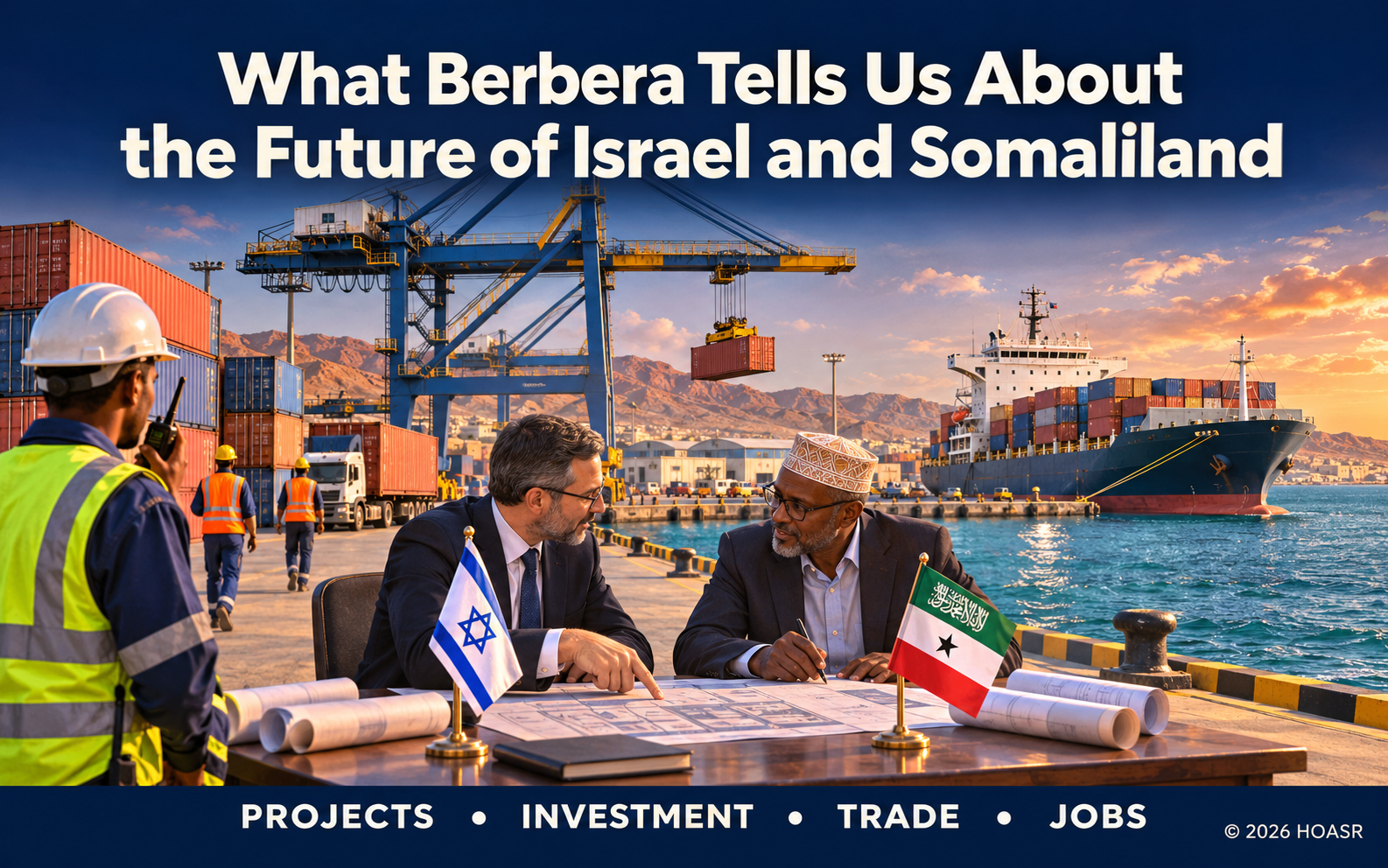
Berbera Port offers an early test of what Israel–Somaliland cooperation could deliver in projects, investment, trade and jobs. Illustration © 2026 HOASR.
One of the most telling moments in Israel’s relationship with Somaliland took place in the offices of a shipping administration. Ali Dirie Ahmed, the Somaliland Ports Authority manager, met Captain Zadok Radecker, his Israeli counterpart.
Their governments had settled the question of recognition that once might have consumed the meeting: in whose name was the Somaliland official speaking? Ahmed was there in his own country’s name: Somaliland. Now, the two men could spend their time discussing ports.
For those of us who have argued the case for recognition since 1991, there is something extraordinary about the ordinary business of that meeting. Port report
On 15 November, I argued that recognition gives Somaliland access to decision-makers and that Berbera would be a good place to see what that access produces. Three days later, the Ports Authority reported exchanging draft agreements with four Israeli organisations.
For a member of the Knesset wondering what recognition has achieved, or a Somaliland parliamentarian asking what the trip was worth, that is a fair first answer. It also sets a higher standard for the next answer. What will the two countries actually do together? My earlier article
How a presidential visit reached the waterfront
When Israel recognised Somaliland on 26 December 2025, its announcement explicitly included economic cooperation. In May, President Isaac Herzog received the credentials of Mohamed Hagi, Somaliland’s first ambassador to Israel. In June, Herzog received President Abdirahman Mohamed Abdullahi Irro on his first state visit.
By November, a Somaliland official with responsibility for a specific industry was sitting down with people who ran that industry in Israel. The sequence is important. Each visit made it easier for someone else to come back with a narrower question and the authority to pursue it. Recognition
Consider what an embassy contributes between visits. An Israeli company may understand the equipment Berbera needs and still have little idea which decisions belong to the Ports Authority, which involve the terminal operator, and whom to approach about permits.
The company can now raise those questions with an accredited Somaliland ambassador. Hargeisa has a similarly useful contact in Michael Lotem. The Africa–Israel Economic Forum listed him as both Israel’s ambassador to Somaliland and its ambassador for economic and business promotion in Africa. An enquiry about a Somaliland project falls squarely within both parts of his brief. Hagi’s credentials
Why this forum earned a second look
Governments attend enough conferences to make scepticism about another one understandable. What distinguished the November gathering in Tel Aviv was what Somaliland could pursue alongside it.
The programme asked where financing would come from, who would own and operate new infrastructure, and how local partners could share the risk.
Ahmed’s working visit brought him into contact with a regulator, port managers, a shipyard and a shipping executive. Each could answer a question the others could only pass on. Forum agenda
The Ports Authority named Israel’s Administration of Shipping and Ports, Ashdod Port and Israel Shipyards among the organisations that exchanged drafts. Its account also records meetings with Yaron Leibovitz of Clipper Shipping and Logistics and businessman Shlomi Fogel.
The statement names three of the four draft partners and leaves the fourth unidentified. As of 19 November, the public account gives no signed project, budget or starting date. But the achievement already on record is worth defending on its own terms. Authority statement
What Israel gains from a successful Berbera
An Israeli reader might reasonably ask what Berbera offers in return. One answer is a chance for Israeli firms to find paying customers at a working port serving Somaliland and parts of eastern Ethiopia. Another is access to people who understand that market better than a visiting delegation ever could.
A Berbera freight agent knows which border delay will cost an importer a sale. A local workshop knows which spare part can leave a vessel idle for a week. Israeli expertise becomes commercially valuable when someone on the Somaliland side can say exactly where it would pay for itself.
Ashdod already invites companies to test technology at the port and through overseas partners. Israel Shipyards has workshops that repair commercial vessels and offers customer training.
Both of those capabilities suggest two quite different opportunities. Ashdod and Berbera could examine a delay that both ports recognise and price a trial. A shipyard and a Berbera firm could find out whether enough vessel owners would pay for a repair service to sustain it locally.
Either proposal would give Israeli participants a commercial reason to stay involved and Somalilanders a say in what gets built. The choice would belong to the operators and their customers. Ashdod pilots
Moreover, there is already money and experience at work in Berbera. DP World operates the terminal, and in 2025 it announced a service from Jebel Ali every nine days. A new Israeli partner would be entering a port with existing customers, contracts and sailing schedules.
For Example, a firm considering a cold store can investigate the cargo arriving today, speak to merchants and estimate what they could afford to pay.
A partnership that helps those merchants reach another market gives the UAE investment, Israeli expertise and Somaliland enterprise room to earn a return from the same shipment. Berbera service
The case a sceptical parliament can take seriously
Supporters sometimes make Berbera’s case with a map and the size of Ethiopia’s population. A legislator weighing public money will want to know which Ethiopian customers can actually save money by using the route.
A study published by British International Investment offers a useful answer. Berbera competes well for parts of eastern Ethiopia. The railway through Djibouti gives that corridor an advantage across much of central and western Ethiopia.
This advantage makes the case for Berbera more persuasive. It identifies places where a shipper has an economic reason to try the port, regardless of anyone’s diplomatic sympathies. Corridor study
There is also a political reward in being equally clear about public responsibilities. If public funds are requested for a port trial, parliamentarians in either country can ask who selected the operator, who bears a loss if the trial fails, and whether the results will be available to other firms.
Somaliland legislators have a further interest in who gets to bid for local work. A family business in Berbera should be able to find the terms of a tender as readily as a company with friends in Hargeisa.
Indeed, such questions give the friendship a wider constituency, including citizens who never took part in the campaign for recognition.
The Scoop
A recognition advocate visiting a foreign parliament is usually asked two questions. Why does Somaliland deserve recognition? And what difference would recognition make?
The first deserves its own historical and political answer. Berbera gives us something specific to say about the second.
Israel made a sovereign decision. Ambassadors took up their duties. A president brought the economic case, and a ports manager followed with business that could occupy both sides long after the delegations went home.
Another government is free to reach its own conclusion. It can now examine what happened when one country acted.
For me, the most convincing ambassador for the next stage may turn out to be an Israeli shipping agent who books Berbera twice, or a Somaliland engineer who can show a visiting legislator a repair her team now carries out at home.
Neither has to make a speech about friendship. Each can explain what became possible because people in two governments opened a door and people in two businesses walked through it.
That is the promise worth putting before friends of Somaliland in Jerusalem, Hargeisa and beyond. The next chapter will be measured in projects, investments, trade and jobs.
Related Topics
Related Posts