Moral Residue and the Jewish Ethics of ‘The Caine Mutiny’
I came to Herman Wouk late, a few years before COVID. I was at High Holiday services in a Chabad in San Francisco and struck up a conversation with a man sitting nearby—Israeli, former military. At one point he mentioned he was about to visit Wouk. Wouk, he said, had used him as inspiration for one of the characters in his novels set in Israel and they remained close. Wouk was close to 100 years old at the time.
What stayed with me wasn’t the anecdote itself, but the way he spoke about Wouk. There was no sentimentality in it, no reverence for reputation. Just seriousness. He spoke about Wouk the way people who have lived inside real chains of command sometimes speak about those who understand authority not as an abstraction, but as something heavy—something that distorts, weighs on people, and leaves residue. Wouk, it was clear, was respected not for being comforting, but for being honest.
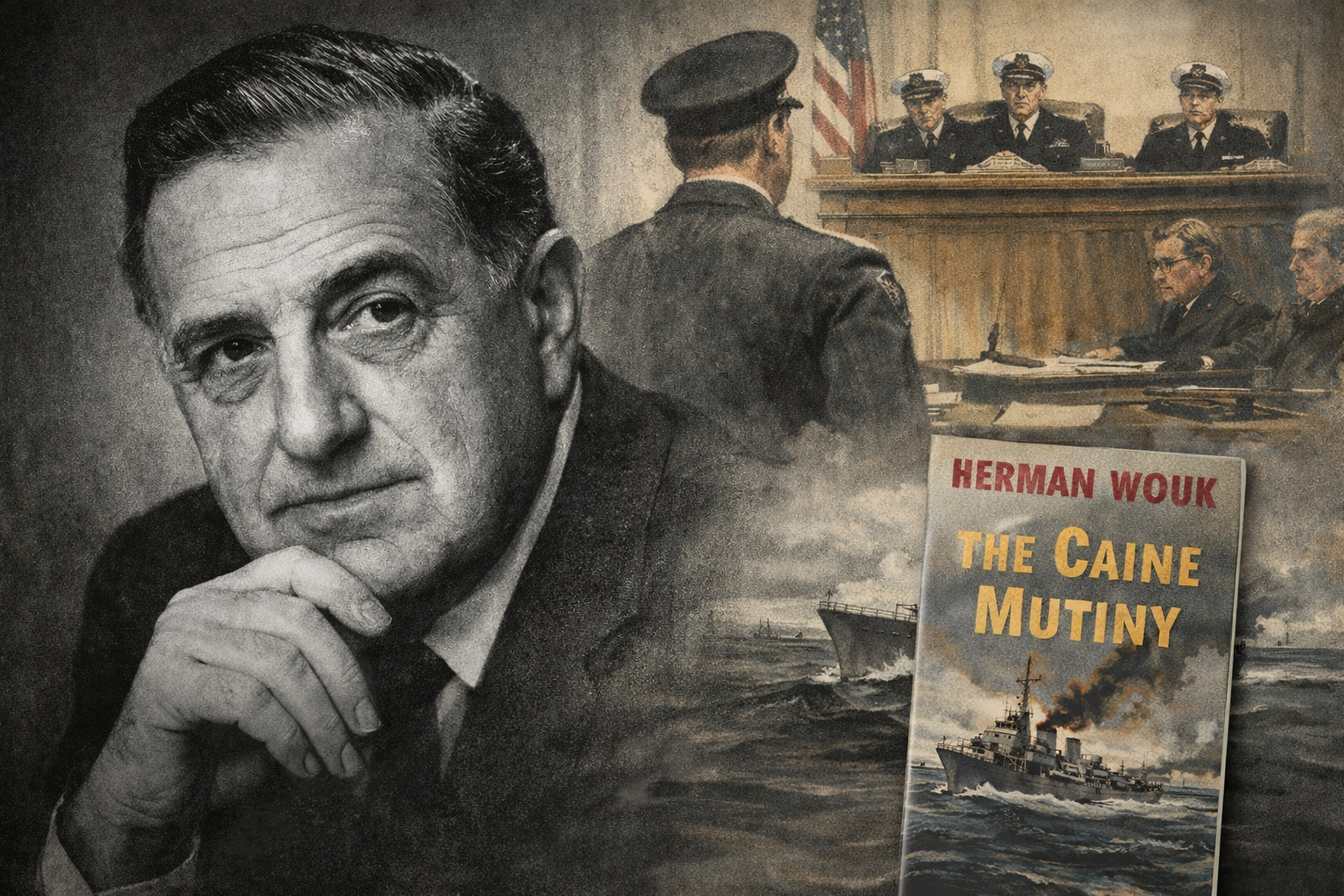
That memory stayed with me as I finished The Caine Mutiny (winner of the 1952 Pulitzer Prize for Fiction).
Much has been written about the book as a courtroom drama or a psychological portrait of Captain Queeg, and those readings are not wrong. But they miss the deeper achievement. What lingered most for me after finishing the novel was the complexity of the moral questions—and how deftly Wouk handles them, particularly through the courtroom and through the explicitly Jewish character, Greenwald.
The trial itself never offers a perfect moral reckoning, and Wouk seems intent on making sure it doesn’t. Law matters in the novel; it sets boundaries, it disciplines chaos. But law cannot finish the moral work. It can rule, but it cannot fully judge. That distinction feels deeply Jewish. Halakhic systems have always understood that legality and righteousness are not identical, and that moral responsibility often survives intact even when legal responsibility does not.
Greenwald becomes essential precisely because he operates inside the framework of the court while recognizing its limits. His drunken assessment after the trial is not a gimmick or a reversal. It is the moment where much of the accumulated moral tension finally straightens out—not into clarity, but into honesty. He manages to articulate what the courtroom cannot: that no one leaves this story morally clean, and that every party involved carries some share of the damage.
Seen this way, Greenwald’s drunken speech functions less as judgment than as cheshbon hanefesh—moral accounting after the fact. It clarifies how to judge Queeg, the officers, the system, and ultimately ourselves as readers looking back from safety. Not by assigning innocence or guilt cleanly, but by exposing how moral decision-making under stress is filtered, rationalized, and compromised in ways that are often invisible in the moment.
This is also where Wouk’s treatment of the novelist sailor Keefer becomes so important. Keefer represents intellect detached from responsibility—ideas untempered by experience, theory masquerading as moral insight. He is chochmah without daʿat. His aura of insight is given more weight than it deserves precisely because he presents himself as an intellectual, and everyone around him allows that posture to substitute for moral seriousness. Jewish history is not short on examples of such figures, and Wouk clearly understands the danger. Keefer’s multiple moral lapses are not accidental; they are the logical outcome of a way of thinking that divorces judgment from consequence and the gravity of ideas from the courage they may imply.
What Wouk ultimately seems to trust is neither command nor law alone, but conscience—fragile, pressured, often belated. Obedience and disobedience in The Caine Mutiny are treated as tragic necessities that always leaves moral residue behind. Even when justified, it does not absolve. Something remains to be answered for later.
Several critics have noted that the novel resists easy moral closure. Early reviewers such as Dwight Macdonald observed that Wouk refused to turn the story into either a simple indictment of authority or a celebration of rebellion. More recent reassessments have emphasized the book’s refusal to grant readers the comfort of moral certainty. That refusal, to my mind, is the point.
The book does not end in moral clarity, but in moral sobriety. It pushes back against the fantasy that history can be cleanly judged, that we can sit in hindsight and sort people into the righteous and the corrupt without remainder. People are bad judges of events when they are inside them. They filter, justify, adapt. Moral compromise rarely arrives as a dramatic choice; it accumulates quietly.
What The Caine Mutiny offers readers today is not a verdict but a discipline: a way of thinking that resists certainty, distrusts intellect divorced from responsibility, and insists that conscience continues its work long after courts have adjourned. That, more than anything else, is why the book still feels alive—and why Wouk’s moral seriousness still holds.