
Urban Sociologist and Global Affairs Commentator
What Israel’s Next Government Owes the India Relationship
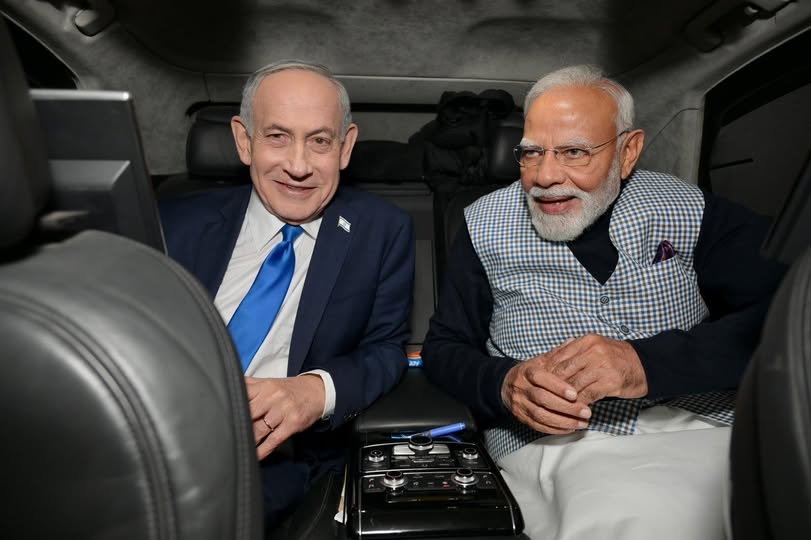
Prime Minister Narendra Modi and his Israeli counterpart Benjamin Netanyahu share a car ride on Wednesday, February 25, 2026. (Credit: PM Modi/X).
Some relationships between states are best explained by interest. Others only make sense once you add something harder to measure: trust. The bond between Narendra Modi and Benjamin Netanyahu belongs to the second kind. Commentators call it a “bromance” and treat it as chemistry or choreography, a photograph on a beach or an embrace on a tarmac. That reading is too small. The warmth between the two men is the visible surface of something deeper, a confidence between two old societies that each recognize in the other a long memory, a stubborn continuity and an unwillingness to disappear.
Whoever forms Israel’s next government inherits that confidence. The question is whether they will understand what they have been handed.
Trust is the point
Diplomacy has a standard toolkit. Confidence-building measures lower suspicion, state visits signal intent, and joint communiqués record agreement. All of these are instruments, and all can be replaced when circumstances change. Trust cannot be replaced that way. It takes years to accumulate and can be lost in a season. It is also what allows two countries to ask hard things of each other without fear of being misread.
That is what makes the India-Israel relationship unusual. Both countries are old civilisations that went through catastrophe and returned as modern states. Both live in difficult neighbourhoods and have had to think seriously about terrorism and survival. And India’s Jewish communities, in Kochi, Mumbai and elsewhere, lived for centuries as part of Indian life, an unusual record in Jewish history, and one that gives the two societies a shared past that few other pairings can claim. Defence, agriculture, water, cyber and technology cooperation grew from that soil. The contracts followed the confidence, not the other way round.
An asset that belongs to the state
Leaders matter. Few would deny that the personal rapport between Modi and Netanyahu raised the profile of the relationship and quickened its pace. But the ties themselves are older than either man. Full diplomatic relations date to 1992, and security cooperation was maintained by successive Indian governments, with Modi’s arrival mainly lifting the visibility of ties that had previously stayed in the shadows. The leaders accelerated something the two states had already begun.
That is why Israel’s next government should resist reading the relationship as one man’s legacy. It is easy to imagine a new coalition, eager to distinguish itself from its predecessor, treating every inherited commitment as suspect. For most policy areas that instinct is healthy, because governments should be free to revisit what they inherit. India is different. A friendship that Israelis come to associate with a single prime minister becomes hostage to the argument over that prime minister. A friendship held as a national interest survives the argument.
Bipartisan by design
This is the heart of the matter. The question of how to build on the relationship is not primarily one of policy. Policy is the detail: which defence programmes to expand, how to structure a trade agreement, where to place research funds. Those are legitimate subjects for debate, and parties will differ on them. What should not be contested is the underlying commitment, that India is a strategic and civilisational partner of Israel, whoever governs in Jerusalem.
That kind of consensus does not happen by accident. It requires deliberate steps. Opposition and coalition leaders should be brought into the relationship, through parliamentary delegations, regular briefings and shared visits, so that no major party sees India as the property of its rivals. A standing mechanism for India policy, insulated from the electoral calendar, would give officials a stable mandate. Multi-year commitments on research, defence-industrial cooperation and trade negotiations would reassure Indian counterparts that agreements outlast cabinets.
The obligation runs both ways. India’s engagement with Israel should likewise rest on broad national consent, not on the preferences of one government. A relationship that depends on a single political camp in either capital is only as durable as that camp’s hold on power.
Friendship without uniformity
Trust does not mean agreement. India has its own regional interests, its relationships across the Gulf and with Iran, and a foreign-policy tradition built on strategic autonomy. Israel has a security environment unlike any other. The two will sometimes vote differently, speak differently and weigh priorities differently.
A mature partnership absorbs this. Indeed, the clearest sign of trust is that disagreements can be stated plainly and managed privately, without either side suspecting betrayal. Israel’s next government should resist the temptation to measure the relationship by how often India echoes its positions. The measure should be whether the channel stays open and honest when positions diverge.
From capitals to societies
Governments can open doors, but only societies keep them open. Universities, laboratories, start-ups, hospitals, think tanks, film industries, farmers’ cooperatives and diaspora communities must carry the relationship into daily life. Student exchanges, joint degrees, research chairs, tourism, translation of literature and shared work in medicine and climate adaptation are unglamorous, and they are what make a partnership last. A young Indian engineer who has worked in Haifa or a young Israeli researcher who has studied in Bengaluru becomes a permanent stakeholder who needs no summit to sustain the connection.
The aim is for the next generation to inherit the relationship as something obviously valuable, not as the remnant of a political era.
The test of succession
The real measure of the Modi-Netanyahu relationship will not be how warm the meetings were or how often the leaders met. It will be whether the partnership still thrives once both have left the stage. Many friendships between leaders end when the leaders do. The rarer achievement is a friendship that outgrows its founders.
That is the responsibility facing Israel’s next government. It should not manage the relationship as a diplomatic gesture, or discard it as an inheritance from a rival. It should treat it as a national asset to be institutionalised, shielded from partisan contest and extended into society. If it does, the personal chemistry of two leaders will have become something far more lasting, a trust between two peoples that no longer depends on anyone’s presence to survive.
Related Topics
Related Posts