
A comedic survival guide to a country that breaks you, rebuilds you, and calls it Tuesday.
Featured Post
Morning has broken and the bus still runs
I take heart as the siren wails and we disembark, for I have spotted acts of faith in a future in the simple packages of my fellow commuters
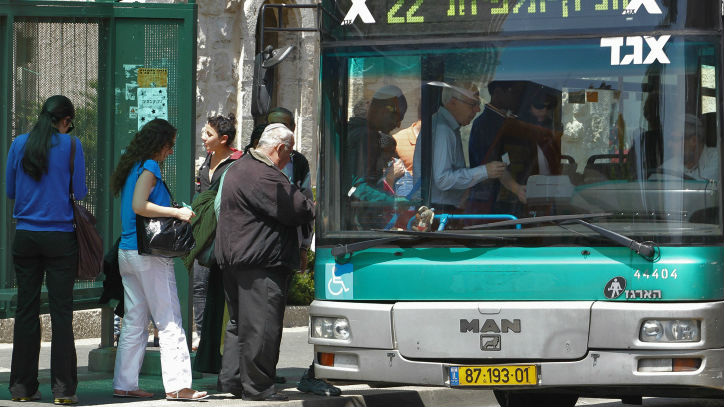
Illustrative: Passengers boarding an Egged bus in Jerusalem. (Nati Shohat/Flash90)
At 7:30 a.m., there are no children on the bus.
Not one.
Because there is no school. There is only “the situation” — that polite, almost apologetic phrase we use so we don’t have to say the words “war” and “Iran” before coffee, like animals.
So the bus carries only adults.
Adults with errands. Adults with obligations. Adults performing that very specific Israeli art form: continuing as if nothing is happening while everything is happening.
You can tell a lot about a person from what they are holding at 7:30 during a war.
A woman has coriander, tomatoes, something green and optimistic — ingredients that assume we’ll still be here for lunch.
A man clutches a pharmacy bag as if it contains not medication but a legally binding promise that he personally will survive.
Someone holds a white bakery box with reverence usually reserved for newborns and ceasefires.
Softness, apparently, is still negotiable.
Just us.
Just the ones expected to continue.
The siren does not arrive.
It barges in.
It cuts through the bus mid-thought, mid-breath, mid-existential denial.
There’s the pre-warning — that little polite ahem before the sky loses its mind — and then the full performance.
One second, we are commuters.
Next, we are a unit.
A reflex.
The driver brakes like this is just another Tuesday. Because it is.
Doors open. We spill out. Not running, not walking — that efficient, slightly irritated urgency of people who have done this before and resent that they are good at it.
7:30 in the morning, and we are crouching on the side of the road in office attire, holding groceries, holding phones, holding onto the increasingly flimsy concept of a normal day.
There is something deeply offensive about fear before sufficient caffeine.
The light is still soft. The day hasn’t even had the decency to start properly.
And already — we’re negotiating with the sky.
The explosions follow.
Not dramatically. Not cinematically.
Rudely.
Loud enough to rearrange your internal organs into a new, less confident version of themselves.
You don’t just hear it. You host it.
Ribs. Throat. That hollow place where you pretend you’re in control.
And then that moment.
Always the same.
Your body reacts before your brain can produce a sentence. Full jolt. Heart sprinting. Breathing becomes compulsory rather than optional.
This is not courage.
This is biology doing its job while your dignity steps aside.
You think completely useless things.
Did I reply to that message?
I should have worn better shoes.
Is this one closer?
No one says “Iran.” No one says “war.”
We’re not stupid. We’re just conserving language.
The woman with the coriander is frozen.
The man with the pharmacy bag is gripping it like it might suddenly develop diplomatic powers.
The bakery box is held closer.
Of course it is.
If cake survives, maybe we do too.
And then, because we are incapable of leaving anything alone, someone says something dry.
Not a joke.
A protest disguised as humor.
It lands.
A thin ripple of laughter moves through us — cracked, brief, but unmistakably alive.
Even here.
Especially here.
The explosions stop.
Which is not the same as everything being fine.
Silence arrives like a question.
We wait.
Because we have learned that endings are unreliable.
Not yet.
Not yet.
Not yet.
Then we stand.
We brush off nothing.
We check everything.
Phones. Messages. Limbs. Reality.
Eye contact is brief. Shared fear is too intimate for 7:30 a.m.
The bus is still there.
Of course it is.
Waiting, like this, was a minor inconvenience.
We get back on.
Of course we do.
The driver shrugs — a gesture that could replace the national anthem.
What now?
We continue.
Coriander.
Prescriptions.
Baked goods.
War.
Commute.
All of it wedged into the same narrow aisle.
This is the part that refuses to sound impressive.
It is not resilience.
That word is for speeches. For people who survived something in the past tense.
This is happening now.
This is smaller.
Less flattering.
More honest.
This is habit.
This is obligation.
This is the deeply unserious insistence on continuing anyway.
We go to work.
We answer emails.
We buy coriander during a war because lunch still needs to exist.
Because bodies still need feeding.
Because life refuses to pause out of respect for our fear.
The siren divides the morning.
Before.
And after.
But the line doesn’t hold.
Because 10 minutes later, we are back on the bus, carrying both halves with us.
And this is the part that really doesn’t flatter us.
The siren doesn’t stop the day.
It joins it.
Becomes another stop. Another sound. Another inconvenience we learn to live with.
At 7:30 in the morning, with no children on the bus and a war we call “the situation,” we are not choosing courage.
We are choosing to continue because stopping is not operationally viable.
And somewhere between the coriander and the explosions, between crouching on the pavement and getting back on the bus, that choice wears down. Until it is no longer a choice at all.
It is just what we do.
Which is another way of saying:
It is who we are.
Related Topics