A Moroccan Journalist
Morocco-Israel Embassy Transition Would Mark Historic Milestone
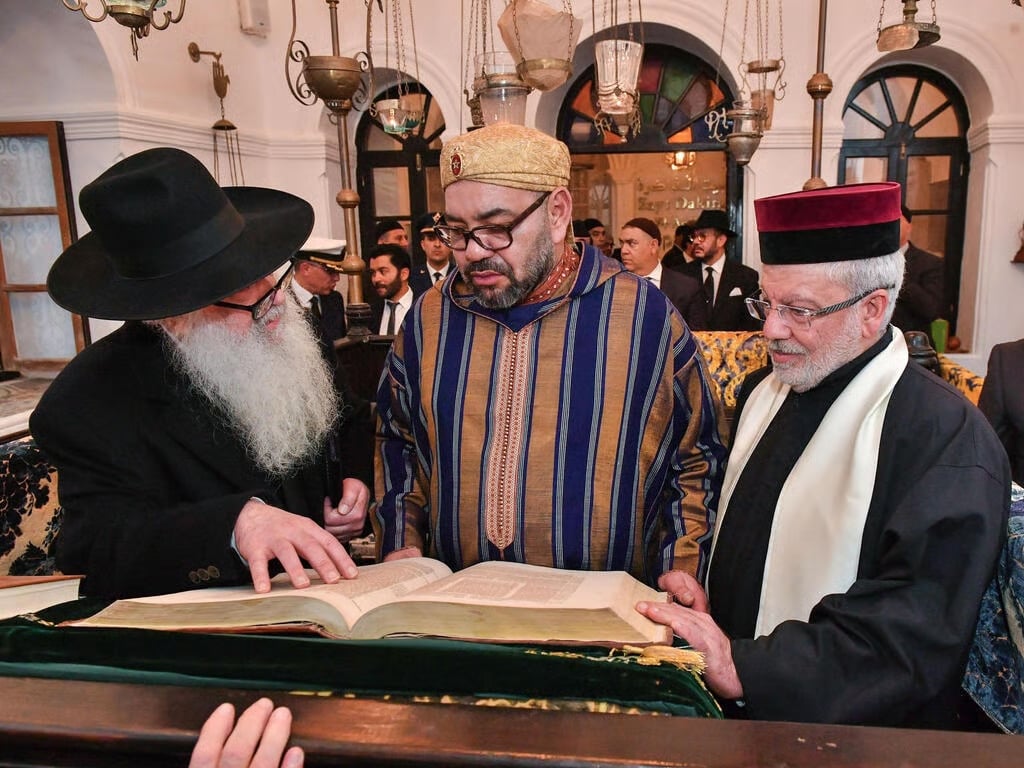
King Mohammed VI during a visit to the “Bayt Dakira” (House of Memory) museum, in the Atlantic coastal city of Essaouira, January 15, 2020. © Moroccan Royal Palace / AFP
In an exclusive interview I conducted with Chaimae Bouazzaoui, the first Moroccan woman diplomat to serve in Israel, she offered in-depth insights into the state of Morocco-Israel relations in the post-Gaza war period, which, while not marked by a rupture, has witnessed a slower pace of engagement compared to previous years.
Bouazzaoui, who served as Political Counselor at Morocco’s Liaison Office in Israel from February 2021 to August 2023, played an instrumental role in the historic 2022 Negev Forum and in shaping bilateral dialogue channels between Rabat and the Hebrew state.
Following the recent President Donald Trump-brokered Gaza ceasefire, analysts see a new window for re-energized engagement, potentially accelerating the transition from liaison offices to full embassies.
One of the Middle East’s most enduring relationships
Her reflections come at a decisive moment for two nations whose ties date back to the early 1950s, when waves of Moroccan Jews immigrated to the newly established Jewish country, and the 1960s, when security and intelligence coordination quietly intensified between the two sides.
These undercurrents of cooperation long predated formal normalization, anchoring what many call one of the Middle East’s most enduring – yet understated – relationships.
As Foreign Minister Nasser Bourita told Yedioth Ahronoth in 2020, “From our perspective, we are not talking about normalization because relations were already normal.”
He stated that “Morocco has an important history with its Jewish community, unique to the Arab world… The kingdom’s relationship with the Jewish people is a special one, unheard of in any other Arab nation.”
Moroccan Jews are estimated at nearly one million in Israel today, forming one of the country’s largest and most influential communities.
Many analysts often say that “Israel was envisioned by Ashkenazi Jews but built by Moroccans,” as Moroccan-born Israelis became deeply woven into the nation’s social and political fabric.
Although they struggled during the early years of the Zionist project, facing cultural marginalization and economic hardship, they have since risen to prominence in politics, arts, and diplomacy. Some of the most prominent political figures from this diaspora include Amir Ohana, Israel’s first Knesset Speaker of Moroccan descent, David Levy, the longtime foreign minister, and Meir Sheetrit, a former minister and Knesset veteran.
Today, Moroccan-Israelis proudly preserve ancestral celebrations such as Mimouna – the post-Passover feast that has become a national holiday in Israel – along with hiloulot (pilgrimages to saints’ tombs) and traditional Andalusian music festivals.
They also maintain a deep reverence for the Moroccan monarchy, viewing respect for the King as an enduring element of their faith and identity, a living bridge between the lands of their origin and their adopted homeland.
King Mohammed VI, continuing the legacy of his father King Hassan II and his grandfather Sultan Mohammed V, has repeatedly championed Morocco’s exceptional approach toward its Jewish citizens – one rooted in protection, coexistence, and recognition.
During World War II, Sultan Mohammed V emerged as an unexpected protector of Morocco’s Jewish faith, defying both Nazi Germany and the collaborationist Vichy regime that controlled Morocco after France’s fall in 1940.
At just 30 years old – a ruler the French had expected to manipulate – he demonstrated extraordinary courage by rejecting antisemitic decrees. When Vichy officials sought to register and segregate Morocco’s 250,000 Jews, his response was unwavering: “There are no Jews in Morocco. There are only Moroccan subjects.”
As Amir al-Mu’minin (Commander of the Faithful), he declared, “Moroccan Jews are my subjects… and it is my duty to protect them against aggression.”
His son, King Hassan II, later continued this legacy of tolerance and dialogue. “When a Jew leaves Morocco, we lose a citizen, but we gain an ambassador,” he famously said – a reflection of his lifelong belief that Moroccan Jews, wherever they lived, remained part of the national fabric.
Hassan II’s pragmatic diplomacy helped pave the way for discreet peace channels between Israelis and Palestinians, laying important groundwork that would later contribute to the Camp David and Oslo processes.
The Moroccan constitution remains the only one in the Arab world that explicitly acknowledges all Abrahamic faiths, a testament to the North African country’s religious inclusivity and its special bond with the Jewish world.
For Bouazzaoui, who began learning Hebrew at a young age out of fascination with Israel’s history, this relationship is more than political; it is cultural, human, and deeply historical. Her appointment in 2021 symbolized the living continuity of that legacy and the modernization of a diplomatic relationship that, in Bourita’s words, “never really stopped.”
Morocco’s unique position in the Abraham Accords framework
“The Abraham Accords have marked a new Age of Peace for the region and beyond, since their historic launch by President Trump,” stated Bouazzaoui. She emphasized that Morocco’s trajectory differs significantly from that of other signatories like the UAE and Bahrain.
Unlike other nations, Morocco has maintained “genuine peace with Israel” based on historical ties and strategic cooperation. While the UAE and Bahrain’s engagement has focused primarily on trade, Morocco has preserved “excellent military and security cooperation” with Israel, becoming “the first ever country in the region to sign a Defense agreement with Israel.”
“Family ties and the human-centered cultural relations have been the central pillar of the cooperation in the Moroccan-Israeli context,” Bouazzaoui explained. “Morocco has consistently highlighted this ironclad cultural connection, in the Negev Forum and beyond.”
At the “One Year Anniversary of the Abraham Accords Ministerial” held in 2021, Bouazzaoui noted that Morocco clearly communicated how the Accords had “significantly revived a resumption case for the Moroccan-Israeli relations, spearheading the process of formal cooperations and accelerating a flourishing bilateral partnership on a wide array of fronts.”
Bouazzaoui clarified Morocco’s perception of the accords, noting that Foreign Minister Nasser Bourita made it clear that although Morocco’s relations with Israel preceded the Abraham Accords, the country recognizes “the significant impetus generated by the resumption and revival of relations.”
She explained that the formal agreements were signed on different dates: the UAE and Bahrain signed on September 15, 2020, while Morocco’s announcement came on December 10, 2020 – the first night of Hanukkah that year – with the trilateral agreements signed on December 22.
“For His Majesty, the signing reflects the profound links between the kings of Morocco and the large Moroccan Jewish community worldwide as well,” Bouazzaoui quoted Minister Bourita as saying. “At the same time, it ties in with the spirit and the dynamic generated by the Abraham Accords.”
By joining the Abraham Accords, Morocco has positioned itself as “a bridge between Africa and the Mediterranean, Muslims and Jewish civilizations, and the transatlantic alliances,” Bouazzaoui argued, suggesting that this has allowed Rabat to reaffirm “its role as a champion of interfaith and a forward-looking actor in the region.”
Strength of Moroccan diplomacy during regional tension
Bouazzaoui attributed Morocco’s diplomatic strength to its “ability to maintain credibility and trust on the global stage.” She noted that Morocco does not recognize Hamas, which she described as “a pro-Polisario terror group,” and has never negotiated with such extremist entities that are “rejected by Palestinians themselves.”
During the recent conflict, Morocco continued to welcome Palestinian Authority visits to Rabat and was “the only country to transfer Gaza terrestrial aid,” facilitated by cooperation with Israel. Morocco maintained its liaison office with Israel, similar to the UAE, while Bahrain temporarily recalled its ambassador before returning him to Israel.
“Morocco’s engagement with Israel has focused on strategic sectors like security, tourism, and technology, all in all, a cooperation shaped by human ties and cultural legacy,” she stated. “Palestinians maintained a positive attitude vis-à-vis Morocco’s active role in the Abraham Accords and its relations with Israel.”
The Moroccan government has allowed public demonstrations both for and against the relationship with Israel, though Bouazzaoui noted that those opposing “normalization” have “failed to understand that the formal bonds that unite the two countries are inscribed in a normal and a renewal paradigm not a normalization process.”
She pointed out that while freedom of expression was respected, “deeds and hostile actions against Morocco’s partners like Israel were not tolerated.” Bouazzaoui cited Morocco’s “firm stance against those who opposed the Moroccan-Israeli Minister Miri Regev’s visit to Halieutis Forum.”
As Chair of the Jerusalem Committee, King Mohammed VI’s leadership in the Abraham Accords has received global praise, particularly evident during the recent war when Morocco welcomed the Trump-brokered Gaza peace deal as “a vital step toward a broader regional peace,” according to Bouazzaoui.
Post-ceasefire bilateral engagement expectations
Looking ahead, Bouazzaoui expects cooperation to “continue to flourish” across all fields. Economic cooperation is anticipated to expand, particularly in tourism, agriculture, and innovation. Cultural and academic exchanges may gain momentum, especially around Moroccan Hebraic Culture and joint research initiatives.
Security collaboration, which has continued throughout the tensions, will likely deepen in areas such as counterterrorism and cyber defense. “His Majesty’s leadership, Israel’s commitment to a more prosperous Abraham Accord, and the Trump-led peace deal have created a more stable environment for these engagements to flourish,” Bouazzaoui observed.
Regarding the potential upgrade from liaison offices to full embassies, Bouazzaoui identified November as “the Golden month of the Abraham Accords,” marking one month before the signing of the Morocco-Israel agreements and coinciding with the 50th anniversary of the Green March. This could be “a good timing to corroborate the assertions and a critical step to prepare for a major status upgrade,” she noted.
Bouazzaoui also highlighted the significance of November in relation to potential designations of Polisario as a Foreign Terrorist Organization (FTO), which would “offer a harmonious collective position at the next Negev Forum where other fellow members have already rejected separatist non-state actors.” Such a decision, she argued, “will ineluctably bolster mutual existing trust and genuine cooperation between Morocco and its allies.”
Crucially, Israel formally recognized Morocco’s sovereignty over the Sahara in July 2023 via a letter from Prime Minister Netanyahu to King Mohammed VI. Israel also indicated it would consider opening a consulate in Dakhla, strengthening the political foundation for expanding bilateral ties.
On the US track, senior officials in the Trump administration have in recent weeks repeatedly signaled Washington’s readiness to open a consulate in Western Sahara. This would reinforce America’s 2020 endorsement of Moroccan territorial integrity, currently reflected in a US “virtual presence post,” and help facilitate the potential transition from liaison offices to full embassies.
“Both Israel and the US already recognize the Moroccan Sahara, a natural and reality-aligned decision,” Bouazzaoui recalled, noting that President Trump’s statement in 2020 cited Morocco’s recognition of the US in 1777 as one of the crucial factors why it was “fitting we recognize their sovereignty over the Sahara.” She described this as “a sovereignty symmetrical-recognition paradigm between Morocco and the US.”
Despite their re-normalization of ties in late 2020, Israel and Morocco only have liaison offices in Rabat and Tel Aviv. For Bouazzaoui, a transition to full embassies would “symbolize a new chapter in the dynamics of the Moroccan-Israeli relations and reflect the success of the Abraham Accords in general in fostering durable peace.”
Beyond government-to-government agreements and public opinion
Critics argue that normalization, by its very nature, must begin with the people, not just governments. The Abraham Accords, however, have often been criticized as elite-driven arrangements – transactional deals struck in diplomatic chambers, lacking genuine grassroots support, and sustained largely by political incentives rather than authentic reconciliation.
Addressing these protester-related concerns, Bouazzaoui rejected the characterization of “normalization,” describing this wording as “void and therefore null” in the Morocco-Israel context. Relations between the two countries are “historical, longstanding, and uninterrupted since the establishment of modern Israel and even before that date,” she explained.
“It is not new, the frame of the cooperation is part of an official resumption and a renewal. The historic Abraham Accords came to bolster the cooperation and give it an impetus in this regard; the new is the official character of the renewal, a historic milestone.”
Bouazzaoui described the Abraham Accords as “a major inter-state diplomatic achievement – an agreement designed by President Trump, who truly mastered the art of the deal – to spearhead cooperation between key countries, ultimately benefiting the peoples of the region.”
President Trump’s success in brokering the ceasefire has “reshaped the regional narrative,” according to Bouazzaoui. “His ability to secure the release of hostages and outline a roadmap for peace has earned praise even from critics among those protestors,” she noted.
“His leadership has fostered a diplomatic environment where normalization – or rather continued cooperation – is both strategic and humane, reflecting a distinct Moroccan constancy and philosophy that offers a model for how government-level agreements can evolve into broader societal engagement.”
The recent 20-point Gaza deal includes provisions for a phased Israel Defense Forces (IDF) drawdown, hostage release and prisoner exchange, plans for an International Stabilization Force, Gaza demilitarization, and a technocratic interim administration overseen by an international board.
While the truce is holding, implementation challenges remain. Israel has accused Hamas of stalling on returning bodies of deceased hostages, while Hamas cites war damage as impeding retrieval efforts. Washington continues to press for disarmament as aid flows remain uneven, with Trump warning, “they will disarm or we will disarm them.”
Five years after their signing, most Abraham Accords-styled normalization tracks have weathered the Gaza war but in a changed context. Recent analysis suggests these frameworks remain intact yet more contingent, while the White House argues the 20-point plan could catalyze an expanded “Accords 2.0” – potentially including Saudi Arabia. Trump himself has said he expects “expansion… soon,” framing Gaza stabilization as a springboard for wider reconciliation.
For Morocco-Israel specifically, the Gaza ceasefire opens space to shift from crisis management back into real, practical cooperation. Rabat has publicly welcomed the US-brokered truce and praised Trump’s role, with security collaboration remaining robust throughout the conflict.
Near-term re-engagement is expected in trade, water, agri-tech, and transport links – tempered by Moroccan public opinion trends that still suggest a careful yet genuinely ally-aligned, future-oriented approach, such as designating the Polisario as an FTO or opening a US consulate, to advance diplomatic ties stepwise.
Related Topics
Related Posts