A Moroccan Journalist
Morocco, the team both Israelis and Palestinians won’t fight over
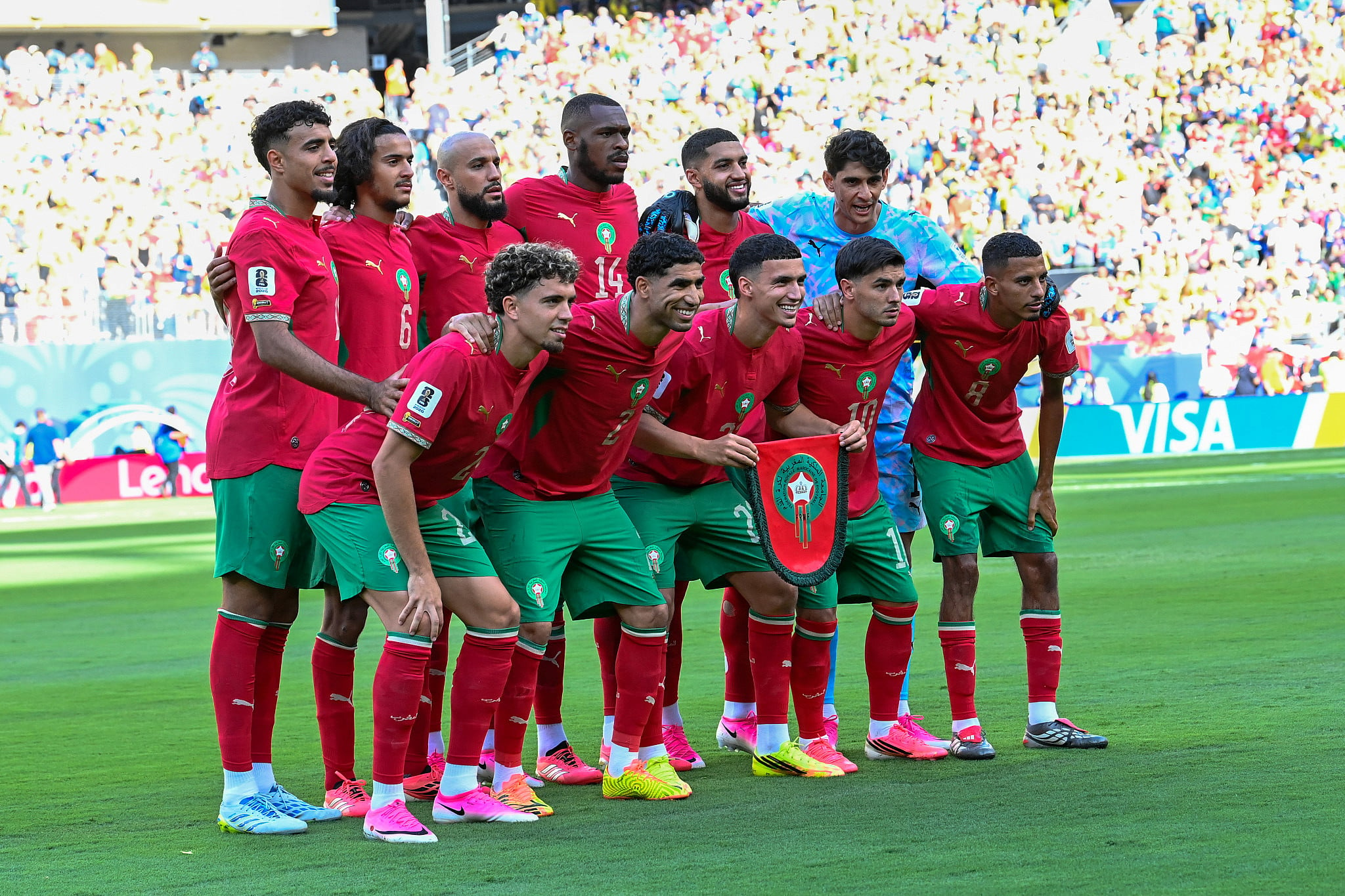
Players of Morocco pose for the photo during the FIFA World Cup 2026 Group C match between Brazil and Morocco at New York New Jersey Stadium on June 13, 2026 in East Rutherford, New Jersey. YantsImages / Wikimedia Commons
On Saturday, in the heat of Houston, Morocco beat Canada 3-0 and became the first nation to reach the quarterfinals of this World Cup. Azzedine Ounahi scored twice, Soufiane Rahimi added a third in stoppage time, and the Atlas Lions moved on to face France in Boston this Thursday. That much is a football result. What happened around the result is harder to file under sports.
In Tel Aviv, Israelis watched and cheered. In Ramallah and Gaza, Palestinians watched and cheered. They were cheering for the same eleven men. I have followed this region long enough to know how rare that sentence is, and how little I should build on top of it.
Let me start with why, because the two crowds arrive at the same team by opposite roads.
For many Israelis, Morocco is not a foreign country. Hundreds of thousands of Israeli Jews descend from families that once lived in Casablanca, Fez, Marrakech, and the villages of the Atlas. Their grandparents kept the recipes, the music, the accent, the ache. When those families watch Morocco play, they are not adopting a team; they are recognizing one. Resumption of ties under the Abraham Accords in 2020 gave the affection a diplomatic frame, but the affection came first, and it will outlast whatever the diplomacy becomes.
For Palestinians, the pull runs the other way. Morocco is the Arab side that wins and still remembers them. In 2022, Moroccan players lifted the Palestinian flag on the pitch after beating Spain and Portugal. This summer, Moroccan supporters carried that flag into the stands in New York. The team does not ask Palestinians to set their cause aside in order to celebrate; it folds the cause into the celebration. So they claim the Atlas Lions as their own, and they are not wrong to.
And perhaps that is not an accident. Long before a football team carried both flags, the Moroccan state did. This is the country both sides have gone to for two generations. In 1977, King Hassan II hosted the secret talks between Israeli and Egyptian envoys that cleared the way for Anwar Sadat’s journey to Jerusalem and the first peace between Israel and an Arab state.
In 1986, he received Shimon Peres at Ifrane while Peres was Israel’s sitting prime minister – an open meeting no other Arab leader would dare. The Moroccan monarch lent his good offices to the road that became Oslo. In September 1993, the day after the Oslo Accords were signed in Washington, Israeli Prime Minister Yitzhak Rabin and Foreign Minister Peres stopped in Rabat on their way home, and Morocco stayed the discreet channel through which word passed to Yasser Arafat’s PLO.
A year later, in 1994, the king gathered Israeli and Arab leaders in Casablanca, where the end of the Arab boycott of Israel was declared aloud. And in 1995, Peres and Arafat traveled together to Morocco to sit with the king and issued a joint statement thanking him for his untiring efforts, over so many years, in the cause of peace.
Yet the same king had created the Al-Quds Committee in 1975 to defend the Arab and Muslim claim to Jerusalem – a body his son, King Mohammed VI, chairs to this day. That is the whole art of it: Morocco kept a door open to Israel without ever bolting the one to Palestine. It could talk to Jerusalem and to Ramallah and be believed in both rooms. A state that has spent half a century earning the confidence of two sides who confide in almost no one is precisely the state whose team those two sides would, without meaning to, find themselves cheering as one.
Here is where I have to be careful, because this is the point at which sportswriting usually reaches for something it has not earned.
I am not a naive believer in peace. If peace in this land were a matter of goodwill, or of one more shared moment, it would have arrived years ago, decades ago, across all the summits and handshakes and signed pages that led nowhere. I do not mistake a football team for a peace process. A team both sides love is not a border both sides accept. Ninety minutes of common feeling settles no question of land, no question of return, no question of who buries whom. Anyone who tells you sport heals these things is selling you the easy version.
And yet.
It is genuinely uncommon to find a single object in this conflict that an Israeli in Ramat Gan and a Palestinian in Nablus will both point to and say: that one is ours. Not a leader. Not a city. Not a holy site, which they would only fight over. A team. For the length of a match, the usual demand – pick a side, and let that side define you – is quietly suspended. Two peoples who agree on almost nothing agree on a goalkeeper named Bono and a right back named Hakimi.
That is not reconciliation. I would not insult anyone’s grief by calling it that. It is smaller and stranger: a shared enthusiasm that the politics has not yet found a way to poison. Morocco has managed, without trying, to be the rare thing both sides can love at once.
On Thursday the Atlas Lions play France, and for a couple of hours the split screen will hold again – the same joy in two cities that do not speak. It will fix nothing. The morning after will look like every other morning. But in a place where common ground is almost always contested ground, a team that both sides refuse to give up is not nothing. It is the smallest possible proof that the appetite for something shared has not entirely died.
I will take it. Carefully, and without pretending it is more than it is. Dima Maghrib!
Related Posts