A Moroccan Journalist
Morocco’s Sahara masterstroke: Changing the rules of a frozen conflict
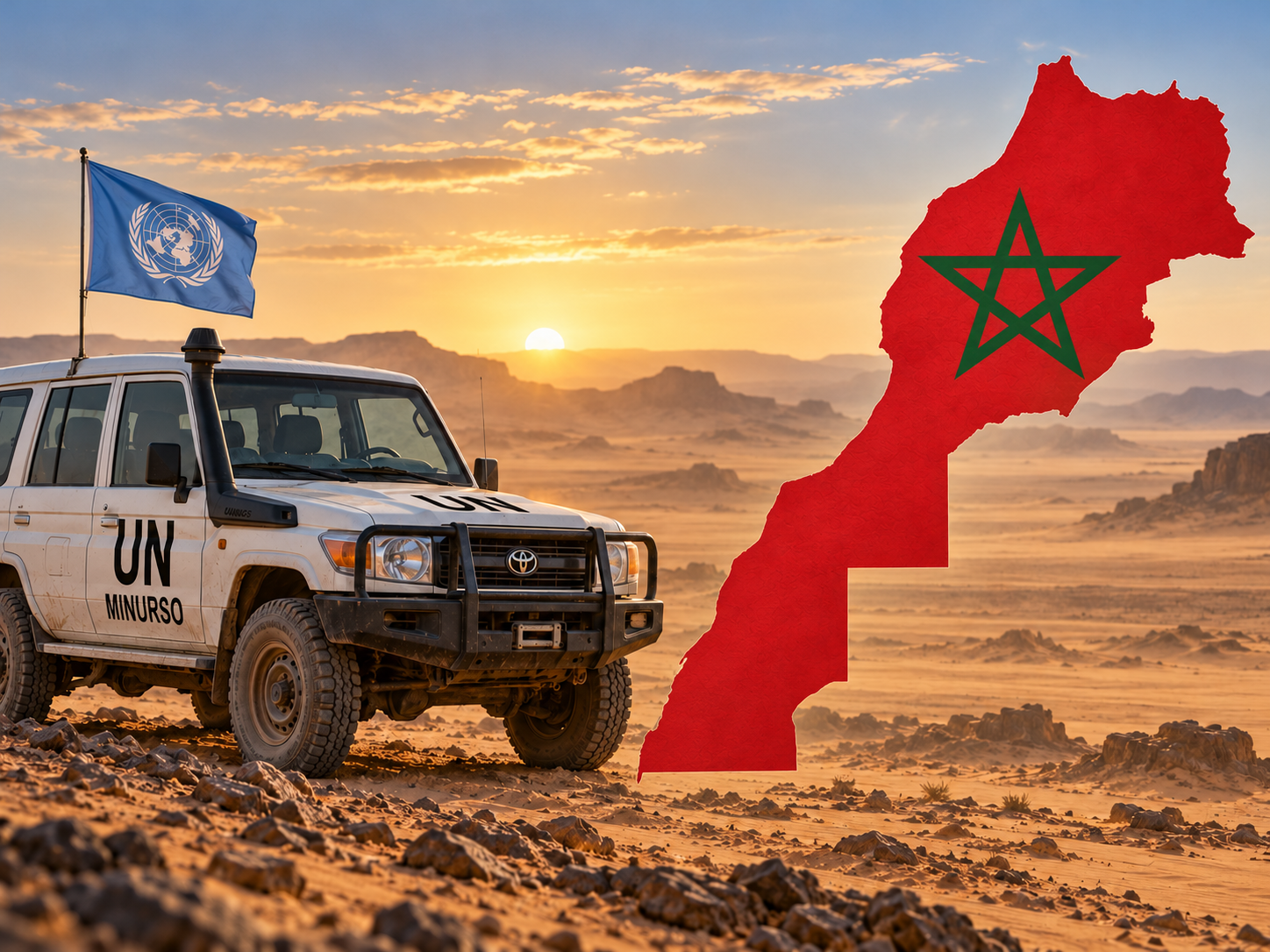
A MINURSO vehicle beside Morocco’s full map. (AI-generated)
On October 30, the UN Security Council failed to renew the mandate of its mission in Western Sahara after Russia vetoed an American draft resolution supported by eleven of the Council’s fifteen members. The proposed text would have extended the mission for another year while changing its name and clarifying the political direction of negotiations toward autonomy under Moroccan sovereignty. Russia, one of the Council’s five permanent members, could block adoption despite that majority.
Moscow then submitted an alternative that would have preserved the mission’s existing name and mandate. It secured only three votes, with eleven abstentions and an American vote against. Neither text was adopted. The mission’s authorization expired at the end of October 31, and on November 1 the UN announced the start of its liquidation: the administrative process of withdrawing personnel, returning equipment and disposing of assets.
The mission, known by its French acronym MINURSO, was established in 1991 to support a ceasefire between Morocco and the Algeria-backed Polisario separatist movement and prepare a referendum on the territory’s future. That referendum never materialized. For thirty-five years, a mission created around a transitional settlement framework remained in place while the political search for a solution moved increasingly toward a negotiated autonomy arrangement.
From a letter to a lever
The American proposal captured that evolution through a conspicuous change: MINURSO would become MINUSO, dropping the letter “R,” which refers to the referendum. Removing one letter would have acknowledged that the original formula had been overtaken by events. Morocco’s response to the anticipated Russian veto went further, opening the possibility of changing the entire institutional arrangement that had kept that formula alive.
Morocco’s most consequential response to Russia’s veto was its refusal to pay for another year of diplomatic paralysis. Rabat understood that preserving an annual resolution at the expense of its substance would preserve the machinery it had spent years working to transcend. Its answer was to turn institutional obstruction into an opportunity to reshape the settlement process itself.
Foreign Minister Nasser Bourita’s October 31 interview with 2M supplied the explanation. Morocco knew several days beforehand that Moscow intended to block the American draft. Under King Mohammed VI’s direction, it assessed the consequences and declined to dilute the text merely to avoid a veto. This was the practical application of the royal doctrine of moving from managing the dispute to transforming its parameters.
The speed of the Royal Cabinet’s response therefore reflected preparation. Bourita explained that the scenario had been considered in advance. Once the Russian position became clear, Moroccan diplomacy examined the consequences of non-renewal and identified what they could make possible. It prepared to pursue its objectives through either a substantive resolution or a fundamental change in the conditions governing the process.
The distinction is fundamental. Management seeks marginal improvements within inherited rules. Transformation examines whether those rules still serve their declared purpose. A diplomatic mechanism that repeatedly postpones settlement eventually becomes part of the problem. Morocco’s calculation was that another compromised renewal could cost more strategically than allowing an exhausted arrangement to reach its expiry.
This is the logic behind the seemingly audacious choice to let the consequences of the veto unfold. If preserving a mechanism requires sacrificing the clarity of the settlement it is supposed to facilitate, the mechanism has acquired a veto over the objective. Rabat refused to make the survival of the diplomatic instrument the overriding measure of diplomatic success.
What autonomy actually offers
For Rabat, the Sahara dossier concerns territorial reunification after colonial fragmentation. Moroccan sovereignty therefore provides the foundation for a settlement. The autonomy initiative translates that principle into a substantive political compromise: the region would have an elected legislature, an accountable executive, regional courts, substantial powers to manage local responsibilities and its own financial resources, while the Moroccan state would retain authority over national defense and foreign affairs.
The historical starting point matters. In Resolution 2072, adopted in December 1965, the General Assembly addressed Ifni and Spanish Sahara together, called for their liberation from Spanish colonial domination and requested negotiations on the sovereignty problems they presented. That record helps explain Morocco’s insistence that the dossier originated in the recovery of territories fragmented by colonial rule. The separatist project cannot erase that earlier history.
The 2007 initiative even provides for submitting the negotiated autonomy statute to the populations concerned through a referendum. This distinction matters: popular approval of an agreed autonomy settlement is different from perpetually reviving the unimplemented independence referendum associated with the 1991 framework.
Morocco built the diplomatic conditions for this shift over many years. Its autonomy proposal, African engagement, return to the African Union, American recognition of sovereignty and subsequent European repositioning gradually changed the international environment. These achievements belong to a continuous strategic trajectory. The present opening rests on that accumulated diplomatic capital.
An essential distinction follows: the expiry of MINURSO’s mandate does not repeal Resolution 2797. The mission’s authorization was limited in time; the political significance of an adopted resolution is a separate matter. Blocking a subsequent draft cannot retroactively erase the Council’s decision to place Morocco’s autonomy proposal at the basis of negotiations.
This allowed Rabat to separate two questions that had too often been bundled together: the substance of the political settlement and the continuation of a particular peacekeeping operation. The autonomy framework does not depend for its existence on the perpetual presence of vehicles, observers, and offices carrying the mission’s acronym.
The case against the mission
Bourita also identified a contradiction that annual renewals had allowed to survive. International support for autonomy under Moroccan sovereignty was expanding while the mission’s name continued to advertise a referendum framework that had remained unimplemented for decades. Rabat sought coherence between the political destination and the institutional instrument. Removing the referendum reference would have expressed that change in the mission’s identity.
This criticism predated the latest vote. In May, Bourita had already argued that peacekeeping mandates must reflect conditions on the ground and be linked to clear political strategies. Otherwise, he warned, operations risk becoming instruments of the status quo. The October decision applied a diagnosis Morocco had articulated before the crisis.
Its operating environment had also changed. Bourita recalled that the Polisario declared itself no longer bound by the ceasefire in 2020. From Morocco’s standpoint, repeatedly renewing a monitoring mechanism without addressing that rupture entrenched an imbalance: the responsible state remained subject to expectations of compliance while the armed movement repudiated its commitment.
Bourita made the operational criticism concrete. He described forty-three personnel on the other side of the Moroccan defense berm, divided among six locations and operating under movement restrictions, including at night. His question concerned what meaningful verification could achieve under such conditions. The existence of observers could no longer be treated as sufficient proof that the monitoring arrangement was functioning effectively.
The deeper problem was institutional inertia. A mission could continue producing reports about an unresolved dispute while its original political purpose receded and its operational limitations hardened. Morocco’s criticism concerns that separation between activity and outcome. Another year of deployment, another report and another briefing do not, by themselves, constitute progress toward a settlement.
The diagnosis also found support from a former head of MINURSO. In remarks on November 1, Julian Harston described the mission as anachronistic, called for its closure and endorsed autonomy under Moroccan sovereignty. His assessment reinforced the argument that an operation’s longevity cannot substitute for a credible, achievable political purpose.
Bourita drew attention to a particularly pointed irony. Among what he estimated at approximately sixteen UN peacekeeping missions, he identified MINURSO as the only one headed by a Russian national. Its head, Alexander Ivanko, was a Russian national serving as the UN Secretary-General’s Special Representative. Moscow’s veto then helped bring that mission’s operations to an end.
The political significance lies in the sequence: Russia blocked the proposed reform, failed to secure sufficient support for preserving the old arrangement, and helped produce the lapse of the mandate. Morocco could therefore insist that the mission’s departure followed the Council’s failure to renew its authorization. Rabat was drawing consequences from that outcome, rather than ordering an expulsion.
The consequences are now operational. On November 1, the UN announced the beginning of MINURSO’s liquidation period, including arrangements for personnel and assets. What Rabat identified as an institutional opening has therefore begun producing changes beyond the wording of a draft resolution.
Those changes also carry symbolic weight. Bourita explained that international coverage repeatedly represented the Sahara through images of UN vehicles, Council meetings and the Tindouf camps. Removing the mission’s physical presence would alter one of those recurring representations. Morocco’s objective is to diminish the institutional and visual apparatus through which its southern provinces have been presented as a permanently exceptional political space.
The broader objective is to dismantle the routine that made the dispute endlessly renewable. Mandate deadlines generated meetings, reports, briefings and another round of bargaining. Bourita explicitly acknowledged that the Security Council retains its general responsibilities for international peace and security. Morocco’s argument concerns ending the automatic review cycle attached to the mission, thereby reducing the mechanisms that perpetuated the dossier’s internationalization.
That has practical diplomatic value. A recurring deadline can give states leverage unrelated to the merits of the dispute. Removing that dependency would allow Morocco to concentrate more effort on consolidating substantive partnerships and securing a final political outcome. The target is the institutional reproduction of stalemate.
The voting arithmetic reinforces this reading. The American draft received eleven votes, including those of three permanent members. Russia’s alternative obtained only three, well below the nine required. As such, it had already failed numerically before the American veto. Moscow blocked a text supported by a clear majority; it failed to assemble a majority for preserving the existing arrangement.
Rabat’s terms, and its alternatives
For renewed negotiations, Morocco now demands explicit parameters: its autonomy initiative as the sole basis, autonomy under Moroccan sovereignty as the outcome, participation by the four concerned parties, and a clearly defined framework. These are Rabat’s conditions for meaningful engagement. Bourita kept the UN available as a diplomatic setting while leaving room for other initiatives capable of producing results.
Bourita’s argument about the wider international system explains that freedom of choice. He cited an estimate that the UN handles only about 23% of the world’s conflicts, pointing to mediation undertaken by states, regional organizations and other groupings. His point was that international peacemaking already operates through multiple channels. Morocco has no reason to confine its diplomatic imagination to a single mechanism.
The criticism of the UN process in the Sahara rests on its own record: thirty-five years of institutional continuity without the final settlement the mechanism was intended to facilitate. That experience justifies demanding results, reconsidering formats and working with partners capable of mobilizing influence over the parties. An internationally legitimate solution can be advanced through complementary diplomatic channels.
Partner states or regional institutions could help facilitate engagement, build confidence, and mobilize political or economic support for an agreed settlement. Such possibilities remain options, rather than an announced replacement process. Their strategic value is already clear: credible alternatives reduce the ability of any single forum to make Morocco indefinitely dependent on its procedures. The choice of venue must serve the settlement.
Requiring Morocco, Algeria, Mauritania and the Polisario to participate addresses responsibility at its source. Algeria’s hosting and support of the separatist movement make its involvement indispensable to a durable settlement. A human dimension also deserves attention: generations have grown up in the Tindouf camps, their lives and futures suspended while diplomatic processes drag on indefinitely and procedures repeat themselves. Algeria, as the host country, should be facilitating durable solutions and genuine opportunities for these populations to rebuild their lives, rather than perpetuating their displacement and restricting their freedom to choose their own futures. A credible settlement must put their dignity, freedom of movement, and right to determine where and how they live above political calculations.
Taking the fight to the Assembly
The General Assembly offers another arena for converting support into institutional consequences. Bourita pointed to the Fourth Committee, where no permanent member possesses a veto. The opportunity extends to efforts to remove the dossier from the Assembly’s agenda and challenge its continued treatment within the decolonization machinery. Morocco should mobilize its accumulated support to change the framework itself.
The Fourth Committee is the Assembly’s body dealing with special political questions and decolonization. Its recommendations proceed to the plenary Assembly, in which all UN member states participate. This changes the diplomatic arithmetic: a permanent member’s veto cannot replace the need to persuade a majority of states.
The Assembly’s own rules provide procedural instruments. Rule 22 permits agenda items to be amended or deleted by a majority of members present and voting. If all 193 members cast votes, that would mean 97 affirmative votes. Rule 66 allows plenary discussion of a Main Committee’s report when at least one-third of members present and voting consider such discussion necessary.
Institutional reconsideration also has historical precedents. In 1972, the General Assembly approved the removal of Hong Kong and Macao from the relevant list of territories, long before their eventual return to Chinese administration. The procedural lesson is that UN classifications can be reconsidered through decisions by member states. Morocco can pursue the decisions appropriate to its own case.
The Royal Cabinet states that more than two-thirds (about 135) of UN members support autonomy under Moroccan sovereignty as the settlement framework. The next task is to translate those national positions into votes on concrete institutional proposals. Agenda removal and changes to the territory’s UN listing would require their own decisions. That is the diplomatic work the opening makes possible.
Morocco’s firmness is accompanied by a clear commitment to stability. Bourita pledged an orderly, supported departure for the mission and reaffirmed the ceasefire as a political and legal undertaking. Respect for peacekeeping personnel and continuity of state commitments give substance to Rabat’s claim to responsible leadership through this transition.
Morocco’s own contributions to peacekeeping in the Democratic Republic of the Congo and the Central African Republic reinforce that position. Its case is for missions with useful mandates, credible operations and attainable political objectives. Respect for peacekeeping includes the responsibility to recognize when a particular arrangement has exhausted its purpose.
Meanwhile, the national project continues. Bourita linked international support to investment, infrastructure and development in the southern provinces. Morocco’s objective is to bring international procedures into alignment with an advancing national reality and a credible autonomy settlement. Development and diplomacy reinforce the same direction.
For other diplomacies, the example offers a lesson in preparation and sequencing. Build substantive support, understand the rules governing the process, assess alternatives before a crisis arrives, and distinguish the survival of a mechanism from achievement of the national objective. Morocco could make this choice because years of diplomatic work had strengthened the position from which it acted.
The contrast between a letter and an institutional system captures the change in ambition. Washington proposed removing the “R.” Once the Russian veto was anticipated, Rabat examined whether the resulting non-renewal could remove the obsolete arrangement itself. A threatened obstruction became an opening because Moroccan diplomacy had the preparation and accumulated support to recognize its possibilities.
The diplomatic masterstroke lies in making obstruction costly to the machinery that sustained it. Rabat preserved its substantive position, accepted an anticipated institutional rupture and began converting the consequences into leverage. Having spent years changing the balance of international support, Morocco is now using that support to change the rules under which the dispute can continue.
Related Topics