Moshiach Cat Why does the Kanaani cat bear the sign of Moses on its forehead
Sometimes the simplest things turn out to be the deepest.
We write the letter “M” without thinking. In English, in Russian, in many other languages. It seems ordinary. But if one pauses and looks more carefully, one begins to see a sign that humanity has carried across thousands of years.
In both ancient and modern Hebrew, this letter is called mem.
According to Encyclopaedia Britannica, the Latin letter “M,” which forms part of the foundation of the English alphabet, comes from the ancient Hebrew letter mem. In its earliest meaning, it represented water — not merely a substance, but flow, movement, and the source of life.
In Jewish tradition, letters are not only sounds. They carry meaning.
Many of the most significant concepts begin with this letter. Moshe Rabbeinu — Moses, our teacher, who led a people out of bondage. Moshiach — not only a future figure, but a direction of history. Malchut — a realm where the spiritual becomes manifest. Mishnah, Midrash, Mitzvah, Mezuzah, Mikveh, Menorah, Mazal — each of these is not merely a term, but a layer of understanding.
Sometimes language itself points us toward depth.
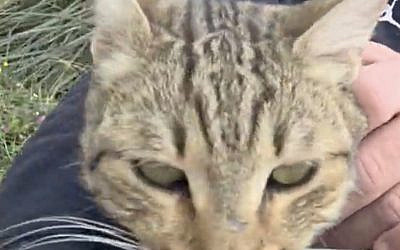
There exists a rare Israeli cat breed — the Kanaani. On the foreheads of many of these cats, a distinct marking appears in the shape of the letter “M.” For some, it is simply a pattern. But if one looks more closely, it is the same sign that has traveled through centuries.
In my correspondence with the TICA genetic committee, including Dr. Adriana Kajon, during the registration of the Kanaani as an experimental breed, it was explicitly noted: “The forehead displays a distinct ‘M’ marking.” It was stated plainly, without interpretation.
And yet, sometimes a fact already carries meaning.
The Kanaani traces back to the Near Eastern wildcat, Felis lybica, which science recognizes as the ancestor of all domestic cats. In that sense, it represents a beginning — a kind of “Adam” of the feline world.
In Midrashic tradition, Adam is not only the one who names the animals, but the one who draws them close, establishing a relationship between human beings and the animal world. In the Talmud, in tractate Chullin, sages including Rav Papa speak of the practical role of cats in the human home. A tradition is preserved that in homes where cats were present, people were protected from snakes and scorpions — especially in the time of Moshe Rabbeinu.
Here, a quiet connection begins to emerge.
The letter “M” on the forehead of the Kanaani.
Moshe Rabbeinu.
Protection.
The passage from bondage to freedom.
In Jewish thought, Moshe Rabbeinu and Moshiach are linked along an inner line. What began as liberation continues as the hope for completion.
I am not making a claim. I am simply pointing.
Sometimes a symbol does not need to be proven. It reveals itself.
Especially when one remembers that the Kanaani breed was developed in Jerusalem in the 1990s by a woman who lived through the tragedies of the twentieth century — someone who came close to loss, and yet brought forth life.
There is something profoundly Jewish in that.
Out of darkness — continuation.
Out of destruction — life.
The State of Israel was established after catastrophe, as something that seemed impossible, yet became real. On a smaller scale, the same principle appears here.
Jerusalem is traditionally seen as a place where worlds touch. Where memory does not disappear, but deepens.
And it is there that a breed emerges, carrying on its forehead a sign that humanity has known for millennia.
One can pass by.
One can call it coincidence.
Or one can simply pause — and see.
I do not consider myself the owner of this story. Rather, a guardian — entrusted with preserving what should not be lost.
And perhaps for that very reason, it is difficult to accept that the Kanaani still remains in an experimental status. This feels temporary. It should not remain so.
Some things take time before they are recognized.
The history of letters does not disappear. It continues to live — in language, in tradition, in memory.
Sometimes — even on the forehead of a cat.
Rav Papa Kanaani