
Mount Sinai: A Look Behind the Matrix
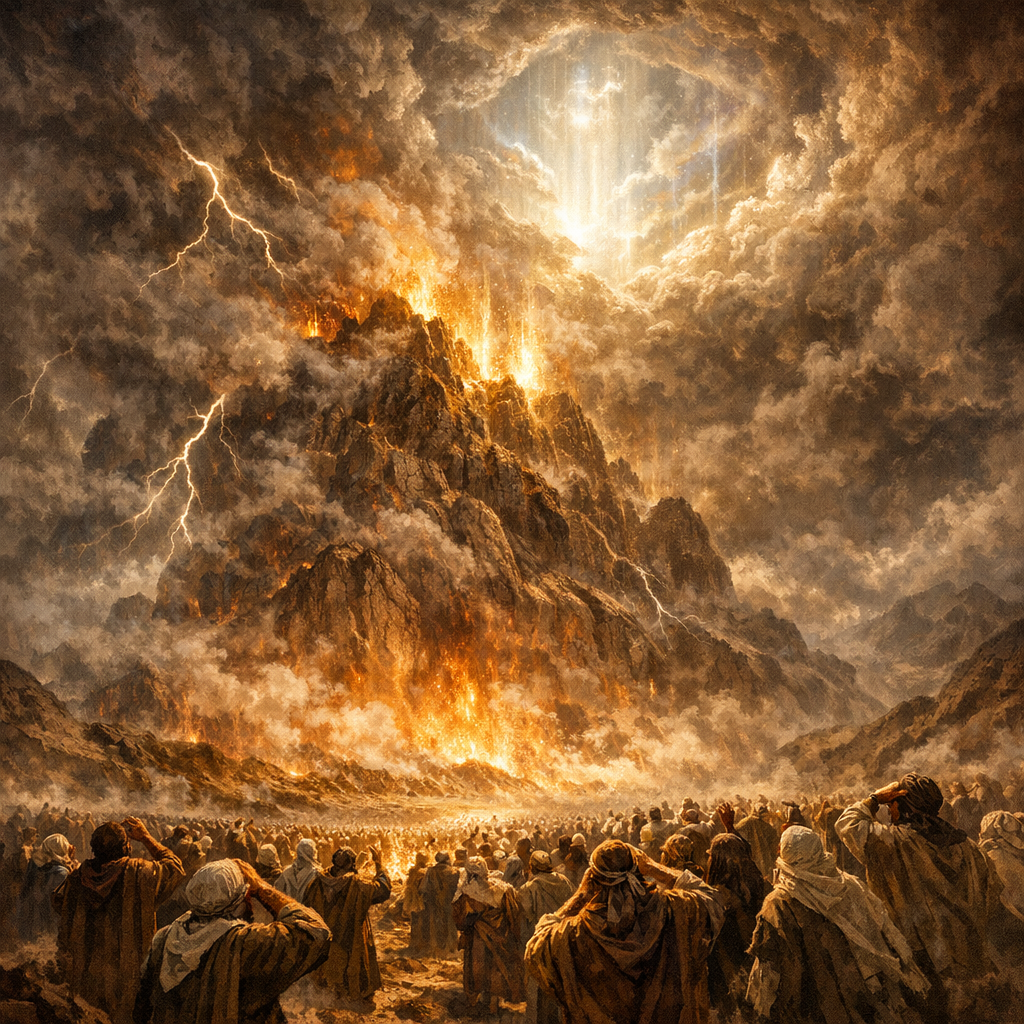
Our childhood impressions of biblical moments often linger like cherished illustrations. For many, Mount Sinai evokes two contrasting images: one bathed in soft light with flowers blooming, a pinnacle of spiritual romance for the Jewish people; the other a mountain suspended above the nation, creating a strange and powerful mix.
This event was unique, arguably the only time Hashem revealed Himself directly to an entire nation at once. How are we to picture this in our limited minds? It is worth noting that no other religion claims such a mass revelation, perhaps a sign that such an event would be impossible to fabricate.
The Torah’s account, especially the verses immediately following the Ten Commandments, along with insights from Rashi and the Netziv, reveals a complex and sobering reality, somewhat different from the childlike image we carry.
Having witnessed thunder, lightning, the piercing blast of the shofar, and the mountain engulfed in smoke, the people were overwhelmed. They recoiled and stood at a distance (Exodus 20:15).
In the very first verses after the Ten Commandments, the narrative seems to shift abruptly. The people said to Moses, “You speak to us, and we will listen; but let Hashem not speak to us, lest we die” (Exodus 20:16).
Moses reassured them: “Do not be afraid. Hashem has come only to test you, and so that the fear of Him may remain with you, that you not sin” (Exodus 20:17).
This was a people hardened by miracles: the ten plagues, the splitting of the Red Sea. Yet this encounter shattered them. It instilled not primarily love, but raw, visceral fear.
Rashi emphasizes the immediate trauma: the awe-inspiring dread of Hashem’s overwhelming presence burned itself into their consciousness to prevent sin. The Netziv, in Ha’amek Davar, offers a complementary layer: the people feared ongoing direct communication with Hashem. Their level of preparation sufficed for this singular moment, but they sensed that future unmediated encounters would be lethal. They needed Moses as a permanent intermediary.
Both interpretations converge on a shared truth: despite their spiritual elevation and firsthand experience of open miracles, the people were traumatized.
What does this teach us? I return to this question often, especially as I confront a terminal illness.
We must not delude ourselves: the world is a tough place full of violence and evil. This is a product of Hashem’s design choice of free will.
Yet the world is padded in a way that enables free will. If we were face to face with Hashem’s majesty, we simply could not survive.
Belief in Hashem implies a parallel spiritual reality: an awesome realm beyond the physical “matrix” we inhabit. This realm may be totally alien to us, something simply unimaginable.
Human frailties and instincts shield us from its full intensity. Direct exposure is overwhelming, even terrifying.
At Sinai, the entire nation was granted one glimpse behind the curtain. The experience was shattering yet purposeful. It etched into our collective memory that a transcendent power exists—one we cannot fully comprehend or withstand in our current form. Our ancestors tasted it; the primal tremor echoes faintly three thousand years later.
I do not advocate fear as the primary path to Hashem; love and connection remain the ideal.
But love without awe risks reducing Hashem to a mere friend or companion. Sinai reminds us: Hashem is the Creator and Sustainer of existence, infinitely beyond our matrix. We needed, at least once, to feel that power in its raw form.
The revelation was not just a gift of law; it was a necessary encounter with the terrifying majesty of the Divine. Only then could love and obedience rest on a foundation of genuine reverence.
As if to round out the point, the Torah continues:
Hashem said to Moses: Thus shall you say to the Israelites: You yourselves saw that I spoke to you from the very heavens (Exodus 20:19).
The Netziv adds something very profound that may account for the “shock” treatment:
“I spoke with you. Not in the manner of human thinking, that it is not honorable for Me to speak directly with the masses of people, except with special individuals who are of elevated stature. But behold, I did speak with you directly to demonstrate that you do not need any intermediary. And the matter is understood: similarly, the Holy One, Blessed be He, hears the prayer of Israel and all His providence over them without any intermediary. And this verse serves as an introduction to the warning that comes immediately afterward, as will be explained.”
The Israelites were accustomed to a society with many gods and idols that served the people, feeding and watering them. Now they had One Hashem who had just established a direct relationship with them. It was not about what Hashem could do for them, but what they needed to do to serve Hashem.
All the people needed to hear it and feel that this was different: a flip in the relationship. Up to this point, it had been Hashem rescuing them. Now, with the coming laws of Mishpatim, they were Hashem’s servants, and they could never say they did not hear Him speak to them directly.
It was quite an event – one that still reverberates, reminding us that true service begins with hearing the voice that once shook the mountain.