A Moroccan Journalist
Muslims Die in Iran, Sudan, and Yemen, Yet the World Only Protests for Palestine
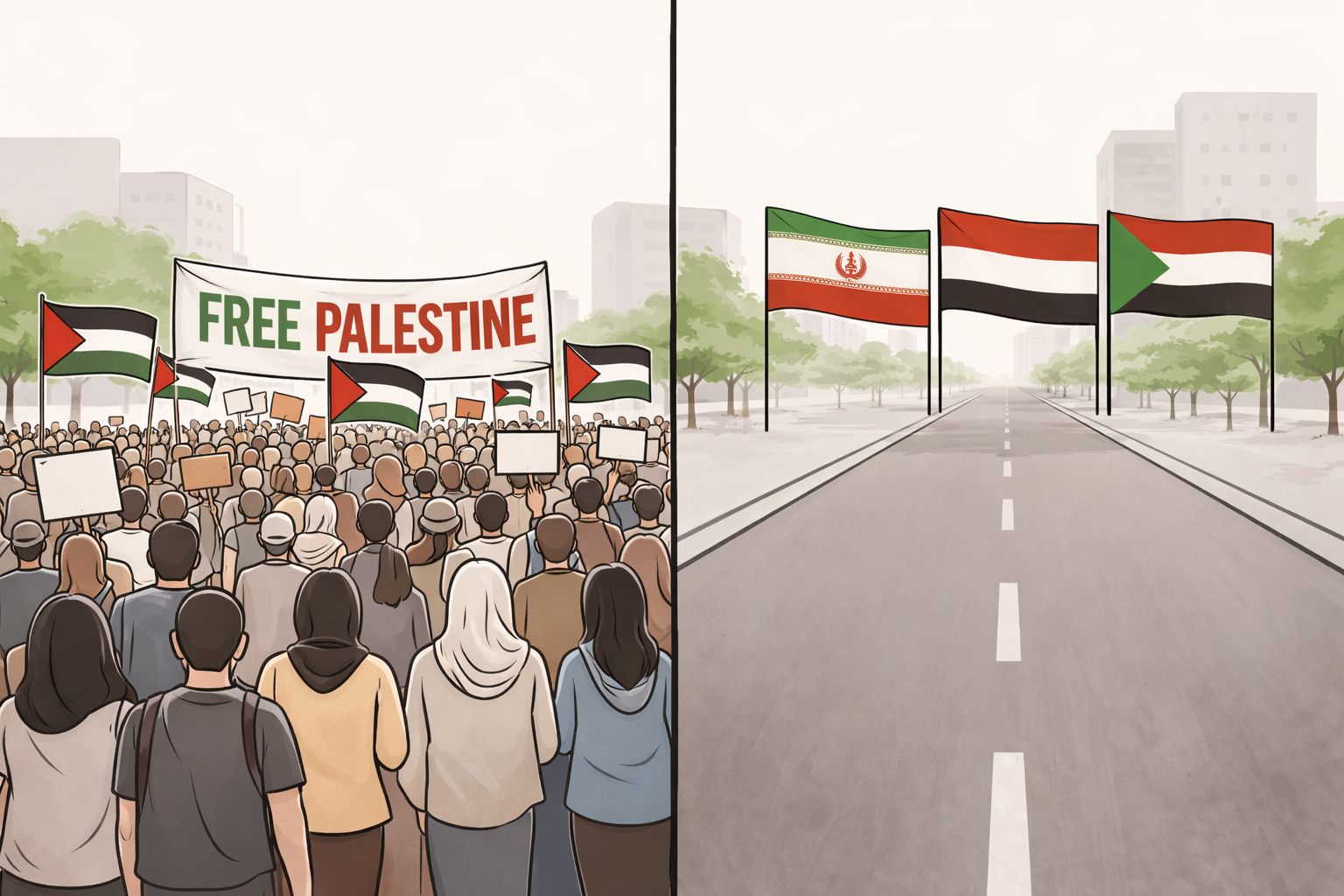
Where are the mass rallies in Cairo, Amman, Casablanca, or Doha demanding the end of clerical rule in Tehran? Where is the sustained regional outrage over Sudan’s slaughter or Yemen’s starvation? (AI generated)
Over the past weeks, Iran has witnessed one of the bloodiest crackdowns in its contemporary history. Reports – contested and difficult to verify amid severe state repression – suggest that thousands of protesters may have been killed, many shot by security forces as entire cities were sealed off and a sweeping internet blackout imposed to conceal events.
Young women have been dragged through streets, beaten, imprisoned, and killed for removing a piece of cloth. Troops were mobilized nationwide to crush dissent, erasing evidence as best they could.
Sudan and Yemen, meanwhile, are no strangers to humanitarian catastrophe. Sudan’s civil conflict, driven by rival militias and complex power struggles, has displaced millions and unleashed horrific violence against civilians – Muslims killing Muslims in numbers that dwarf most contemporary conflicts.
Yemen has endured years of war that have produced famine-like conditions, indiscriminate bombing, and a collapsed health system, leaving its children to starve slowly, off-camera. And yet, unlike Gaza, Western and Arab streets alike have not filled with sustained protest. No mass mobilization. No tents, no slogans, no moral theatre.
The uncomfortable truth is that suffering alone does not generate solidarity. Narrative does. And the narrative that mobilizes Western crowds today is not “Muslims are dying” or even “injustice is happening.” It is a far narrower script: a story that requires a specific kind of perpetrator, a specific kind of victim, and a specific ideological payoff. Palestine fits this script perfectly. Iran, Sudan, and Yemen do not.
A colonizer versus colonized?
The Palestinian cause, particularly since the latest escalation of the Gaza conflict, has been reframed in Western public discourse not as a regional conflict with specific historical roots, but as a global moral axis: oppressor versus oppressed, colonial power versus dispossessed people. Media ecosystems – especially social media platforms like TikTok and Instagram – have amplified visual narratives of civilian suffering, circulating them under universal hashtags such as #Palestine and #FreePalestine, generating billions of views.
Palestine has thus become a symbolic site onto which activists project broader critiques of imperialism, racism, and domination. Support for the cause is no longer only about Palestinian rights; it functions as a marker of political identity, a way to signal moral enlightenment and political radicalism within Western liberal democracies.
Movements grow when they are able to anchor themselves in shared narratives of injustice and collective identity. The Palestinian cause has cohered around a dense symbolic repertoire – the olive tree, Jerusalem, Gaza, the key of return, checkpoints and walls, refugee camps, and the keffiyeh – as well as frames such as settler colonialism and apartheid that resonate globally. These elements transform distant suffering into proximate moral obligation. Silence itself is increasingly framed not as neutrality, but as complicity.
Here lies the core of the double standard, and it must be stated bluntly. Iran, Sudan, and Yemen are also sites of mass killing, repression, and humanitarian collapse. All of these societies are Muslim. All of the victims are Muslim. All of the perpetrators, in Iran, Sudan, and Yemen, are Muslim as well. Yet only one of these crises generates global protest culture at scale. Why?
Because only one can be framed as Israel versus the world. Contemporary protest politics in the West no longer operates primarily on humanitarian logic; it operates on identity logic. Conflicts are filtered through a rigid moral grid inherited from post-colonial theory and simplified by social media: white versus brown, colonizer versus colonized, West versus Global South.
A white settler-colonial state?
Within this framework, Israel is absurdly and dishonestly cast as a “white settler-colonial state,” regardless of historical, demographic, or anthropological reality, while Palestinians are elevated to the position of ultimate moral victims. Every other Middle Eastern tragedy – no matter how deadly – recedes into background noise, unfit for moral theatre, protest spectacle, or global outrage.
Settler colonialism, in its classical sense, however, involves a metropole exporting a population to a distant territory in order to exploit land and resources while remaining anchored elsewhere – Britain in Australia, France in Algeria, Spain in the Americas. Zionism fits none of these criteria. Jews did not arrive in the Land of Israel as agents of an imperial mother country, nor did they come to extract wealth on behalf of an external power.
They returned to the only land where Jewish political, religious, and cultural life originated, speaking an indigenous Middle Eastern language, reviving institutions rooted in antiquity, and severing – not maintaining – ties with Europe. The majority of Israel’s Jewish population is descended not from Europeans but from refugees expelled from Arab and Muslim countries after 1948, many of whom arrived penniless and stateless.
A movement of return by an indigenous people escaping persecution, lacking a metropole, and absorbing refugees rather than exporting surplus population cannot coherently be described as settler colonialism; the label persists not because it explains reality, but because it ideologically neutralizes Jewish sovereignty.
Where are the Arab streets for Iran?
Iran’s regime cannot be racialized as white. Sudan’s militias cannot be blamed on Western liberalism. Yemen’s war does not offer a clean villain that flatters Western moral vanity. These conflicts expose something deeply inconvenient: violence that is internal, ideological, religious, and regional. Violence that cannot be outsourced to Western guilt. And so they are quietly ignored.
In other words, these conflicts are intra-Muslim, intra-regional, and not easily mapped onto the dominant Western binaries of white colonial power vs. racialized victims. Iran’s brutal suppression of protest is tragic and grotesque in human terms, but it does not fit the prevailing narrative of Western imperial culpability. The perpetrators are not Western armies; they are local regimes whose ideology tends to be coded, in Western discourse, as “other” in ways that don’t align with the oppressor-victim dichotomy that motivates sustained protest.
Iranian protesters are often portrayed in Western media as courageous and doomed, yet they are not central characters in a narrative of Western implication and accountability. Yemen’s suffering, while catastrophic, is mediated through geopolitical analyses of Saudi, Emirati, and Houthi roles – lacking the simplicity that fuels mass protest. Sudan’s losses, devastating as they are, are fragmented across ethnic and factional lines that Western audiences struggle to synthesize into a unified moral narrative.
Palestine, in contrast, has become a moral currency. To protest it publicly is to acquire political capital. It signals radical awareness, opposition to “the system,” rebellion against mainstream narratives. It allows Western activists to feel revolutionary. After all, a segment of the radical left prides itself on being “out of script.” Marching against Jewish sovereignty is fashionable, while confronting Muslim regimes that slaughter their own citizens remains awkward.
Ask the uncomfortable question: where are the Arab streets for Iran? Where are the mass rallies in Cairo, Amman, Casablanca, or Doha demanding the end of clerical rule in Tehran? Where is the sustained regional outrage over Sudan’s slaughter or Yemen’s starvation? If this were truly about Muslim solidarity, those streets would be overflowing. They are not. Silence reigns not because people do not know, but because these causes do not serve a usable political narrative.
White Europeans parachuted into the Middle East?
Israelis are not “white Europeans parachuted into the Middle East.” “Whiteness” is not a biological category but a shifting social designation, and Jews have historically been excluded from it whenever it mattered. In Europe, Jews were racialized as Semitic, Asiatic, and alien; they were barred from citizenship, professions, land ownership, and ultimately marked for extermination precisely because they were not considered white.
In the Middle East and North Africa, Jews were never perceived as European but as a distinct, often subordinate ethno-religious minority. Today’s attempt to retroactively cast Jews as white is a political maneuver, not an anthropological one: it allows critics to reframe Jews from a historically persecuted Middle Eastern people into representatives of Western power.
Israeli Jews are overwhelmingly Mizrahi, Sephardi, and Middle Eastern in origin, with family histories rooted in Baghdad, Fez, Sana’a, Tehran, Aleppo, and Cairo – not Paris or London. To call Jews white is to erase their history, deny their indigeneity, and deploy race selectively as a weapon rather than a tool of understanding. Jews are indigenous to the Levant. Hebrew is a Middle Eastern language. Jewish history in the region predates Islam by centuries.
So why does the “white Israel versus brown Palestinians” myth persist? Because it is politically useful. It allows Israel to be slotted into Western racial discourse as an extension of Europe, and Jews to be recast as beneficiaries of whiteness rather than a Middle Eastern minority with a long history of persecution. This reframing is not accidental. It is a prerequisite for turning Israel into the universal villain.
Critical theory offers a name for this phenomenon: moral framing asymmetry. Suffering is not evaluated equally; it is filtered through ideological schemas that determine whose pain counts and whose does not. Israel is subjected to maximal moral scrutiny precisely because it disrupts the neat categories of post-colonial theory. A non-Western, non-Christian, non-white people exercising sovereignty is an anomaly the framework cannot tolerate. So it is reclassified as colonial, European, and illegitimate.
The result is a perverse inversion of ethics. The world obsesses over Israel while entire Muslim societies collapse in silence. Protest culture claims universalism but practices hierarchy. It condemns Jewish power while excusing or ignoring Islamist power. It claims to stand with the oppressed, but only when the oppressor fits a pre-approved ideological profile. Western progressives, intoxicated by woke dogma and critical race theory, have replaced moral reasoning with ideological reflex, recognizing injustice only when it flatters their racialized, anti-Western worldview.
What does it say about our moral order when Iranian women dying for freedom inspire fewer marches than slogans about a conflict thousands of miles away? What does it say when Muslim victims only matter when Jews can be blamed? What does it say when outrage is loudest not where suffering is greatest, but where ideology is most comfortable?
This is not a crisis of information. It is a crisis of honesty. And until that is confronted, the silence over Iran, Sudan, and Yemen will remain the most damning indictment of contemporary global activism – not of Israel, but of those who claim to oppose injustice while practicing it selectively.
Related Topics
Related Posts