A Moroccan Journalist
My first academic paper on Israeli media is out. Here is what I found
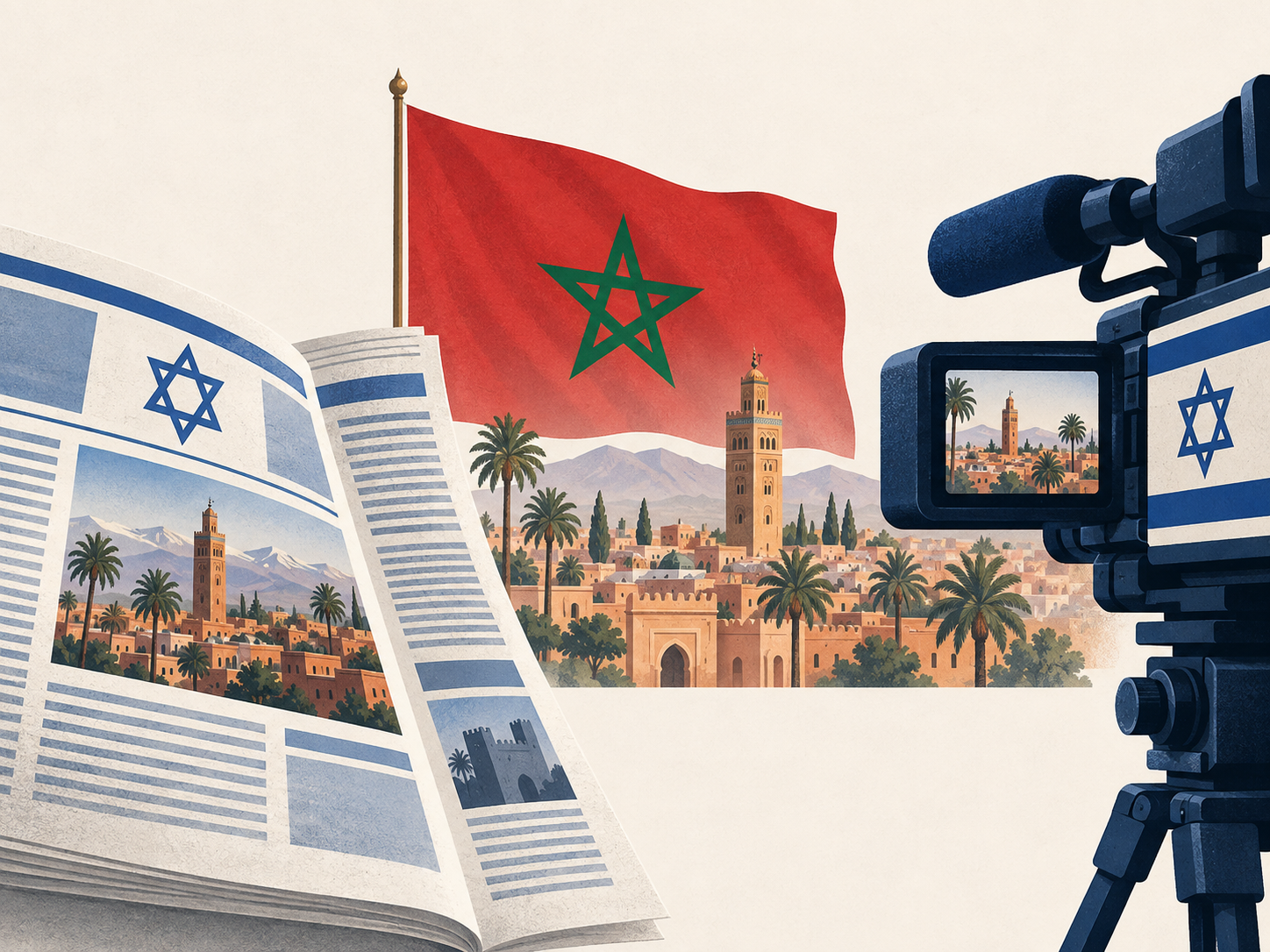
Illustration depicting Israeli media coverage of Morocco. (AI-generated)
Shalom everyone, and Gmar Chatimah Tovah. I hope you are having a meaningful Yom Kippur.
After months of research, revision, and close reading, my paper, “Adaptive Frames, Convergent Silences: Morocco in Israel’s English-Language Press across the Pre-Normalization, Normalization, and Post-October 7 Periods”, has been accepted and is now published online by the Journal for Interdisciplinary Middle Eastern Studies (JIMES), a peer-reviewed, Scopus-indexed journal published by Ariel University Press. It will appear in Volume 13, No. 1 (2027).
What began as my master’s thesis at the Doha Institute for Graduate Studies in Qatar became a 42-page attempt to answer a deceptively simple question: How has Israel’s English-language press imagined Morocco?
The study does not ask whether Morocco-Israel relations are simply “good” or “bad.” It asks which Morocco becomes visible in Israeli coverage, which voices are treated as authoritative, which histories are activated, and which are left outside the frame.
I examined coverage in Haaretz, The Jerusalem Post, and Ynetnews across three periods: before formal normalization, from the December 2020 agreement to October 6, 2023, and from October 7 through March 18, 2025. I mapped 1,092 eligible articles and closely analyzed 45 – five from each outlet in each period.
The findings resisted any neat left-right formula. Each newspaper changed its language as events changed, but it did so without surrendering its deeper editorial instincts. Haaretz coupled appreciation of Morocco’s Jewish heritage with sustained scrutiny of the monarchy and the transactional foundations of normalization. The Jerusalem Post folded cultural memory into a strategic-partnership narrative and, after October 7, stressed the resilience of official ties. Ynetnews presented normalization as the restoration of an older kinship and later explained much Moroccan hostility through “media distortion” and misinformation.
I call these “adaptive framing ecosystems”: outlets absorb major shocks, but they interpret them through commitments that remain remarkably durable.
Yet the similarities were more revealing than the differences. Across the ideological spectrum, Jewish-Moroccan history received rich attention: mellahs, synagogues, cemeteries, Andalusian music, migration, memory, and the roughly one million Israelis of Moroccan descent. This shared past allowed normalization to be narrated not as the beginning of something controversial, but as the return of something interrupted. I describe this as “mnemonic bridging.”
The contrast was striking. While Jewish-Moroccan heritage was given centuries of context, popular Moroccan opposition to normalization was often given very little history at all. Protesters appeared as crowds, Islamists, obstacles, or victims of bad information, rather than as actors situated within Morocco’s long tradition of solidarity with Palestine. Outside Haaretz, the monarchy was generally treated with deference or left largely unexamined. Islamist actors repeatedly became the convenient spoilers of an otherwise promising relationship.
As a Moroccan journalist and researcher, this was perhaps my most important lesson. I recognized my country in the coverage, but never in its entirety. Morocco appeared as a home of Jewish memory, a diplomatic asset, a tourism destination, a strategic partner, and sometimes a difficult Arab public. Each image contained truth; none was the whole truth.
That is how framing usually works. It need not fabricate facts. Its power lies in deciding which facts receive history, whose grievances receive explanation, and which absences become so routine that readers cease to notice them. The study’s “convergent silences” are therefore not empty spaces. They are part of the story the coverage tells.
The paper arrives with an unexpected postscript. Its dataset ends on March 18, 2025, so it does not include the September 16, 2026 development under which Morocco and Israel agreed to upgrade diplomatic relations by opening embassies and appointing ambassadors. That moment belongs to the next chapter – and perhaps to my next research project.
It creates a particularly useful test. Will Israeli outlets frame the upgrade as proof of institutional resilience after October 7, as the culmination of an ancient friendship, or as another strategic bargain? Will Moroccan public opposition and the Palestinian question receive context, or appear chiefly as complications surrounding an otherwise successful diplomatic story? And will the Hebrew and English editions narrate the same event in the same way?
Academic research moves slowly; diplomacy does not. A study must stop its clock somewhere, even while the relationship it examines keeps changing. I am proud that this paper is now out not because it settles the argument, but because it offers a transparent corpus, archived links, and claims that readers can test against the texts themselves.
As a Moroccan writing about Israeli media, my purpose was neither celebration nor indictment. It was careful reading. If the paper encourages Israeli readers to examine how Morocco is narrated – and Moroccan readers to ask how we narrate Israel – it will have achieved something more valuable than a personal milestone: reciprocal scrutiny worthy of a relationship that is too layered to be reduced to slogans.
Related Topics