My Shtetl Chose the Truth

Papilė corrected its Holocaust record. That simple act shows Lithuania what reconciliation could look like.
In the Jewish cemetery of Papilė, there is a stone with one word on it: GOCHIN. I placed it there to memorialize the Gochins buried in that cemetery whose individual gravestones were destroyed, and the Gochins of Papilė who were murdered and left in anonymous death pits. It is not an attempt to replace their lost graves. It is a marker that says they existed, they belonged to this place, and their names did not disappear simply because their stones did.
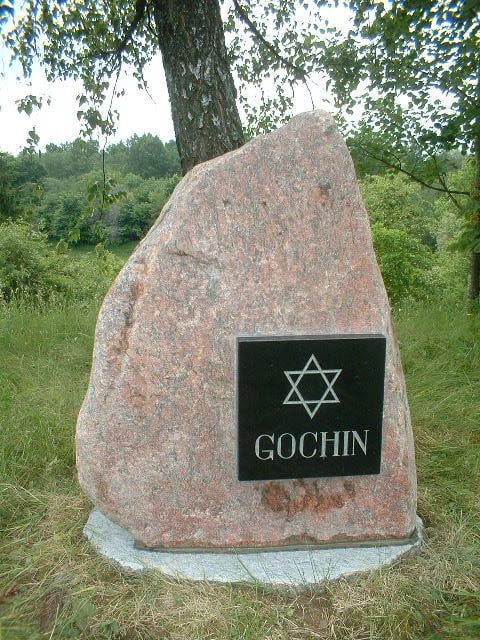
Memorial stone placed by the author in the Jewish cemetery of Papilė.
Papilė is my family’s shtetl. My grandfather, Samuel Gochin, was born there in 1902. I have written about him because even the simplest fact, that Samuel Gochin existed, had to be recovered from a world Lithuania’s Jews were largely denied the chance to transmit themselves. Meyer Shimon Gochin, Rochel Reiza, Miriam and four-year-old Raymond belonged to my family, as did Tsila Gochin and her household. The cemetery stone is for them too.
By October 6, something happened in Papilė that deserves to be praised plainly. The Akmenė District Municipality Administration and the Akmenė District Municipality Public Library corrected the public historical record of the murder of Papilė’s Jews. They did it promptly.
Sixteen days earlier, on September 20, I had sent five documented requests concerning Papilė. I had already published the evidentiary problem and then sent the source package to the institutions capable of correcting different parts of the public record. The fifth request went to the Akmenė District Municipality Public Library and the editors of the Akmenė Regional Encyclopedic Dictionary. It identified three entries, ŽYDAI, ŠIAUDINĖS DVARAS and DILBYČIAI, whose victim figures did not agree and whose wording did not identify the Lithuanian participants documented in the historical record.
The request was not complicated. It did not ask Akmenė to accept my opinion. It asked the institution to compare its public text with documented historical research and, where the evidence required it, correct the text. The signed request is public. The municipal administration registered it the next morning as GPD-1543; the registration record is public as well.
On October 6, Zita Sinkevičienė, a specialist in the Education, Culture and Sports Division of the Akmenė District Municipality Administration, answered. She had prepared the revised text. The library’s deputy director published it. At my request, the earlier versions were preserved and sent to me together with the revised versions. I have now published the municipality’s answer and the before-and-after material so the change can be checked against what came before it.
The officials did not attack the requester or convert a historical correction into a political dispute. They examined the evidence, prepared a revised text and published it.
The revised ŽYDAI entry now states that Bronius Paliulionis, chief of the Šiauliai county public police; Vincas Viskantas, chief of the Papilė police; K. Malinauskas, an officer of the Lithuanian security police; Kazys Milevičius, commandant of the Šiaudinė ghetto; a German officer recorded as Šmitas; and Papilė police and auxiliary police took part in the process of organizing and carrying out the killings. The entry records a ghetto of about 150 Jews at the Šiaudinė manor and gives 45 Jewish men murdered on July 22, 1941, the number Milevičius later said he handed to the police.[1]
The research on which the correction rests was published in 2004 by historian Alfredas Rukšėnas in the Papilė monograph series.[2] Akmenė did not have to invent a new history for my benefit. It had to let established research enter the public-facing text. It did.
Naming those men does not accuse Lithuania as a people. It identifies people who held offices and exercised authority. A public institution can name a Lithuanian participant in the murder of Jews without treating that act of historical accuracy as an attack on Lithuania. Akmenė has now done so.
The sources do not agree on every number, date or place. Pinkas Hakehillot Lita dates the shooting of the men to July 18, 1941. The Akmenė History Museum records Milevičius’s statement that he handed 45 Jews to police, while also reporting that about 20 policemen and partisans shot about 40 Jewish men. The memorial inscription gives about 50 Jews.
The 45 men were not the whole Jewish community of Papilė. On July 7, 1941, SS personnel shot a group of imprisoned Jews whom Lithuanians had handed over to them. On August 25, the women and children were taken to Žagarė. According to Pinkas Hakehillot, armed Lithuanians and Latvians tortured and raped many of the Jewish women held there. On October 2, 1941, Papilė’s Jewish women and children were shot with the other Jews of the Žagarė ghetto. The revised entry still says only that part of Papilė’s Jews was “destroyed in Žagarė.” That later part of the community’s fate remains available for further correction; it does not erase the correction Akmenė has already made.
The five requests I filed on September 20 stood as follows on October 6:[3]
- Akmenė District Municipality Public Library: dictionary entries; answered October 6, correction published. request registration/transmission record
- Akmenė District Municipality and Papilė Eldership: memorial wording, public description of the murder site and preservation of records; no answer as of October 6. request registration/transmission record
- Visuotinė lietuvių enciklopedija, the national encyclopedia: no acknowledgment and no answer as of October 6. request registration/transmission record
- Cultural Heritage Department: heritage-register object 21109; no answer as of October 6. request registration/transmission record
- Lithuanian Special Archives: the 1967 Viskantas case and exhumation records; no acknowledgment and no answer as of October 6. request registration/transmission record
Akmenė had already examined the material, prepared a correction and published it.
As of October 6, the national encyclopedia’s Papilė entry still stated that 45 Papilė Jews and nine Soviet activists were killed “on the order of the Nazi German occupation authorities” and named no Lithuanian participant.[4] The memorial at the murder site attributes the killing to “Hitlerite executioners and their helpers” and gives about 50 Jews.[5] The public sources also disagree on place: the dictionary says Jonaičiai forest near Dilbyčiai, the national encyclopedia says Šiaudinė forest, and the heritage register places the site at Kerežiai.[6] Akmenė’s library has shown how a public institution can begin resolving such discrepancies: inspect the sources and correct the text that can be corrected.
For descendants of destroyed Jewish communities, reconciliation cannot be built from ceremony alone. It cannot require descendants to accept euphemism where names are known or ambiguity where the documentary record is clear. It must also recognize institutions that respond to evidence by correcting their own public record. Akmenė did that.
I therefore credit the Akmenė District Municipality Administration, the Akmenė District Municipality Public Library and Zita Sinkevičienė by name. Their response did not restore a single murdered person. It did not rebuild the homes emptied of Jews. It did not replace the gravestones destroyed in Papilė’s cemetery or identify every anonymous death pit. No historical correction can do those things. This is one entry in one regional dictionary. It is not evidence that Lithuania’s memory policy has changed.
The correction did return agency to the murder of Papilė’s men. Men with offices organized it and carried it out, and a Lithuanian public text now names them. For the women and children murdered at Žagarė, the entry still says only that they were “destroyed.” The work is therefore incomplete, but the correction is real.
Every municipality, museum, library, encyclopedia, memorial project and tourism portal in Lithuania can follow the same method: quote the existing public statement, identify the documentary problem, supply the archival or scholarly evidence, preserve the old version, correct the new one, publish the source, and credit the institution that corrects the record.
I intend to continue that work. Papilė is the first of my September 20 requests to produce a published correction. Corrections, explanations and refusals will all be documented with the same precision. Institutions that correct documented errors should receive public credit for doing so.
I return to the stone in the cemetery. It carries only a family name because so many individual stones are gone. The people it memorializes cannot receive Akmenė’s correction. Their descendants can.
A district administration and a public library were shown difficult evidence about their own locality. They examined it and corrected what the public would read next. By naming Lithuanian participants in the murder of Jews, they strengthened the credibility of the public record.
My shtetl chose the truth. Akmenė deserves credit for choosing it too.
[1] Akmenės krašto enciklopedinis žodynas, “ŽYDAI,” Akmenė District Municipality Public Library, retrieved October 6, 2026. The operative phrase is “žudynių organizavimo ir vykdymo procese dalyvavo” (“took part in the process of organizing and carrying out the killings”); translation by the author. The entry gives initials. Full first names for Paliulionis and Milevičius follow the Akmenė History Museum’s summary of Rukšėnas’s research; Viskantas’s first name follows the 1967 case title in my request to the Lithuanian Special Archives. Malinauskas’s first name appears differently in the sources; the entry’s initial is used.
[2] Alfredas Rukšėnas, “Papilės valsčius pirmaisiais vokiečių okupacijos 1941-ųjų metų mėnesiais,” in Papilė, vols. II–III (Vilnius, 2004), pp. 464–504, as cited in the revised ŽYDAI entry; publication year as cited by the Akmenė History Museum.
[3] Status as of October 6, 2026, based on correspondence received at that date. Response periods under Lithuanian administrative procedure had not expired for every request. An unanswered request is recorded here as unanswered, not as refused.
[4] Visuotinė lietuvių enciklopedija, “Papilė,” retrieved October 6, 2026. Original: “nacių Vokietijos okupacinės valdžios įsakymu.” Translation by the author.
[5] Inscription as quoted in A. Mikalauskas, “Išvaryti ir negrįžę – Atminties kelias Papilėje,” published by the International Commission for the Evaluation of the Crimes of the Nazi and Soviet Occupation Regimes in Lithuania (2021). The inscription uses “hitleriniai budeliai ir jų pagalbininkai” and gives “apie 50 žydų,” together with five people of Lithuanian nationality.
[6] Revised ŽYDAI entry; Visuotinė lietuvių enciklopedija, “Papilė”; Kerežiai location as raised in my September 20 request to the Cultural Heritage Department concerning register object 21109. The municipal cemetery list records the site as “Žydų žudynių vieta,” Dilbyčiai village, Papilė eldership.