
Russian-American-Israeli Palestinian. Palestine is Israel.
Narrative Inversion
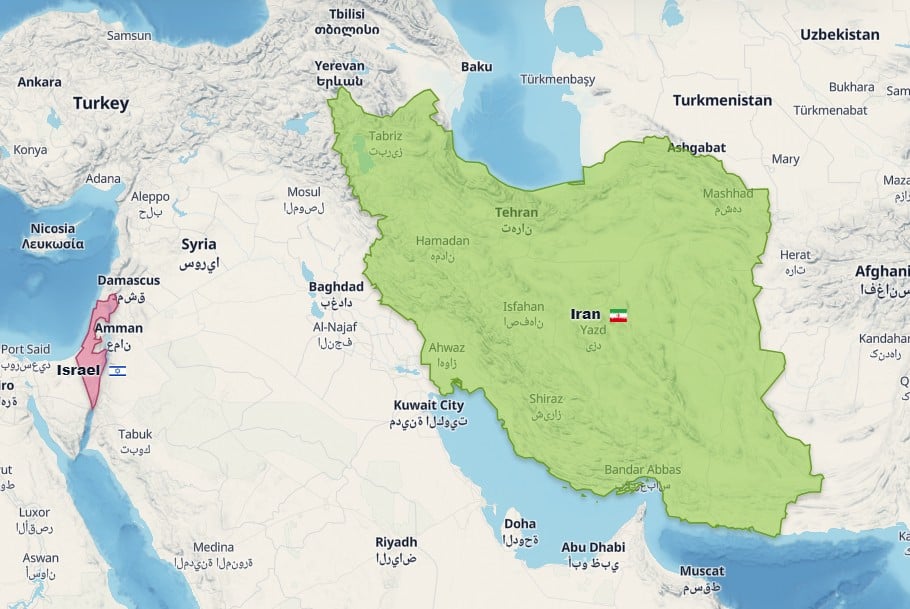
"Iran is about 80 times larger than Israel. Of course, it is harder to defend. Iran is at a significant disadvantage." A representative argument that circulated online. Image generated via TrueSize.net (free for unrestricted public reuse).
When the Same Fact Means Opposite Things
One of the most fascinating aspects of political discourse is not simply that people disagree about facts. It is that they can assign opposite meanings to the very same fact.
Over the past two years, I noticed an intriguing example involving Iran’s geography.
During the direct military exchanges between Israel and Iran in 2024 and 2025, and in the months that followed, one argument repeatedly surfaced online:
Iran is a huge country, so it’s hard to defend. Israel is a small country, so it’s much easier to defend. That gives Israel a significant advantage.
Whether or not that military assessment was correct is beside the point. What caught my attention was the logic behind it: Iran’s large size was presented as a strategic liability.
Then, in 2026, as discussion shifted to U.S. strikes against Iran and Israel was no longer directly involved, I began seeing a remarkably different argument:
Iran is a huge country. Bombing it won’t make much difference.
The geography had not changed. Iran was exactly as large as it had been a year earlier.
Only the narrative had changed.
Suddenly, the same characteristic that had previously been described as a weakness became a strength. Iran’s size was no longer evidence that it was difficult to defend; it became evidence that military strikes would have little strategic effect.
The most striking aspect was not merely that opposing camps interpreted the same fact differently. It was that the interpretation itself shifted within the same anti-Israel and anti-US online spaces. The underlying reality remained unchanged, but the meaning assigned to it was reversed.
This observation is not really about Iran. It illustrates a broader feature of political reasoning.
Facts Do Not Carry Their Own Meaning
We often imagine that facts naturally lead to conclusions.
In practice, interpretation frequently works in the opposite direction.
People can begin with a preferred conclusion and then interpret available facts through a framework that supports it.
The facts remain constant.
Their interpretation changes.
A large country can be portrayed as impossible to defend—or impossible to defeat.
A small country can be portrayed as easy to defend—or fatally vulnerable.
Neither description is universally true or false. Military strategy depends on countless variables: objectives, logistics, intelligence, technology, industrial capacity, population distribution, geography, and political will.
Yet public narratives often compress this complexity into simple slogans, assigning facts whichever significance best fits the broader argument.
When Facts Change Direction
The example above illustrates a broader phenomenon: narrative inversion.
A fact does not always carry a fixed strategic or moral significance. The same characteristic can be presented as either an advantage or a disadvantage, depending on the narrative framework surrounding it.
A large territory can be portrayed as a vulnerability because it is difficult to defend. The same large territory can also be portrayed as a strength because it makes an opponent’s attacks less decisive.
The fact remains unchanged. Only its interpretation reverses.
This pattern appears far beyond military discussions.
Economic sanctions can be interpreted as devastating under one framework, yet dismissed as ineffective under another.
A democracy’s lengthy public debates can be criticized as paralysis when explaining failures, yet praised as resilience when explaining successes.
A nation’s diversity can be celebrated as a source of innovation in one context and condemned as a source of division in another.
In each case, the underlying fact remains the same. What changes is the direction in which that fact points.
Narratives do not merely select facts. They assign those facts a significance, a value, and sometimes even an opposite sign.
Narratives as Interpretive Frameworks
An analogy from information theory may help.
Facts are like raw signals. But signals do not automatically become meaningful information. Meaning emerges from the system used to interpret them.
A narrative provides that interpretive framework. It determines which relationships are emphasized, which comparisons are made, and which conclusions appear natural.
People often assume they are debating facts when, in reality, they are often debating the framework through which those facts are interpreted.
Looking Beyond the Headlines
Recognizing this pattern does not tell us which military assessment is correct. Nor does it prove that any particular narrative is false.
It does, however, encourage a more disciplined way of thinking.
Facts matter.
But facts rarely speak for themselves.
Narratives influence what those facts are taken to mean.
Before people disagree about policies, wars, or borders, they often disagree—implicitly—about the narrative through which reality is interpreted. Once that narrative is in place, the very same facts can point to entirely different conclusions.
The battle over facts is often preceded by a battle over the framework that gives those facts meaning.
—
See Also
Related Topics
Related Posts