
Examining Extremism, Identity, and Influence
Nepal Floods: But Why Is China Deleting Videos?
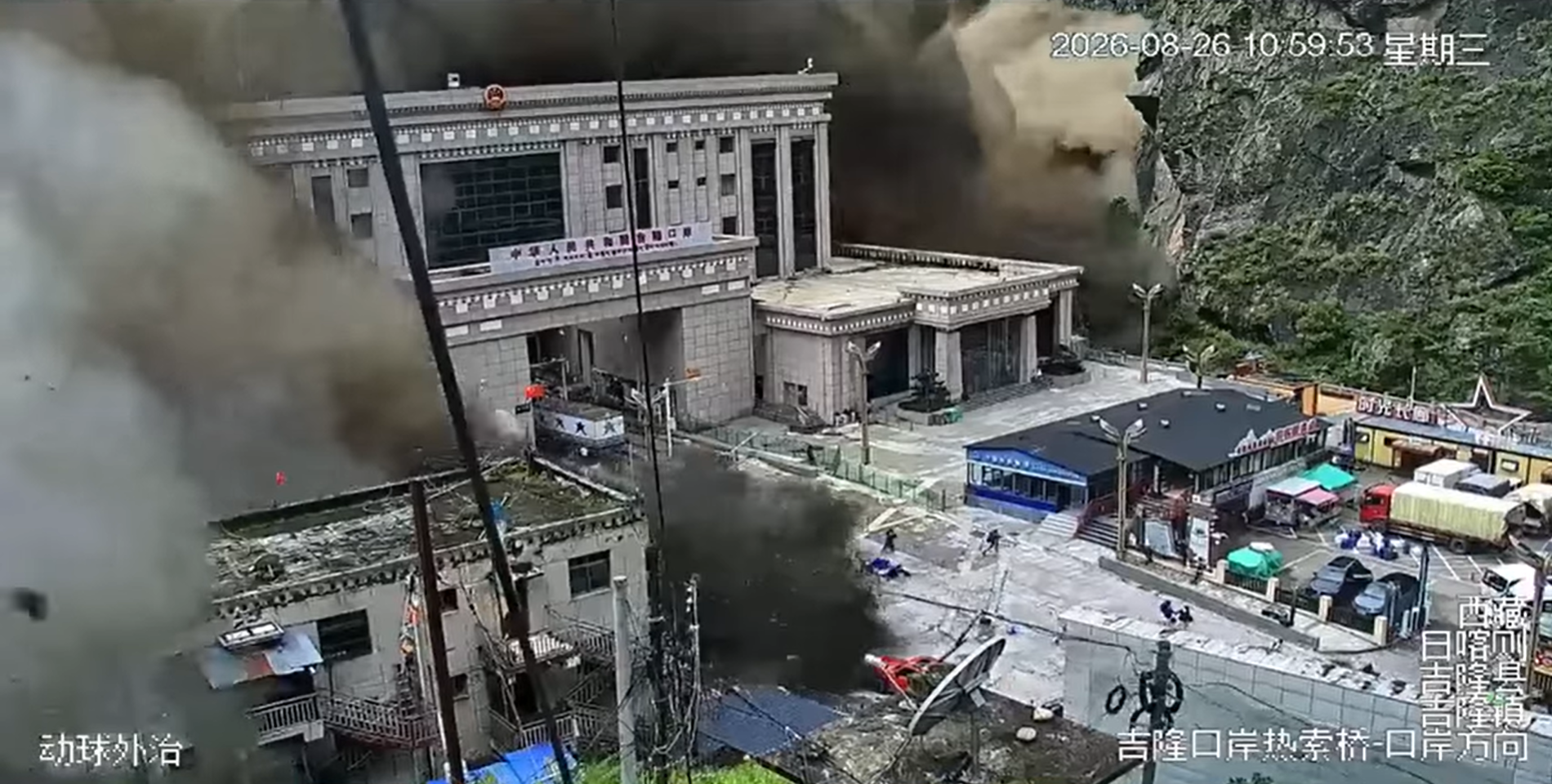
Image: Resound News via X
Access to the Tibetan side is restricted, foreign journalists face serious limitations and citizen footage is being removed from Chinese platforms.
A river does not respect a border, but a censor does. That contradiction sits at the heart of the catastrophe unfolding along the Nepal-Tibet frontier, where a glacier collapse on August 26 sent a massive surge of mud, rock and water through the Lhende Khola and into the Bhote Koshi and Trishuli river systems.
The destruction has been staggering. By August 28, Nepal had reported 579 deaths, with nearly 1,924 people still missing. On the Chinese side, five deaths and 558 missing people were officially reported in Tibet’s Gyirong County, including 260 foreign nationals. Ten bodies were also recovered from rivers in northern India.
But the numbers tell only part of the story. The other part is increasingly about what China does not want people to see.
A Disaster, Then a Digital Cleanup
Within hours of the disaster, videos from the Chinese side began circulating on Chinese social-media platforms. Security footage showed a wall of mud and debris crashing over buildings at Gyirong Port as people ran for their lives. The location and footage were subsequently verified by international media.
Then the videos started disappearing.
Bhutanese journalist Tenzing Lamsang highlighted the removal of flood footage from Chinese platforms, stressing that this was not political protest or anti-government activity. It was disaster footage.
China starts censoring flood videos on its social media.
This is not some political protest or ‘anti-govt’ activity.By contrast Nepal has been transparent on its side & there is help & sympathy pouring in & healing will also start.
On the Chinese side propaganda & censorship. https://t.co/CRI6k2VHE2
— Tenzing Lamsang (@TenzingLamsang) August 27, 2026
Journalist Aadil Brar similarly reported that citizen videos filmed on the Chinese side were being deleted while footage from Nepal remained widely available.
The distinction is important. A citizen recording a flood is not challenging the Chinese Communist Party. A person filming a collapsing building is not conducting an information war. Yet once those images contradict the carefully managed official picture, they can become inconvenient.
What remained on Chinese platforms was largely the official narrative: rescue operations, government statements, President Xi Jinping’s instructions and limited information about the extent of the destruction.
That creates a remarkably one-sided picture of a disaster.
In Nepal, journalists have been able to travel to affected areas, speak to survivors and publish photographs and videos of the devastation.
In Tibet, foreign access is heavily restricted, particularly around sensitive border areas. The result is predictable: the world can see the destruction in Nepal far more clearly than it can see what happened just across the border.
That is not merely a media problem. It is an information-control problem. And in a disaster, information is part of relief.
What Happened in the Mountains?
The censorship becomes even more troubling because important questions about the disaster remain under investigation.
Early reports suggested that an earthquake may have triggered the collapse. That explanation has since become more complicated. The US Geological Survey initially recorded a magnitude-4.4 seismic event but later determined that the signal was generated by the landslide itself rather than an earthquake.
Satellite imagery showed a huge collapse of glacier and bedrock, followed by an ice-and-rock avalanche that temporarily blocked the river before the natural dam gave way.
That still leaves plenty to investigate.
Reports from Nepal have raised questions about explosive devices washed downstream from the Tibetan side and whether blasting associated with construction or tunnelling could have played any role in destabilizing the terrain.
Nepal's media is reporting that explosive devices were washed down from Tibet side into Nepal after the floods. What were these devices used for in Tibet side?
Breaking mountains for some construction? Did the Glacier break after one such detonation for tunneling or… pic.twitter.com/3V2n2oucS9
— Aravind (@aravind) August 28, 2026
What were the reported devices? Where did they come from? Were they connected to construction work? Were explosives being used for tunnelling or cutting through the mountains? Were they completely unrelated to the disaster?
These are not unreasonable questions. Yet the very conditions needed to answer them are missing. Access to the Tibetan side is restricted, foreign journalists face serious limitations and citizen footage is being removed from Chinese platforms.
That is precisely how an information vacuum is created.
And an information vacuum does not eliminate speculation. It feeds it.
If Beijing wants the world to accept a particular explanation for what happened, the answer should not be censorship. It should be evidence.
Whose Disaster Is It?
China’s control over the narrative matters far beyond Gyirong.
The river system originating in Tibet does not end there. The Lhende Khola feeds the Bhote Koshi, which flows into Nepal’s Trishuli and eventually becomes the Gandak in India. Thousands of people in Bihar and other downstream areas have already faced evacuation and flood warnings.
Last year, another flood in the Bhote Koshi killed nine people and left 24 missing, while destroying the Friendship Bridge connecting Nepal and China. That disaster was reportedly linked to the draining of a supraglacial lake in Tibet.
This is becoming a pattern that the countries downstream cannot afford to ignore.
The Tibetan plateau is one of Asia’s most important water towers. Decisions made there — whether involving infrastructure, roads, tunnels, hydropower or environmental management — can have consequences far beyond China’s borders.
Yet the people living downstream are being asked to trust information coming from a region where independent access is severely constrained.
That is unacceptable.
China has deployed rescue personnel, drones, search dogs and other emergency resources, and Premier Li Qiang has visited the affected region. But a government can conduct rescue operations and censor information at the same time. One does not cancel out the other.
The issue is not whether China has sent rescuers. The issue is whether China is allowing the world to see what those rescuers are finding.
A government facing a natural disaster should not fear citizen footage. It should preserve it. Journalists should be able to examine the damage. Scientists should be able to study the terrain. Independent experts should be able to compare satellite imagery, eyewitness accounts and official statements.
Instead, the pattern emerging from Tibet is the opposite: restricted access, disappearing footage and an overwhelmingly official narrative.
That is why China’s censorship matters.
It is not simply about a few videos being removed from Weibo or Douyin. It is about controlling the historical record of a disaster that has crossed three countries.
Beijing can control what appears on Chinese social media. It can restrict journalists. It can manage the official narrative. But it cannot control the rivers flowing out of Tibet.
Eventually the water will recede. The satellite images will remain. Survivors will speak. The debris will reveal its own story. And the questions Beijing tried to bury may become harder, not easier, to suppress.
The flood has already crossed the border. Now the truth needs to be unearthed.
Related Topics
Related Posts