
From Kibbutz to the global stage
Netanyahu and MBS Could Meet in December as Trump Shapes Peace Council
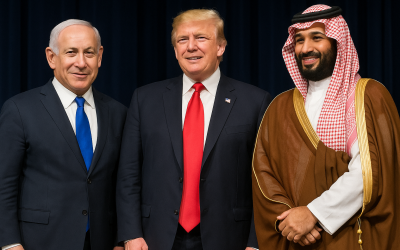
A conceptual artistic rendering of the three leaders within a shared regional framework.
Subtle signals, shifting schedules, and one late-night statement all point in the same direction: a new Middle Eastern dynamic is accelerating.
Saudi Crown Prince Mohammed bin Salman’s late-November state visit to Washington ended without any public declaration on normalization with Israel or on Riyadh’s commitment to Gaza reconstruction. Yet it was precisely the absence of such a declaration that became the signal.
In recent days, the broader picture has begun to take shape.
For weeks, fragments of information — some minor, some significant — hinted that a new regional framework was forming behind the scenes. This was not merely a reaction to the Gaza war but part of a political architecture that regional power brokers aim to anchor ahead of 2026.
Then, two nights ago at midnight, Donald Trump delivered the clearest indication yet:
“Phase two… will happen pretty soon.”
Simultaneously, US reports surfaced about another call between Trump and Prime Minister Benjamin Netanyahu, in which the issue of a potential pardon — politically explosive in Israel — was raised once again.
For those following the signals closely, the implication was unmistakable:
“Phase Two” is not only a ceasefire stage. It is the activation point for Trump’s emerging “Peace Council” — a regional leaders’ forum he has been quietly assembling for months.
Advancing the Meeting: The Detail That Shifted the Map:
Until recently, Israeli media reported that Netanyahu was expected to visit Trump’s Mar-a-Lago estate on December 28 — a quiet window between Christmas and New Year’s Day, suitable for discreet diplomacy.
But yesterday, Barak Ravid (Axios, Channel 12) revealed that efforts are underway to move the meeting forward — to the days before Christmas.
At the same time, Saudi media floated hints about the kingdom’s commitment to Gaza reconstruction, while US outlets discussed the possibility that MBS may join the Peace Council.
When a bilateral meeting moves forward rather than later, it usually means one thing:
A third (or additional) leader must align their schedule.
A New Regional Framework: US–Saudi–Israel — and Potentially Seven More Countries
When reports first emerged weeks ago suggesting that MBS was “considering joining the Peace Council,” it sounded speculative. But his massive visit to Washington — accompanied by nearly 1,000 officials, including much of his cabinet — changed the equation.
This was not a bilateral photo-op.
It was a state asserting its place in a redesigned regional architecture.
In parallel, observers noted:
- Quiet advance delegations in Washington and Abu Dhabi
- Unusual calendar movements
- Public references to a “day-after model”
All signals point in one direction:
a preliminary gathering of roughly ten leaders — possibly already in December, perhaps even at Trump’s Mar-a-Lago compound.
Why Now?
The explanation is simple: 2026 is a strategic pivot point.
The US–Saudi–Israel triangle must stabilize before the global system enters another cycle of conflict and shifting power balances.
The international landscape is pushing in this direction:
- India and Russia are charting new strategic courses
- China is expanding its presence in the region
- Europe is exploring greater strategic independence from Washington
Even in an unexpected domain — the global planetary-defense exercise surrounding 3I/ATLAS — one can see NASA, the European Space Agency, and a long list of Indo-Pacific partners (China, Japan, Australia, India, South Korea and others) converging into a coordinated multinational framework.
The global system is signaling clearly:
Alliances are shifting, and windows of opportunity are narrowing.
The ToI Investigation: The Most Concrete Clue Yet
Today, The Times of Israel published an investigation that reshuffles the entire equation:
- The US and Saudi Arabia had already reached detailed understandings — before October 7, 2023 — on the Palestinian component of a normalization deal.
- These included transferring certain civil powers to the Palestinians in parts of the West Bank — changes in the classification of Areas C/B/A.
- According to the report, Israel itself was involved in drafting versions of these understandings.
In other words:
Normalization was far closer than most realized — and was merely paused.
Does This Hint at a Parallel Netanyahu–MBS Agreement?
Potentially — and it is a significant signal.
The report indicates that Saudi Arabia already gave an in-principle yes to a diplomatic structure that included Israeli concessions. If so, the ball now moves decisively to the Israeli side.
Why does this matter?
- Because Riyadh is signaling that, from its perspective, the “Palestinian chapter” of the normalization formula is essentially resolved.
- Because Israel has previously demonstrated willingness, in principle, to engage with such a framework.
- Because Washington is pushing for a coordinated — and carefully timed — breakthrough.
In other words:
A Netanyahu–MBS meeting is no longer a theoretical possibility. It is a logical step in a process whose outlines already exist.
The Real Test: The Four Days Before the Meeting
Diplomatic moves of this scale rarely reveal themselves on announcement day.
They become visible four to six days earlier — through sudden flights, unusual security preparations, and unexplained calendar reshuffles.
If Trump’s “Phase Two” is indeed the moment when the Peace Council becomes operational?
The next two weeks constitute the window of maturation.
We may see another hint in US media in the coming days — or perhaps a week from now.
But the principle remains:
When ten leaders synchronize a shared time slot, it does not stay secret for long.
Conclusion:
There is no declaration yet.
There is no signed document.
But there is:
- A new diplomatic lexicon
- Coordinated signaling
- Accelerated scheduling
- Old documents resurfacing
- And a regional system seeking stability ahead of 2026
This is precisely the moment when history begins to move — before anyone says the words out loud.
Illustrative Image (AI)
A conceptual artistic rendering of the three leaders within a shared regional framework.
Related Posts