
Netanyahu Didn’t Just Attend a Concert. He Borrowed a Public.
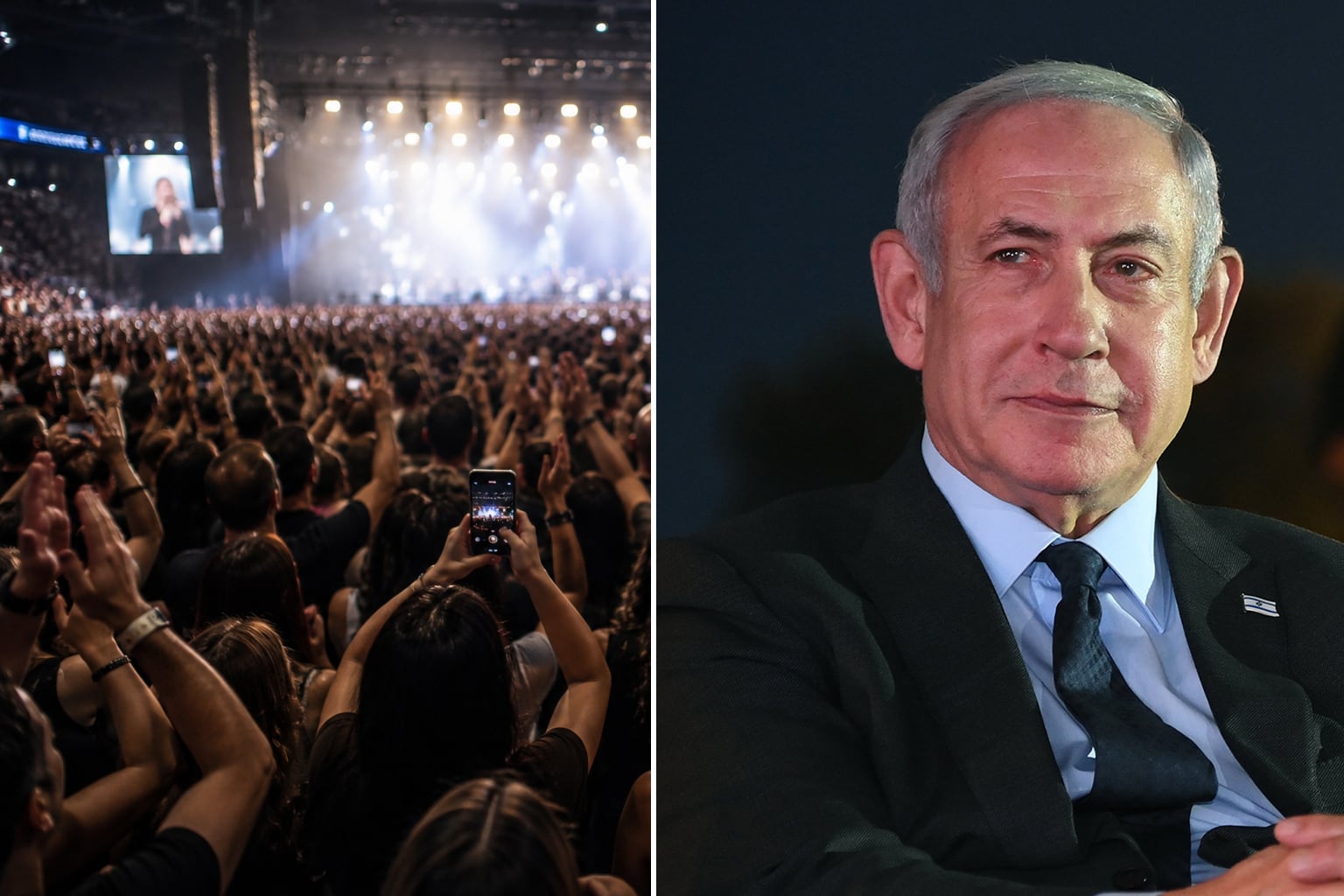
Politicians have always looked for places where politics does not look like politics. They are photographed at diners and county fairs, walking through the shuk, buying falafel. The setting varies and the purpose does not. A politician usually seen behind a lectern appears where ordinary life is already underway, and the picture says what a speech cannot: this is one of us. Netanyahu’s appearance at Eden Ben Zaken’s concert last week began inside that tradition.
The genre exists because belonging cannot be argued. A record can be defended and a policy can be explained, but no one has ever been talked into feeling that a politician is one of them. It has to be shown. But Netanyahu used the appearance for more than belonging. What the crowd was already showing – life, strength, happiness – became a way of reframing the record on which he is about to be judged.
Netanyahu was entitled to attend Eden Ben Zaken’s concert. There is nothing improper about a prime minister at a concert, and nothing suspect about an audience applauding him. The interesting part began when the applause was given a meaning. Ben Zaken is one of Israel’s most popular singers, and thousands had bought tickets to see her at Menora Mivtachim Arena. There were no party banners and no political speeches on the program. Then Netanyahu was handed a microphone. “Do you know what you are proving?” he asked the crowd. Am Yisrael chai: the people of Israel are strong, and happy.
The question did most of the work. Netanyahu did not tell the crowd that Israel was alive and strong; he told them that they were proving it. A room full of people who had come to hear a singer became evidence for a proposition about the country. The concert had acquired a second meaning without anything about the people in it having to change.
That matters because this was not a political crowd. A campaign rally manufactures its own public: people come because they already share, or are willing for an evening to perform, a political identity. The audience at Menora had been assembled by Eden Ben Zaken. Some applauded Netanyahu because they support him, some because they were swept up in the moment, some because applauding a prime minister seemed natural. Politically, those differences matter. In the picture, they disappear. A public that was not politically assembled can stand for something larger precisely because nobody selected it to do so. For an evening, it was simply an us.
Netanyahu also had a way into that us. In 2020 he and Ben Zaken recorded a cover of Yesh Bi Ahava, “There Is Love in Me,” written by Arkady Duchin and made famous by Arik Einstein. At the concert he returned to the song’s closing promise with the pronoun changed: We have love, he told the crowd, and it will win. The I had become a we. He was no longer simply standing before the picture; he had placed himself inside it.
But the resilience visible in that arena was not the government’s achievement. It belonged to people who buried friends, sat in shelters, waited for news, went back to work, raised children and eventually bought concert tickets again. It was produced by families, communities and sheer persistence, much of it beyond the reach of government altogether. Netanyahu did not need to claim that resilience as an accomplishment of his government. The more consequential move was to make it a way of seeing the period over which his government had presided.
That period contains October 7, the war that followed and the unresolved argument over responsibility for both. An election centered on that record asks a conventional political question: what happened under this government, and what responsibility does the government bear for it? The arena offered another way of describing the same years. Israel had suffered, but Israel was alive; Israelis had been tested, but they were strong; after everything, thousands of them were standing in an arena and singing.
The two descriptions are not contradictory. A country can be badly governed and extraordinarily resilient at the same time. The political advantage comes from allowing the second fact to answer a question that properly belongs to the first. Government performance can fail. Public resilience almost cannot. The worse the ordeal, the more impressive the survival may appear.
That is why resilience is such a peculiar standard for judging power. Any prime minister, after almost any national failure, may eventually stand before citizens who have rebuilt routines, reopened businesses, returned to schools and filled concert halls. Their presence says something important about them. It says very little, by itself, about the government that governed them. A standard that improves as citizens recover from what happened on a government’s watch cannot tell us whether that government succeeded.
Whether Netanyahu’s appearance changed a single vote is impossible to know, and it may have alienated some people in the arena as much as it pleased others. Its significance does not depend on that. The more important question is which measure follows him into the campaign: what his government got wrong, or how strong Israelis proved to be. The resilience was theirs. The political use of it was his.