
Middle East Analyst
Netanyahu’s Trump–Saudi–Turkey–Qatar Dilemma
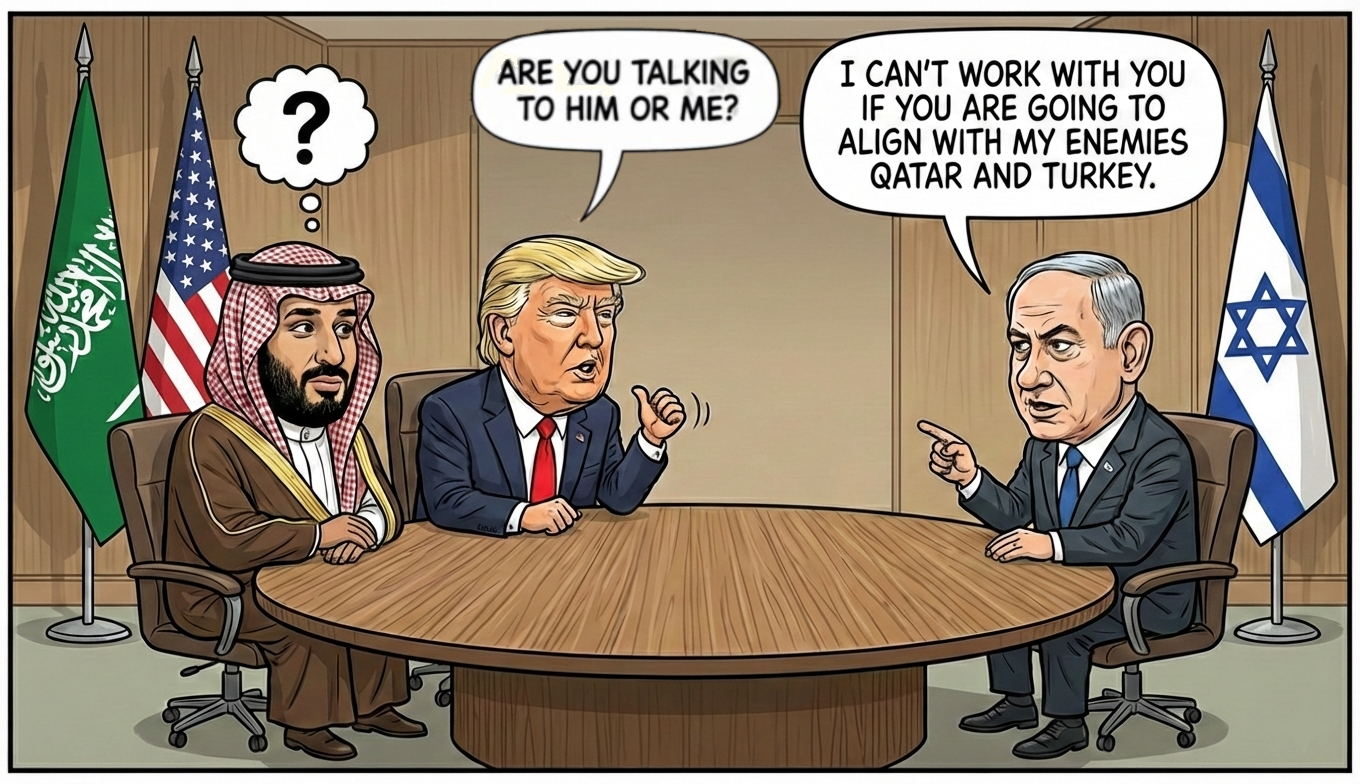
Image courtesy of author
Prime Minister Benjamin Netanyahu recently declared, “We expect from anybody who wants normalization or peace with us that they not participate in efforts steered by forces or ideologies that want the opposite of peace.” The remark was widely understood as a pointed reference to Saudi Arabia’s deepening engagement with Turkey and Qatar. Of the two, Turkey represents the more consequential concern for Israel: it is a major regional power, a NATO member, and—according to multiple reports—in advanced exploratory discussions about joining the emerging Saudi–Pakistan mutual defense framework.
For Netanyahu, this evolving alignment presents a layered strategic and political dilemma shaped by domestic constraints, shifting regional alignments, and the central role of the United States in shaping the Gaza endgame.
At the heart of this challenge lies a balancing act between two incompatible imperatives. On one hand, Netanyahu must demonstrate to Israeli voters—and to key coalition partners—that he is resisting the growing influence of Turkey and Qatar in Gaza’s political and security future. Both states now occupy prominent roles in the emerging post-war diplomatic architecture, including participation in the newly established Board of Peace and, more significantly, in the Executive Board tasked with overseeing ceasefire implementation, disarmament pathways, and reconstruction oversight.
While these bodies remain politically fragile and their ultimate authority contested, they nonetheless represent the UN mandated plan for the stabilization of Gaza. There is no Plan B. Their composition alone is enough to trigger deep unease within Israel. Turkish involvement is especially sensitive: Ankara has long been one of Israel’s most vocal regional critics, and its political and logistical ties to Hamas are well documented. Qatar, meanwhile, has for years served as both a financial conduit into Gaza and a mediator with Hamas leadership, which it continues to host.
Israeli public opinion—particularly within Netanyahu’s political base—remains broadly hostile to any arrangement that grants Turkey or Qatar a meaningful role in shaping Gaza’s future. Skepticism toward international oversight mechanisms is equally entrenched, especially when such mechanisms are perceived as constraining Israeli freedom of action. For Netanyahu, signaling resistance to Turkish and Qatari influence is therefore a domestic political necessity.
On the other hand, Netanyahu must avoid any direct confrontation with President Donald Trump, whose administration is the principal architect of the very framework that elevates Turkey and Qatar. Israel’s reliance on the United States—for military resupply, diplomatic cover, intelligence coordination, and deterrence signaling toward Iran—has only intensified amid heightened regional volatility. Netanyahu cannot afford a rupture with Washington at a moment when escalation with Iran or its proxies remains a persistent risk.
This is the core of Netanyahu’s dilemma: the very actors he must oppose rhetorically at home are the same actors Trump has empowered diplomatically.
The result has been a thinly veiled narrative attack not on Turkey or Qatar directly, but on Saudi Arabia’s evolving regional alignments. By framing Riyadh’s engagement with Ankara and Doha as a drift toward “forces or ideologies that want the opposite of peace,” Netanyahu can express concern about their influence without openly challenging Trump’s decisions or the US-designed architecture underpinning the Gaza process. The criticism is formally aimed at Saudi Arabia, but the underlying target is the framework itself—one Netanyahu cannot publicly reject.
Netanyahu’s messaging is thus calibrated for two audiences. The first is domestic: Israeli voters who expect visible resistance to any post-war arrangement that empowers Turkey, Qatar, or international bodies perceived as hostile or constraining. The second is the American right, particularly the media and political networks that constitute the core of Trump’s pro-Israel ecosystem. By shifting blame toward Saudi Arabia, Netanyahu seeks to limit erosion of support within this constituency without appearing to challenge Trump directly.
The strategic risk in this approach is clear. It was Trump himself who insisted on involving Turkey and Qatar in ceasefire negotiations, hostage mediation, and discussions surrounding Hamas disarmament. It was Trump who elevated them into central roles in Phase II planning for Gaza’s security and reconstruction. And it is Trump who continues to view both states as indispensable to the success of his broader Middle East initiatives.
There are structural reasons for this reliance. Turkey maintains channels to multiple Palestinian factions and retains influence across parts of Gaza’s political landscape. Qatar, however, occupies an even more protected position within US strategy. Beyond its longstanding mediation role and its hosting of the largest US airbase in the Middle East, Trump formalized the US–Qatar relationship through a mutual defense pact, placing Doha under explicit American security guarantees. This status elevates Qatar from a useful intermediary to a treaty-backed US security partner, making its inclusion in the Gaza process not merely a policy preference but a structural constraint.
Saudi Arabia, by contrast, has no comparable mutual defense treaty with the United States. Despite decades of close cooperation, US–Saudi security ties remain deliberately informal, contingent, and politically deniable—granting Washington flexibility but leaving Riyadh without the institutional protection Qatar enjoys.
Trump also maintains a close personal relationship with President Recep Tayyip Erdoğan, reinforcing Ankara’s diplomatic relevance despite deep tensions with Israel. From Washington’s perspective, reliance on both Turkey and Qatar reflects continuity in US regional practice rather than an anomaly tied to Gaza alone.
Saudi Arabia has historically viewed both Turkey and Qatar with suspicion. Riyadh’s rivalry with Ankara has sharpened over the past decade, and its relationship with Doha has oscillated between uneasy coexistence and open hostility. Yet in the current environment, Saudi Arabia has had little choice but to adapt. If the United States has designated Turkey and Qatar as gatekeepers of the Gaza diplomatic track—and if one of those gatekeepers enjoys deeper and more formal security ties to Washington than Saudi Arabia itself—then Riyadh must engage within that structure, even if doing so carries political and strategic discomfort.
Netanyahu has made a similar accommodation privately. He has accepted the functional centrality of Turkey and Qatar in the Gaza process because no viable alternative exists. Publicly, however, he continues to signal opposition, creating a widening gap between private acceptance and public posture—one that increasingly defines his messaging strategy.
The most consequential—and least flexible—point of divergence between Israel and Saudi Arabia remains the question of Palestinian statehood. Contrary to repeated Western assumptions, Saudi Arabia’s position on this issue is neither performative nor easily traded away. While Riyadh has softened its formulation from immediate statehood to a phased, irreversible pathway—with negotiable timelines and robust guarantees—the requirement for a credible and politically defensible path to Palestinian statehood remains a genuine red line.
This has been widely misunderstood. Western analysts, Israeli officials, and senior figures in the Trump administration have repeatedly assumed that Crown Prince Mohammed bin Salman would ultimately accept normalization without such a commitment. That assumption was tested directly in recent White House engagements and proved incorrect. Despite intense and largely unreported pressure, MbS resisted.
For Riyadh, normalization absent a credible statehood pathway would pose risks greater than declining US and Israeli security guarantees. MbS must account not only for Saudi domestic opinion but also for his standing across the broader Muslim world. Any arrangement perceived as abandoning the Palestinian issue would expose the Kingdom to sustained internal and external pressure at a moment of regional realignment.
It is within this context that Saudi Arabia’s pursuit of alternative security arrangements—including the deepening defense relationship with Pakistan and the prospective inclusion of Turkey—should be understood. These moves are not merely leverage plays; they are hedges against a normalization process that Saudi leadership believes cannot proceed on Israeli terms.
This is the final layer of Netanyahu’s dilemma. Saudi Arabia is aligning with a US-led framework while insisting that normalization cannot proceed unless Netanyahu embraces the explicit language in UN Security Council Resolution 2803 calling for a credible path to Palestinian statehood – conditions Netanyahu cannot politically meet. The result is a narrative conflict in which Netanyahu criticizes Saudi behavior for adhering to a plan he himself cannot publicly oppose.
In the end, Netanyahu’s predicament is not fundamentally about Turkey, Qatar, or even Saudi Arabia. It is about navigating the narrowing space between US strategic architecture and Israeli political reality—a space that continues to contract as regional alignments shift and the Gaza process moves into its next, more consequential phase.
Related Topics
Related Posts