
Strategist and Diplomat Analyzing Somaliland and Horn Affairs
Somaliland’s Washington Moment: President’s Visit
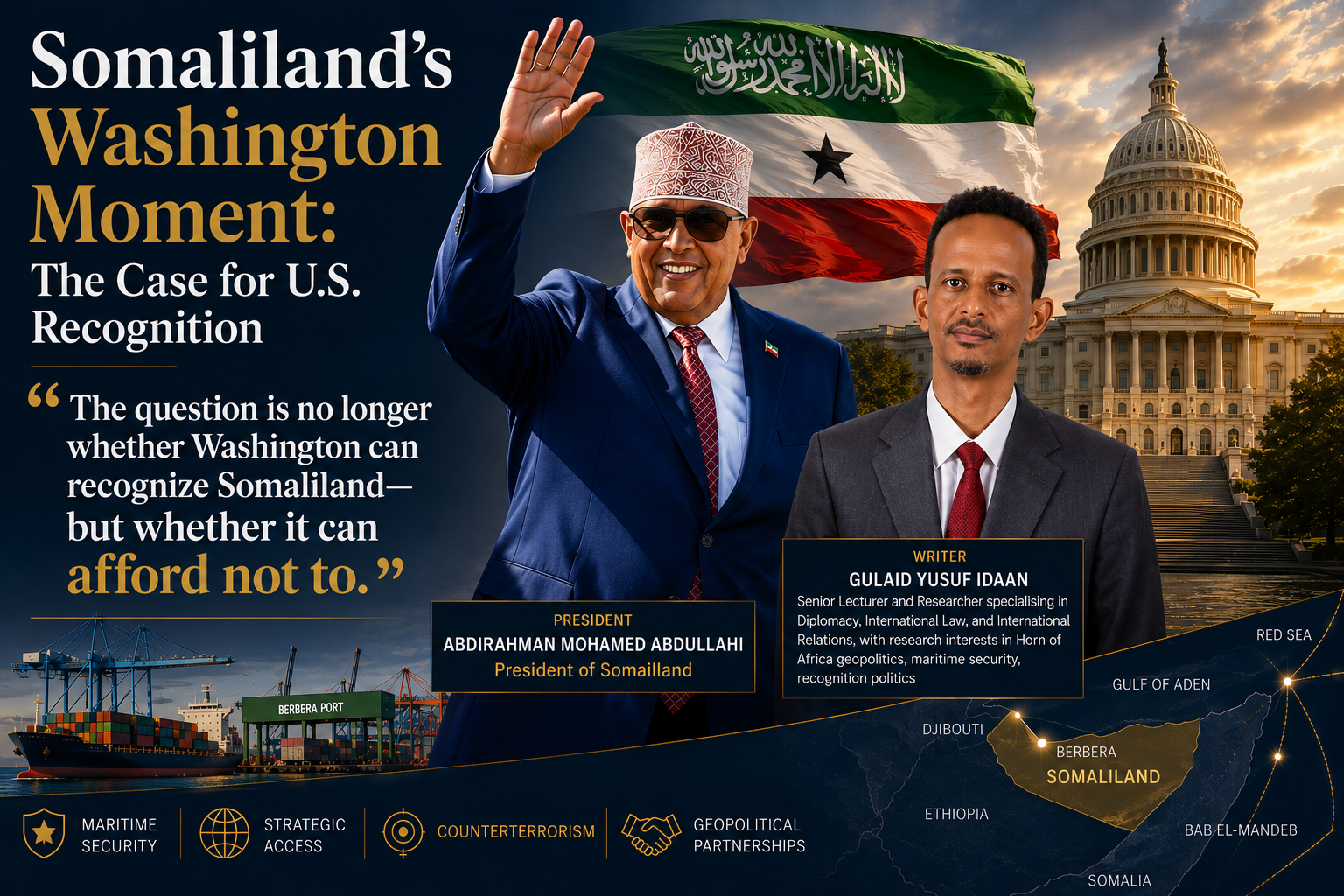
The question is no longer whether Washington can recognize Somaliland—but whether it can afford not to.”
Somaliland’s Washington Moment: The Case for U.S. Recognition
All eyes in Somaliland and the region are turning toward Washington as President Abdirahman Mohamed Abdullahi prepares to make the case for a historic shift in U.S. policy: formal recognition of Somaliland.
The timing of the visit is as important as the diplomatic objective itself. The strategic environment surrounding the Horn of Africa, the Gulf of Aden, and the Red Sea is changing faster than the diplomatic assumptions that have traditionally governed Washington’s policy toward Somaliland. What was once treated primarily as a question of Somali territorial politics is increasingly becoming a question of maritime security, strategic access, counterterrorism, geopolitical competition, and the credibility of American partnerships.
That transformation creates a different strategic calculation for Washington.
The central question is no longer simply whether Somaliland should be recognized. It is whether continuing to deny recognition is becoming more costly to American interests than changing course.
Somaliland has spent decades presenting itself as a functioning political entity seeking international recognition. Washington, meanwhile, has largely approached the issue through Somalia’s territorial-integrity framework. But the strategic geography of the region has not remained static. China has established a military foothold in Djibouti. Turkey has expanded its military relationship with Mogadishu, operating Camp TURKSOM. The United Arab Emirates has invested heavily in Berbera, with DP World developing the deep-water port and an associated economic zone. Israel has recognized Somaliland, with Prime Minister Netanyahu announcing the decision on December 26, 2025. Ethiopia has deepened its strategic interest in Somaliland’s maritime access. India, Greece, and Cyprus have also become increasingly relevant to the wider regional network.
The result is a strategic paradox: Somaliland is becoming more important to the regional order while remaining outside the formal U.S. diplomatic architecture.
A Diplomatic Campaign Arrives in Washington
President Abdullahi’s expected visit to Washington represents the latest stage in Somaliland’s diplomatic campaign, which has continued since 1991. But unlike previous efforts, this campaign is unfolding within a rapidly changing strategic environment in the Horn of Africa and the Red Sea.
For more than three decades, Somaliland has functioned as a de facto independent political entity, developing its own institutions, security forces, electoral system, currency, and administrative structures. It has conducted competitive elections and experienced peaceful transfers of political power while exercising effective control over much of the territory it claims. Yet Washington has continued to approach Somaliland primarily through the framework of Somalia’s territorial integrity. This has constrained direct American diplomatic engagement with Hargeisa and limited Somaliland’s integration into U.S. security and strategic planning.
That policy framework is becoming increasingly difficult to reconcile with the region’s strategic transformation.
External powers have expanded their presence across the Horn and the Gulf of Aden. China has established a military presence in Djibouti alongside major infrastructure investments; Turkey has developed a significant military footprint in Mogadishu through Camp TURKSOM; and the United Arab Emirates has invested heavily in port infrastructure, including Berbera. At the same time, Ethiopia, India, Israel, Greece, and Cyprus have developed increasingly consequential relationships with Somaliland and the wider region.
These developments have created a growing strategic paradox for Washington: Somaliland’s geopolitical importance is increasing even as its formal diplomatic relevance to the United States remains constrained.
The question for Washington, therefore, is no longer simply whether Somaliland should be recognized. The more immediate strategic question is whether the United States can afford to treat Somaliland as peripheral while other powers are steadily incorporating its geography, infrastructure, and political relationships into their own regional strategies.
That is precisely the opening President Abdullahi has an opportunity to address in Washington. Somaliland’s diplomatic argument should move beyond the familiar language of recognition and toward the language of strategic utility: its geography, stability, institutions, and infrastructure intersect with challenges that Washington already considers strategically important.
The objective is not to ask the United States to choose between Somaliland and Somalia in abstract diplomatic terms. It is to demonstrate that Somaliland has become a consequential strategic actor in a region where maritime security, great-power competition, counterterrorism, supply-chain resilience, and Red Sea stability are increasingly interconnected.
In this changing environment, the central argument is straightforward: Somaliland is no longer merely seeking a place within the international system; its strategic position is becoming increasingly difficult for that system to ignore.
The Geography of American Power
The strongest argument for a reassessment of U.S. policy is geography.
Approximately 12 percent of global trade passes through the Bab el-Mandeb, the narrow maritime chokepoint connecting the Red Sea to the Gulf of Aden. Energy shipments, commercial shipping, and strategic maritime traffic all depend upon this corridor.
The waterway is consequently one of the world’s most consequential and heavily contested maritime spaces. The United States, China, France, Japan, Turkey, and the United Arab Emirates maintain varying forms of military, logistical, commercial, or maritime infrastructure across the wider region.
For Washington, the strategic problem is not simply protecting the Bab el-Mandeb. It is maintaining sufficient strategic flexibility to respond when the regional balance changes.
The United States currently relies heavily on Camp Lemonnier in Djibouti. That installation provides important capabilities, but geographic concentration also creates a structural vulnerability. Djibouti hosts military facilities belonging to several foreign powers, including China, while Beijing’s expanding presence introduces a long-term challenge to American freedom of maneuver.
China established its first overseas military base in Djibouti in 2017 and has subsequently expanded its strategic capabilities there. Chinese state-linked companies have also developed extensive interests in ports, logistics, and infrastructure across the region.
For American planners, the implication is straightforward: redundancy matters.
A regional strategy dependent upon a single principal U.S. installation is less resilient than one built around multiple access points, logistics nodes, maritime partnerships, and capable regional actors.
This is where Somaliland becomes strategically relevant.
Its approximately 840-kilometer coastline places it along the maritime approaches linking the Gulf of Aden with the Red Sea. Its proximity to the Bab el-Mandeb gives its geography strategic significance extending well beyond the immediate politics of Somalia.
More importantly, Somaliland offers Washington a potential additional strategic node in a region where access, maritime security, and logistical flexibility are becoming increasingly important. Its relative political stability and functioning institutions further distinguish it from many of the surrounding security environments.
The question for Washington, therefore, is not whether Somaliland occupies strategically important territory. It plainly does.
The more consequential question is whether the United States will incorporate that geography into its own long-term strategic planning—or allow competing powers to shape the strategic environment before Washington does.
In an era of intensifying competition across the Red Sea and the wider Indo-Pacific–Middle East–Africa corridor, geography is not simply a feature of Somaliland’s diplomatic case. It is an American strategic asset that Washington must decide whether to engage.
Berbera and the Logic of Strategic Access
if geography establishes Somaliland’s strategic relevance; Berbera provides its most tangible expression.
The deep-water port has been substantially developed through Emirati investment and management, while road infrastructure toward Ethiopia creates a physical connection between maritime access and the economic weight of the Ethiopian interior. Together, the port and the emerging Berbera Corridor connect the Gulf of Aden to one of Africa’s largest and most strategically important landlocked economies.
This combination matters because modern ports increasingly function as strategic systems rather than isolated commercial facilities. A port connected to roads, markets, security infrastructure, and regional supply chains can become a platform for economic influence, maritime surveillance, logistics, and geopolitical access.
Berbera is therefore potentially more important to Washington than simply another port on the African coast.
For the United States, its principal strategic value may lie in operational redundancy.
A formally engaged Somaliland could provide Washington with additional options for contingency logistics, maritime-security cooperation, port-security planning, humanitarian operations, and alternative access arrangements beyond its concentrated reliance on Djibouti. This would not necessarily mean establishing a permanent American military base. The more strategically useful objective could be developing access, interoperability, and logistical optionality.
That distinction matters.
In an increasingly contested Red Sea environment, strategic resilience depends not only on military strength but also on the availability of alternative routes, ports, logistics nodes, and reliable partners. Berbera potentially offers all four.
Its significance is further reinforced by the emergence of the Ethiopia-Somaliland corridor, which links maritime access to the Ethiopian hinterland. The corridor demonstrates that functional regional integration can develop even when formal political status remains unresolved. Trade, infrastructure, investment, and connectivity can therefore create strategic realities that move faster than diplomatic recognition.
For Washington, this creates a strategic choice.
It can continue treating Somaliland primarily as an unresolved territorial question within Somalia, thereby allowing its strategic geography to remain outside the core of American regional planning.
Or it can begin treating Berbera and Somaliland’s wider geography as components of the emerging Red Sea security architecture.
The second approach would not necessarily require Washington to abandon its broader relationship with Somalia or immediately resolve the question of recognition. It would instead allow the United States to build strategic optionality—developing relationships, access arrangements, maritime cooperation, and economic partnerships before a regional crisis makes those options urgently necessary.
In geopolitics, access becomes most valuable before it is needed.
For that reason, Berbera’s importance to Washington may ultimately lie not in what the port is today, but in what strategic options it could provide tomorrow.
Why the Trump Administration Matters
The Trump administration’s strategic outlook makes this moment particularly significant.
A policy centered on burden-sharing, strategic competition, transactional partnerships, and reducing unnecessary American vulnerabilities creates a different environment for evaluating Somaliland. Recognition need not be understood principally as an act of diplomatic charity.
It can be understood as a strategic investment.
Somaliland offers Washington several capabilities that align with American interests: geographic access, political stability, security cooperation, counterterrorism potential, and a regional partner capable of assuming greater responsibility for local security.
This matters because the United States increasingly faces a regional environment in which other actors are willing to move faster. Turkey has expanded its military relationship with Somalia; China has consolidated its position in Djibouti; the UAE has developed major commercial and logistical interests around Berbera; and Israel has deepened its relationship with Somaliland.
The danger for Washington is therefore not simply that other countries are engaging Somaliland. The deeper risk is that they may gradually construct a regional strategic architecture in which the United States becomes an observer rather than a central participant.
For an administration focused on competition and leverage, that would represent a significant lost opportunity.
Israel Has Changed the Diplomatic Equation
Israel’s recognition of Somaliland at the end of 2025 further altered the diplomatic environment surrounding the issue.
For decades, Somaliland’s recognition campaign operated within a framework in which major powers largely avoided taking the first step. Israel’s decision disrupted that pattern by demonstrating that recognition could be incorporated into a broader strategic relationship involving maritime security, regional connectivity, and the security architecture of the Red Sea and Gulf of Aden.
Israel’s move also creates a new strategic question for Washington. Rather than considering Somaliland recognition solely through the lens of Somalia’s territorial politics, the United States can now evaluate it within the wider network of relationships developing around the Red Sea and Gulf of Aden.
India, Israel, the UAE, Greece, Cyprus, Ethiopia, and Somaliland are increasingly connected through overlapping economic, maritime, security, and geopolitical interests.
If Washington remains outside this emerging network, it risks allowing regional arrangements with direct implications for American interests to develop without meaningful American participation.
The issue, therefore, is no longer simply whether Washington recognizes Somaliland. It is whether the United States intends to help shape the emerging regional order—or wait until that order has already been shaped by others.
Recognition as an American Strategic Investment
The congressional record demonstrates that the debate over Somaliland is not new in Washington. What has changed is the direction of the debate.
Over time, congressional engagement has moved from practical cooperation toward increasingly explicit consideration of recognition.
U.S. Congressional Acts and Bills on Somaliland
Five major legislative initiatives illustrate this evolution.
S.3861 (2022), introduced by Senator James Risch with bipartisan co-sponsorship from Chris Van Hollen, Mike Rounds, and Cory Booker, called for a feasibility study concerning a U.S. diplomatic presence in Hargeisa and expanded security and development cooperation. It passed the Senate Foreign Relations Committee but did not receive a floor vote.
H.R.7900 (2022), the FY2023 National Defense Authorization Act introduced by Adam Smith, included provisions concerning a possible U.S. diplomatic presence in Hargeisa, Somaliland’s counterterrorism role, and defense cooperation. The House approved the provisions, but they were removed during House-Senate conference negotiations.
H.R.7170 (2022), introduced by Scott Perry, went further by directly calling for U.S. recognition of Somaliland, diplomatic relations, and rejection of Somalia’s territorial claims. It expired without advancing beyond committee consideration.
H.R.10402 (2024), again introduced by Scott Perry and co-sponsored by Andrew Ogles, renewed the recognition proposal, authorizing the President to recognize Somaliland and establish diplomatic relations. It remained stalled in committee.
H.R.3992 (2025), introduced by Scott Perry with five Republican co-sponsors, renewed the call for formal recognition and diplomatic relations while emphasizing Somaliland’s strategic location near the Bab el-Mandeb, Gulf of Aden, and Red Sea.
Taken together, these initiatives reveal an important shift.
The debate has gradually moved from whether Washington should engage Somaliland pragmatically toward whether the United States should ultimately recognize Somaliland as a sovereign state.
That trajectory matters for President Abdullahi’s visit because his argument does not begin from zero. Congress has already connected Somaliland with diplomatic presence, counterterrorism, defense cooperation, strategic geography, and recognition.
The Cost of Doing Nothing
The cost of maintaining the status quo is increasingly visible.
The first risk is Chinese encirclement. China already maintains a military presence in Djibouti and has developed extensive infrastructure and port interests in the region. If Chinese economic or strategic engagement expands into Somaliland, Beijing could acquire additional leverage around the Bab el-Mandeb while strengthening its position on both sides of the maritime corridor.
The second is operational vulnerability. Continued dependence upon Camp Lemonnier leaves the United States heavily concentrated in one location. A broader regional network would provide greater resilience.
The third is alliance erosion.
If U.S.-aligned countries develop strategic relationships with Somaliland without Washington’s participation, American influence can become increasingly peripheral. Israel’s recognition and the growing interaction among India, Israel, the UAE, Greece, Cyprus, Ethiopia, and Somaliland demonstrate that regional actors are capable of constructing strategic relationships without waiting for Washington.
The fourth is security risk.
Somalia’s continuing struggle against Al-Shabaab means that Washington needs capable local partners able to control territory and share security responsibilities. A policy that prevents deeper engagement with Somaliland limits the range of partnerships available to the United States.
The problem is therefore not simply that Washington is failing to reward Somaliland.
It is that Washington may be imposing strategic costs upon itself.
From Recognition Policy to Regional Strategy
The congressional trajectory suggests that the United States does not necessarily need to jump immediately from diplomatic exclusion to full recognition.
A structured transition is possible.
Washington could begin by increasing diplomatic engagement with Hargeisa, establishing a formal liaison presence, incorporating Somaliland into Red Sea risk assessments, and expanding maritime-security and counterterrorism cooperation.
The next stage could involve greater cooperation over Berbera’s port security, infrastructure standards, logistics, and contingency planning.
Development assistance could also strengthen the governance and infrastructure systems that underpin long-term strategic cooperation while providing an alternative to excessive dependence on Chinese investment.
What Abdirahman Must Sell in Washington
President Abdullahi’s most important task in Washington is to change the language of the debate.
He should not present recognition exclusively as Somaliland’s historical entitlement, although history and law remain central to the case.
He should present recognition as an American strategic opportunity.
The argument should be simple: Somaliland can help the United States solve problems that Washington already knows it has.
It can provide strategic redundancy around the Red Sea.
It can become a partner in maritime security.
It can contribute to counterterrorism and regional stability.
It can provide an additional location for logistics and contingency planning.
It can strengthen American partnerships with India, Israel, the UAE, Ethiopia, Greece, and Cyprus.
And it can reduce the strategic space available for Chinese expansion.
The congressional record provides an important foundation for this argument. From S.3861 and H.R.7900‘s emphasis on diplomatic and security engagement to H.R.7170, H.R.10402, and H.R.3992‘s explicit recognition proposals, members of Congress have already articulated many of the components of a new U.S.-Somaliland relationship.
The presidential visit therefore offers an opportunity to connect these legislative initiatives into a broader strategic narrative.
The Decision Ahead
The United States faces a choice between diplomatic inertia and strategic adaptation.
But geography does not wait for diplomatic recognition.
The Bab el-Mandeb remains a critical artery of global commerce. China continues to expand its regional position. Turkey is strengthening its military footprint in Somalia. The UAE has established major commercial and logistical interests around Berbera. Israel has changed the diplomatic equation through recognition. Other regional actors are developing relationships with Somaliland that increasingly intersect with the emerging Red Sea order.
The United States can either remain tied to an increasingly restrictive policy framework or develop a strategy that reflects the region as it actually exists.
Congress has already begun that conversation.
The question now is whether the executive branch will act on it.
For President Cabdirahman, Washington is therefore more than a diplomatic destination. It is an opportunity to argue that Somaliland should no longer be viewed merely through the lens of Somalia’s unresolved territorial question.
It should be viewed through the lens of American strategic interests.
Recognition would provide Washington with a stable regional partner, a potential alternative logistical node, greater maritime flexibility, additional counterterrorism cooperation, and a means of strengthening the emerging network of states with interests in Red Sea security.
The alternative is continued strategic concentration, diminished flexibility, and the possibility that other powers will define the regional architecture without the United States.
The fundamental question is therefore no longer whether Washington can afford to recognize Somaliland.
It is whether the United States can afford not to.
Related Topics
Related Posts