The views expressed herein are solely mine.
New Interdiction Doctrine: War on Shadow Fleet
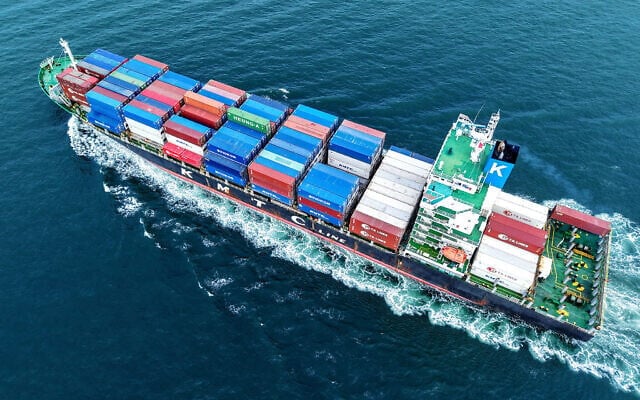
Illustrative: A cargo ship loaded with containers leaves the port in Qingdao, China, on July 8, 2025. (AFP)
The United States is no longer warning its adversaries. It is physically denying them resources.
In late 2025, Washington crossed a doctrinal threshold. Sanctions—long treated as financial abstractions—are now being enforced at sea, in real time. Ships are seized. Cargo is destroyed. Supply chains are disrupted mid-route.
Clearly, this marks a shift from deterrence-by-threat to deterrence-by-denial, aimed not at signaling displeasure but at preventing power from materializing.
For decades, sanctions relied on compliance and fear of future punishment. That model collapsed under adaptation.
Evidently, sanctioned states learned to reroute oil, launder ownership, spoof AIS signals, and exploit maritime insurance gaps. The result: an unaccountable rise of the shadow fleet.
By 2024, an estimated 15–20% of the global oil tanker fleet was operating in gray or illicit markets, moving sanctioned crude from Venezuela, Iran, and Russia. Enforcement became sporadic; evasion became routine. Time favored the sanctioned.
Accordingly, Washington has chosen to upend that dynamic.
Meanwhile, off Venezuela’s coast, U.S. authorities intercepted the tanker Skipper just as a federal warrant was nearing expiration. The vessel was carrying approximately 1.8 million barrels of Venezuelan crude—sufficient to generate more than $120 million at market value, even when sold at a discount.
For a regime whose survival depends overwhelmingly on hydrocarbons—oil accounts for more than 95% of Venezuela’s export earnings—this was not merely symbolic; it was structural.
In fact, it was the first U.S. seizure of Venezuelan oil cargo since 2019, and it targeted the Venezuela–Iran shadow oil ecosystem: shell companies, permissive flags, ship-to-ship transfers, and insurers gambling that interdiction would remain unlikely. Caracas called it piracy. Washington answered with silence.
Nevertheless, the real audience was the market. Once insurers, brokers, and charterers price in seizure risk, the entire shadow system becomes fragile and expensive.
Days earlier, the second pillar of the doctrine was revealed.
Far from Sri Lanka’s coast, U.S. special operations forces boarded a vessel transiting from China to Iran. The ship was carrying military-related components applicable to Iran’s conventional weapons programs—precisely the inputs Tehran requires to reconstitute capabilities degraded by sanctions, sabotage, and regional conflict. The cargo was seized and destroyed, while the vessel itself was permitted to continue on its route.
That restraint, however, was intentional. Rather than an exercise in escalation theater, the operation reflected a doctrine of precision interdiction, designed to punish capability rather than nationality. In doing so, it sought to deny rearmament pathways while deliberately avoiding the thresholds that trigger open conflict.
Consequently, Iran’s long-protected military regeneration—previously insulated by distance, deniability, and the ambiguities of dual-use trade—has become physically targetable under this emerging enforcement logic.
Taken together, these actions expose a coherent geopolitical logic.
In the new U.S.-led geopolitical framework, oil is not commerce; it is regime finance. Components are not trade goods; they are force multipliers. Logistics are not neutral; they are instruments of power.
Thus, by cutting revenue and reconstitution simultaneously, the United States is waging supply-chain warfare—a strategy historically reserved for major wars, now applied below the threshold of open conflict.
The signals are unmistakable.
Venezuela’s claims to sovereignty now terminate at the point where sanctions evasion begins. Iran’s rearmament pipelines are no longer insulated from disruption. China, in turn, is being put on notice that commercial distance will not confer immunity when its manufacturing base materially enables sanctioned adversaries.
This is not about blockades; it is about selective denial.
However, the risks are real. Interdiction invites retaliation—proxy harassment at sea, cyber operations against ports and insurers, diplomatic escalation.
But Washington appears to have concluded that passive sanctions were more dangerous. Shadow fleets expanded precisely because enforcement was predictable and rare.
Taken together, these actions were not isolated incidents; they were precedents.
The United States is no longer upholding the international order through paperwork alone.
Instead, it is enforcing it through warrants, boarding teams, and the physical destruction of cargo. This is not symbolic power but operational power—applied deliberately and with clear geopolitical intent.
The era of passive sanctions has ended. A “New Interdiction Doctrine” has emerged—and the shadow fleet now understands that it is being hunted.
Related Topics
Related Posts