No Balancing Act: Pakistan’s Defining Position
In moments of regional upheaval, ambiguity can be mistaken for strategy. But every so often, a state chooses clarity over calculated silence. That is what Pakistan has done. The recent messaging attributed to the Pakistan Armed Forces is not a balancing act dressed up as diplomacy—it is, instead, a deliberate articulation of where Pakistan stands and, just as importantly, where it will not stand.
For weeks, a familiar story has been making the rounds: that Pakistan is quietly trying to “balance” its relationships with both Iran and the Kingdom of Saudi Arabia (KSA). It’s a tempting narrative, one that fits neatly into the larger picture of geopolitical maneuvering and multi-alignment. But, as the official response indicates, this view is fundamentally off the mark. Pakistan isn’t adjusting its ties with Riyadh; it’s reinforcing them. The strategic partnership with Saudi Arabia isn’t just transactional or conditional——it is, by all indications, ironclad.
????⚠️ Is Pakistan trying to do a balancing act on the foreign front?
▪️Rumours of #Pakistan balancing its relations between #Iran and Kingdom of Saudi Arabia (KSA) are not near to reality.
▪️Pakistan was and is a strategic partner and this is ironclad.
▪️Pakistan is only playing…— Pakistan Armed Forces News ???????? (@PakistanFauj) March 25, 2026
This clarity matters, particularly at a time when the region risks sliding into a wider and more dangerous confrontation. The conflict involving Iran, Israel, and the United States is already volatile. Expanding its theatre—especially by drawing Saudi Arabia into direct confrontation—would not merely escalate tensions; it would fundamentally alter the nature of the conflict. What is currently a complex geopolitical struggle could quickly devolve into something far more perilous: a fracture within the Muslim world itself.
Pakistan’s clear message, through Pakistan Armed Forces’ X account, is rooted in both strategic calculation and historical experience. The idea of dragging Saudi Arabia into this conflict is described, quite pointedly, as “self-defeating” and even “conspiracy-oriented.” That language reflects a deeper concern—that external actors, and perhaps even internal miscalculations, could transform a contained crisis into a broader sectarian or intra-Muslim confrontation. For Pakistan, that is a red line.
There is also a moral dimension to this stance, one that resonates deeply within Pakistani society. Saudi Arabia is not just another regional country; it holds a unique place in the hearts of millions of Pakistanis as the custodian of Islam’s two holiest sites. Any attempt to turn it into a battlefield is not merely a geopolitical misstep—it is an emotional and ideological rupture. This is why the question posed by Pakistani officials carries such weight: why force a war upon a country that has, despite sustained provocations, refrained from deploying its full military capabilities?
Field Marshal Syed Asim Munir, NI (M), HJ, #COAS & CDF of #Pakistan
“Allah (SWT) chose Saudis as the custodians of the Two Holy Mosques, and Pakistan as the Protector of the Two Holy Mosques.”
Al Haramain Al Sharifain
Allāhu ʾAkbar — الله أكبر#EidMubarak #AsimMunir #ISPR pic.twitter.com/Mcu8Gh0Omh
— Pakistan Armed Forces News ???????? (@PakistanFauj) March 21, 2026
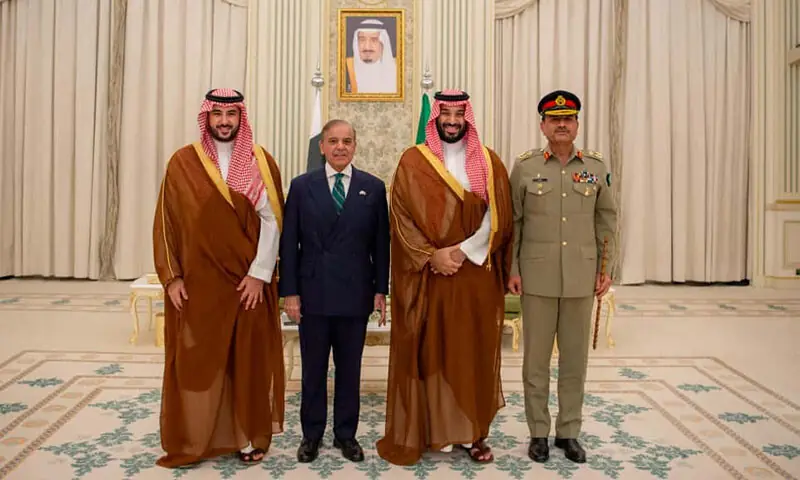
At the diplomatic level, Pakistan’s position has been reinforced through direct engagement. Prime Minister Shehbaz Sharif’s conversation with Crown Prince Mohammed bin Salman was not a routine exchange of pleasantries. It was a reaffirmation of solidarity at a time when words carry strategic consequences. By condemning attacks on Saudi Arabia and reiterating unequivocal support, Islamabad has signaled that its partnership with Riyadh is not open to reinterpretation.
Pakistan’s Prime Minister Shehbaz Sharif says he spoke with Saudi Crown Prince Mohammed bin Salman, condemning recent attacks on the Kingdom and reaffirming full support. He adds he briefed him on diplomatic efforts for regional stability and called for de-escalation.
Read more:… pic.twitter.com/C4ZGgEyl8B
— Al Arabiya English (@AlArabiya_Eng) March 25, 2026
Earlier, Pakistan’s Deputy Prime Minister and Foreign Minister, Ishaq Dar, confirmed that he personally informed Iranian leadership, specifically Foreign Minister Abbas Araghchi, that Pakistan has a binding strategic mutual defense agreement with Saudi Arabia
Nuclear Pakistan reminds Iran of defense agreement with Saudi Arabia
Pakistani Foreign Minister Ishaq Dar said on Tuesday that he reminded Iranian officials about Islamabad's defense treaty with Saudi Arabia. https://t.co/gLgglUdVlQ
— AL-Monitor (@AlMonitor) March 3, 2026
Recent developments show that the collective condemnation from Gulf states and their allies highlights a growing agreement: violations of sovereignty, whether they happen directly or through proxies, simply can’t be accepted. When they refer to international law and UN Security Council resolutions, it’s not just diplomatic talk—it’s a way to frame the crisis in a manner that discourages any further escalation.
#Statement | The Kingdom of Saudi Arabia, the State of Qatar, the State of Kuwait, the United Arab Emirates, the Kingdom of Bahrain, and the Hashemite Kingdom of Jordan renew their condemnation in the strongest terms of the blatant Iranian attacks, which constitute a flagrant… pic.twitter.com/ZqsU2cPEeu
— Foreign Ministry ???????? (@KSAmofaEN) March 25, 2026
At the same time, the regional mood is shifting in ways that are difficult to ignore. Iran today finds itself increasingly isolated—arguably more than at any point in its recent history—as a broad spectrum of Muslim countries openly condemns its actions. What was once a complex web of influence is beginning to fray under the weight of its own consequences. Nowhere is this more evident than in Lebanon, where the government has taken the extraordinary step of declaring Iran’s ambassador persona non grata and ordering his departure.
It marks a sharp break from years in which Tehran, largely through the IRGC and its proxy Hezbollah, exercised outsized influence, often at the expense of Lebanon’s sovereignty. The cost of that arrangement has been severe: a state weakened from within, drawn into cycles of confrontation, and left to bear the repercussions of decisions not entirely its own.
Lebanon declares Iran’s ambassador persona non grata and orders his departure within days—extraordinary break in a relationship long shaped by Iran’s influence inside Lebanon. https://t.co/KA4ftVw5Ox
— Brett McGurk (@brett_mcgurk) March 24, 2026
This action taken by Beirut indicates something deeper than a mere diplomatic disagreement—it suggests a realignment. Lebanese political leaders, including MP and prime ministerial candidate Fouad Makhzoumi, have not only welcomed the expulsion but called for a broader reset: a legal pathway to sever ties with Tehran, the restoration of full state authority, and even the demilitarization of the capital.
بعد قرار مجلس الوزراء اعتبار السفير الإيراني شخصًا غير مرغوب فيه، لم يعد الأمر سياسيًا بل سياديًا وقانونيًا.
على الحكومة، في حال عدم الامتثال للمغادرة، اتخاذ الخطوات التالية وفق الأصول الدبلوماسية:
1.إبلاغ رسمي ونهائي عبر وزارة الخارجية بمهلة محددة للمغادرة
2.سحب الاعتراف…— Fouad Makhzoumi (@fmakhzoumi) March 25, 2026
The sharpening regional tone is also reflected in unusually direct messaging from Gulf capitals. In a pointed remark, UAE Minister of State for International Cooperation Reem Al-Hashimy made it clear that coercion has no place in regional conduct, stating bluntly that “you can’t bully your neighbours.” Her warning that no country should be allowed to hold the Strait of Hormuz “hostage” underscores a broader consensus taking shape: strategic waterways and regional stability cannot be leveraged as tools of pressure.
????️ "You can't bully your neighbours."
UAE minister of state for international cooperation Reem Al-Hashimy tells @SkyYaldaHakim no country should hold the Strait of Hormuz "hostage".
Much of the world's oil supply flows through the narrow waterway. pic.twitter.com/sVZHbRHNBl
— Sky News (@SkyNews) March 25, 2026
For Pakistan, and indeed for the wider Muslim world, the lesson is clear. When state sovereignty is compromised by external entanglements, the eventual correction is often abrupt and costly. The question now is whether others will draw the same conclusions before reaching a similar breaking point.
In the present context, Pakistan’s stance comes down to a principle it has chosen to articulate plainly: stand by what is right and just. In a geopolitical environment often defined by careful ambiguity, that kind of clarity is rare. It may not resolve the crisis on its own, but it does set a marker—one that signals where Pakistan stands as the region navigates an increasingly uncertain path.
There is, in this position, both realism and restraint. Pakistan is not claiming to reshape the conflict, nor is it pretending to be a neutral bystander. Instead, it is asserting that some lines should not be crossed and some relationships are not up for reinterpretation.