
Eyes everywhere
No point in downplaying the role of Qatar as reality hits hard
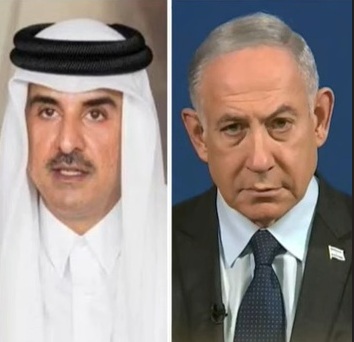
Qatari emir Tamim bin Hamad bin Khalifa Al Thani and Israeli PM Benjamin Netanyahu (YouTube; used in accordance with Clause 27a of the Copyright Law)
On April 2, 2025, Israeli PM Benjamin Netanyahu said in a video statement that Qatar is not listed as an enemy state, adding that “it’s a complex country, not a simple country”, and that “many praise it”.
Statements that have raised many doubts among those who deal with terrorism and know the Middle Eastern dynamics quite well. For decades Qatar has been funding and providing support to Islamist groups in Syria, Afghanistan, Chechnya, Gaza, Yemen and Lebanon.
In July 2020, a private contractor working for the German security services revealed to the German weekly Die Zeit that Doha was financing Hezbollah. The contractor reportedly stumbled upon an alleged arms deal run by a company in Qatar that was directed at the Shia terror group.
As to Hamas, since 2007, Qatar has pumped about $1.8 billion into Gaza, and in 2021, Doha pledged $360 million in annual support to the Strip, as reported by the Foundation for Defense of Democracies. Funds that helped subsidize Hamas’s force buildup ahead of the October 7 massacre, as recently concluded by a Shin Bet investigation and highlighted by FDD researcher Natalie Ecanow:
“The Shin Bet identified “the flow of money from Qatar to Gaza and its delivery to Hamas’s military wing” as one key reason why Hamas was able to build up its offensive power. In its rebuttal, Doha insisted that “no aid has ever been delivered to Hamas’s political or military wing.”
By supporting Hamas, Qatar has sought to consolidate its hegemony in the Arab-Islamic world where the Palestinian terrorist organization is seen as a “resistance movement,” helping it achieve political and media legitimacy, also through the television channel al-Jazeera, which was banned last year by Israel.
As reported on April 25 by the Times of Israel , “Prime Minister Benjamin Netanyahu was warned at least twice before the October 7, 2023 massacre that Hamas’s military chief, Muhammad Deif, was appropriating funds provided by Qatar to Gaza with the premier’s approval”. Moreover, “according to near-identical reports by Channel 12 and the Kan public broadcaster, Netanyahu was warned in 2019 by then-Shin Bet chief Nadav Argaman, and again in 2020 by the IDF’s Military Intelligence Directorate.”
Paradoxically, Qatar is not listed as an “enemy state” by Israel, and continues to play the role of the main mediator between Israel and Hamas, despite its support for the Palestinian terrorist group and with much praise from the White House special envoy John Witkoff and US President Donald Trump, to whom Qatar also generously gifted a luxury jet to be used as presidential plane and estimated to be worth around $400 million. Trump thanked Qatar and defined the move “a great gesture”.
However, in the meantime, journalists in Qatar continue to express support for Hamas and speak against the terror group’s disarmament. For instance, Jabar Al-Harmi, editor of the Al-Sharq government daily, called on Hamas not to give up its weapons and not to disavow its October 7, 2023 attack on Israel, because “what was taken by force will be restored only by force.” This individual also called for the destruction of Israel and expressed support for Hamas on his X account and in his articles, as reported by MEMRI.
In April 2024, during an Arab League session, Essa Al-Nassr, a member of the Qatari legislative Shura council, accused Israelis of “lying” and being “killers of the prophets”; the latter is a notorious antisemitic accusation found in Islamic sources and widely used by Islamist preachers worldwide.
After all of this, how is it still possible for Netanyahu not to consider Qatar an enemy and a terror-supporting state? What else should Doha do to earn this status and join its neighbor, Iran?
Furthermore, let’s keep in mind that, by doing so, Netanyahu also puts in a difficult position all those politicians, decision-makers, law enforcers, academics, reporters and activists who, for years, have been trying to counter the infiltration in the West of the Muslim Brotherhood, Doha’s main hegemonic instrument, as exposed in the book “Qatar Papers”, by French investigative journalists Christiane Chesnot and Georges Malbrunot.
The Islamist movement is in fact widely infiltrated on multiple levels: economic, political, academic, and institutional, to the point that the French government recently published a report highlighting the serious dangers of such infiltration, both at the local level and in terms of attempts to influence decision-makers regarding foreign policy. Among the objectives, there are not only the Islamization of France (and therefore Europe) and the subversion of the values on which it is founded, but also pushing leaders to take positions against Israel.
On May 29, at the fourth CPAC conference in Budapest, the Israeli Minister of Diaspora Affairs and Combating Antisemitism, Amichai Chikli, cited the French report and denounced Qatar’s central role in supporting the activity of the Muslim Brotherhood to bring Islamization to Europe.
We can all agree that Israel is the frontline of the war against Islamism and that “if Israel falls, Europe will too”, but consistency is needed. It’s simply unthinkable to aim at waging war on Islamism while in the meantime looking the other way when it comes to Qatar. It is a mechanism similar to fighting Hamas on the battlefield while supplying it with “humanitarian aid” at the same time, and negotiating continuous truces that allow it to regain oxygen which is what Qatar wants, by the way, with the hope to see its creature, Hamas, survive and maintain the control of Gaza.
Related Topics
Related Posts