
A comedic survival guide to a country that breaks you, rebuilds you, and calls it Tuesday.
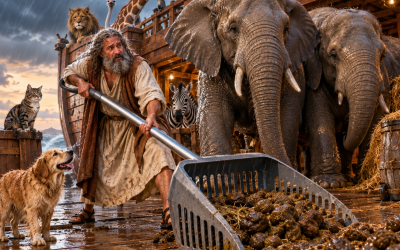
Noach: Forty days of rain, eight human beings and not one bloody pooper scooper
Parashat Noach | 17 October 2026 | Genesis 6:9–11:32
I have some questions for G-D. Nothing impertinent, naturally, merely a few concerns about His original business plan, the spectacular absence of quality control, and the somewhat disproportionate disciplinary measures employed when humanity failed its first performance appraisal. Last week, in Bereishit, G-D created a magnificent universe. Light, oceans, mountains, vegetation, an astonishing variety of animals and, eventually, human beings. It was all going swimmingly until the humans arrived, at which point the entire enterprise began to resemble a poorly managed residential complex with a deeply inadequate body corporate. By this week’s parashah, G-D has decided to flood the place. Personally, I might have started with eviction notices.
I have always maintained that G-D’s finest work was the animal kingdom. Consider the elegance of a horse, the loyalty of a dog, the magnificent indifference of a cat, and the extraordinary engineering involved in a giraffe. Now consider humanity, a species that has invented both open-heart surgery and Love Is Blind. I rest my case. Animals may occasionally eat the furniture, defecate in inconvenient places, and display questionable personal hygiene, but they have never formed a coalition government, invented telemarketing, or subjected me to a motivational podcast.
As somebody who earns part of her living walking dogs, babysitting other people’s fur babies, and moving into their homes while their actual parents abandon them for holidays, I have a professional interest in Noach. I regard him as the founding father of my industry, although his business model was catastrophically flawed. No deposit, no agreed daily rate, no written cancellation policy, and a client who provided an extraordinarily detailed list of requirements but neglected to mention that the entire world would be unavailable for emergency assistance. I charge for additional animals. Noach accepted the complete inventory of terrestrial life. This is what happens when you fail to establish boundaries at the quotation stage.
The Torah describes him as righteous and blameless in his generation, which sounds impressive until Rashi introduces the inevitable Jewish complication. Was Noach genuinely exceptional, or merely the least appalling person in an exceptionally appalling generation? The commentators disagree. Imagine receiving a personal endorsement from the Almighty, surviving the destruction of civilization and then having your character assessed by a committee of rabbis who cannot decide whether you were a saint or simply fortunate in your choice of contemporaries. I suspect Noach would have preferred another forty days of rain.
Nevertheless, G-D appoints him to construct an ark measuring three hundred cubits by fifty by thirty, with compartments, waterproofing and enough provisions to sustain an entire floating menagerie. I have some experience with clients who provide detailed instructions for their pets. There are feeding schedules, preferred walking routes, medication charts, sleeping arrangements, and occasional warnings that the dog becomes emotionally distressed if his supper is served in the wrong bowl. Yet even my most conscientious clients have never instructed me to construct a three-storey vessel from gopher wood and prepare for the annihilation of civilization.
And then there is the passenger list. We all know the children’s version: two of every animal, proceeding obediently up the gangplank while Noach smiles benevolently from the doorway. The Torah is somewhat less accommodating. Seven pairs of each clean animal, a pair of each unclean animal, birds and provisions. Who prepared the lions’ dinner? How did the carnivores coexist with their natural food supply? And who, precisely, was responsible for collecting the droppings? There are practical aspects of biblical survival that receive scandalously little attention in the average Torah discussion.
My own three cats, Purrcy, Petunia and Sammi, would have brought the entire operation to a halt before the first raindrop. Purrcy would have demanded seniority privileges, Petunia would have required an individually negotiated catering arrangement, and Sammi would have spent the voyage investigating which structural components could be dismantled without immediate detection. Anyone who believes animals naturally cooperate has clearly never attempted to administer medication to a cat that has decided the relationship is over.
But there is something about the animals in this story that moves me far more deeply than the familiar rainbow imagery. The Torah describes a world filled with violence and corruption, yet the animals are caught in the catastrophe too. Genesis 6:12 speaks of all flesh corrupting its way, a phrase the commentators explore in different ways, but the narrative’s emphasis on human wickedness remains impossible to ignore. Creatures that cannot argue their case, negotiate for their survival, or explain their innocence are swept up in the consequences of a world gone wrong.
Perhaps that is why I take my work with animals so seriously, despite the fact that much of it involves walking around carrying little plastic bags of excrement. There is an extraordinary trust involved when somebody hands over the care of a creature they love. A dog cannot telephone its owner to complain that the substitute human has forgotten supper. A cat cannot lodge a formal grievance because its medication was administered late, although it can communicate its displeasure through methods that would impress an experienced interrogator. Their welfare depends upon whoever has accepted responsibility for them. It is not glamorous work, but there is something deeply satisfying about being trusted with a life that cannot advocate for itself.
What troubles me about Noach is his apparent silence regarding the humans outside the ark. The Torah records his obedience, construction, and survival, but not an explicit plea to the people about to perish. Later, Avraham will argue with G-D over Sodom, and Moshe will repeatedly intercede for a nation whose principal recreational activity appears to be driving him towards a nervous breakdown. Noach builds. Rabbinic tradition suggests he warned his contemporaries, so it would be unfair to conclude that he was indifferent. Nevertheless, the contrast raises an uncomfortable question: can we be scrupulously responsible for those entrusted to us while remaining detached from the suffering of everybody else?
I have sometimes found animals easier to love than people. Animals are generally honest about their intentions. A dog wants affection, food, exercise, or access to something revolting on the pavement. A cat wants whatever you are currently refusing to provide, preferably accompanied by an acknowledgement of your inferiority. Human beings can spend three months assuring you that everything is perfectly fine while quietly assembling a comprehensive prosecution case against your character. I know which species I would rather negotiate with. Unfortunately, Judaism refuses to let me substitute affection for animals for responsibility towards humanity. This is profoundly inconvenient.
Eventually the Flood begins. Forty days and forty nights of rain, followed by months before the earth becomes habitable again. The familiar children’s illustrations scarcely convey the horror of the narrative. This is not a charming adventure involving an unusually ambitious petting zoo. It is the destruction of almost all terrestrial life, and the magnitude of that loss deserves to be taken seriously.
When the waters recede, Noach sends out a raven and then a dove. Eventually the dove returns with an olive leaf, providing evidence that the earth is recovering. I have always admired that dove. She completes her assignment without demanding overtime, losing the documentation or becoming distracted by an argument on social media. Had Noach sent out a hadeda, I suspect the mission would have been accompanied by sufficient noise to convince the surviving population that a second catastrophe was imminent.
G-D then establishes His covenant, promising never again to destroy all flesh by a flood. And here is a detail I particularly love: the covenant explicitly includes the animals. Not merely Noach and his descendants, but every living creature with them. The rainbow is a sign of G-D’s covenant with all flesh, not an exclusive benefit of human membership. Considering humanity’s conduct thus far, I find it rather generous that we have been included at all.
The theological tension is delicious. Before the Flood, human wickedness helps explain the catastrophe. Afterwards, G-D acknowledges humanity’s continuing inclination towards evil and promises not to repeat this particular destruction. We have not become better. Nobody has emerged from the ark clutching a certificate of moral rehabilitation. Human nature remains recognizably defective, but G-D’s declared response has changed.
Noach’s own post-Flood behavior rather confirms the assessment. He plants a vineyard, makes wine, gets drunk and ends up naked in his tent. Having successfully preserved terrestrial life, he apparently decides to celebrate by creating the world’s first recorded incident of regrettable alcohol-related family drama. I am not entirely unsympathetic. After months trapped on a boat with eight humans and an enormous collection of animals, the prospect of a decent glass of wine must have been almost irresistible. Nevertheless, one might have hoped for a slightly more dignified conclusion to the greatest animal-rescue operation in history.
And humanity, demonstrating its commitment to learning absolutely nothing, proceeds to construct the Tower of Babel. A common language, a grandiose building project, and the determination to make a name for themselves. The people have barely survived the destruction of civilization and are already launching a major property development. G-D confuses their language and scatters them. The Torah does not explicitly identify their precise offense, and commentators offer different explanations, but the spectacle of humanity organizing itself around an enormous monument to its own ambition is depressingly familiar.
Which brings me to the exquisite irony of this particular Shabbat. On 17 October, Jews in Johannesburg and Israel will read the same account of the Flood. Then, as Shabbat ends and 7 Cheshvan begins, Jews in Israel start asking G-D for rain by adding V’ten tal u’matar livrachah to the Amidah. We have barely finished reading about the catastrophic consequences of excessive precipitation and are already requesting more. It is the religious equivalent of surviving a shipwreck and immediately booking a cruise.
The timing is magnificent. The Mishnah, Ta’anit 1:3, records Rabban Gamliel’s ruling that the request for rain should be delayed until fifteen days after Sukkot, allowing the last pilgrim returning from Jerusalem to reach the Euphrates. The country needs rain. Farmers depend upon it. But somewhere, far from Jerusalem, one Jew may still be walking home, and rain would make the journey more difficult. So the community waits.
I find this particularly moving because it reflects the very principle that governs responsible animal care: the needs of someone dependent upon us do not cease to matter simply because attending to them is inconvenient. When I agree to care for somebody’s pets, their routine becomes my responsibility. I cannot decide that the dog no longer needs a walk because I am tired, or that a cat’s medication can wait because I have found something more entertaining to do. Their needs exist independently of my preferences.
The traveller in the Mishnah is similarly absent from the community’s immediate concerns. Nobody may know his name or whether he is an agreeable traveling companion. He may be a complete nuisance. Nevertheless, his welfare is taken into account. The community delays its request for something beneficial because the timing of that blessing could impose hardship upon somebody else. It is a remarkably sophisticated ethical principle, particularly for a civilization that had not yet invented the automated customer service department, which appears to have been designed specifically to eliminate such considerations.
There is an additional geographical wrinkle. Israel begins requesting rain on 7 Cheshvan, while Jews in Johannesburg and elsewhere in the Diaspora follow a different seasonal calculation, beginning in early December under the contemporary Gregorian calendar. Thus, two Jewish communities read precisely the same parashah, acknowledge the same covenant, and operate according to different meteorological timetables. We have survived exile, persecution and theological disputes, yet apparently still require separate arrangements for precipitation.
And perhaps that is what makes Noach so relevant to the world we inhabit. The parashah begins with a civilization in which violence and corruption have become intolerable. It proceeds through a catastrophe in which the vulnerable suffer alongside the guilty, and ends with humanity once again displaying an extraordinary capacity for collective foolishness. Yet embedded in the aftermath is a covenant that includes every living creature, a recognition that life deserves preservation despite imperfection.
I cannot pretend to have an uncomplicated relationship with humanity. I love people, sometimes fiercely, but I also find them exhausting, unreasonable and occasionally so spectacularly stupid that I question whether evolution has been adequately supervised. Animals, by comparison, are refreshingly straightforward. They may require feeding, walking, cleaning, medication and reassurance, but they rarely demand that I admire their political opinions or listen to a lengthy explanation of why their behavior was technically justified.
Still, somebody has to open the tins, operate the leads, administer the medication and appreciate the extraordinary privilege of being loved by a creature that has no interest in our bank balance, professional achievements or social standing. Animals remind me daily that responsibility is not a philosophical abstraction. It is the dog waiting patiently by the door, the elderly animal needing help, the frightened rescue learning to trust, and the cat who will not eat until somebody has provided the precise meal it has decided is acceptable that afternoon.
The Midrash describes Noach and his sons laboring to feed the animals according to their needs, an image considerably less picturesque than the nursery-school illustrations but infinitely more meaningful. There is holiness in that kind of work, even when it involves scrubbing floors, preparing meals and dealing with bodily functions that no respectable religious painting would dare depict.
So this Shabbat, while humanity continues its determined campaign to exhaust the patience of its Creator, I shall be thinking about Noach as the world’s first professional pet sitter. A man who accepted the most demanding assignment imaginable, worked under appalling conditions, received no remuneration and was subsequently criticized by commentators for several thousand years. I suddenly feel considerably better about my own employment arrangements.
And when Israel begins asking G-D for rain on Saturday night, I shall remember the last pilgrim still making his way home, the animals entrusted to Noach’s care and the extraordinary Jewish insistence that even a blessing must take account of those who might suffer from its arrival.
Should G-D decide to reconsider the Flood, I would appreciate advance notice. I have three cats to pack, several clients whose pets will require alternative arrangements, and a business policy that clearly states a fifty per cent deposit is payable before commencement of services. Divine intervention notwithstanding, I am not making Noach’s mistake of accepting an open-ended assignment without discussing the terms.
And if anybody expects me to accommodate two elephants, seven pairs of sheep and a family of rhinoceroses at my usual daily rate, they can take it up directly with the Almighty.
Shabbat shalom.
Related Topics
Related Posts