I believe in independent, clear, and courageous journalism – especially where injustice is being silenced
Not Just Freedom: The Fight to Save Iran – Inside Iran’s Nationwide Resistance
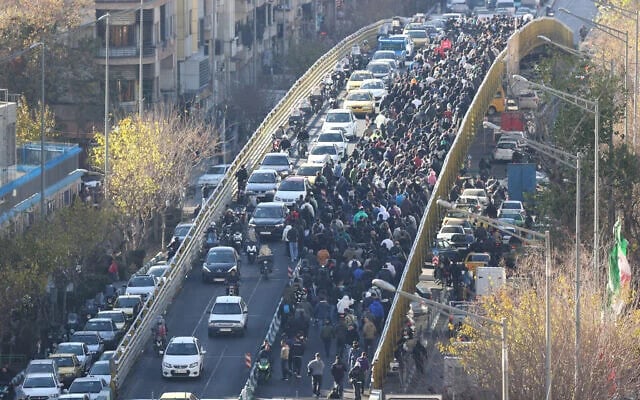
Shopkeepers and traders walk over a bridge during a protest against the economic conditions and Iran’s embattled currency in Tehran on December 29, 2025. (Handout/Fars News Agency/AFP)
In the heart of Iran, a profound transformation is unfolding. What began as a localized cry for justice has evolved into an existential battle for the soul of a nation. For the protesters on the ground, the risks are immeasurable, but as one activist – speaking anonymously for security reasons – puts it, the cost of staying silent is now far greater than the cost of resistance.
The death of Mahsa Amini was more than a singular tragedy; it was the moment an entire society realized that “this could happen to anyone.” For our respondent, this realization stripped away the paralyzing fear that had gripped the country for decades.
“The death of Mahsa Amini was a breaking point,” the protester says. “It was not a single incident, but the realization that this could happen to anyone. Silence began to feel like complicity.”
“Before, life was about survival and adaptation,” the protester explains. “Now, it is about dignity. Even with the fear, there is more meaning in our lives than ever before.”
This shift marks a point of no return: the understanding that living quietly under injustice is, in itself, a form of slow death.
“I understood that living quietly under injustice is also a form of loss. I became more aware, more responsible, and more connected to others.”
A Struggle for the Nation’s Existence
The current movement has transcended individual demands for personal freedoms. It is now a desperate attempt to save Iran from total collapse. According to the activist, the protesters are fighting to prevent further isolation and destruction. Without fundamental change, many believe Iran will cease to be a “livable homeland.”
“People are demanding the saving of Iran itself — its people, its future, and its dignity. This is no longer only about personal rights, but about preventing the country from further collapse, isolation, and destruction. Many believe that without fundamental change, Iran as a livable homeland is at risk.”
The interview paints a picture of a regime that has lost its right to rule. It no longer governs by consent, but through a calculated machinery of arrests, intimidation, and both physical and psychological violence.
“The regime rules through fear, not consent. But for many, fear has already been exhausted. When life offers no dignity, no future, and no security, violence loses its power as a deterrent.”
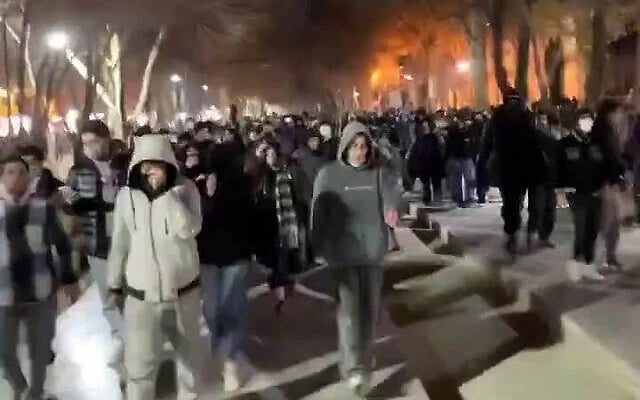
This loss of legitimacy has led to a singular, clear demand: Regime Change. There is a growing consensus among those on the streets that the current system is beyond reform. Increasingly, the return of Reza Pahlavi is being discussed as a unifying symbol for a democratic transition.
“This movement is about regime change,” the protester says. “There is a growing belief that the existing system cannot be fixed and must be replaced entirely.”
Israel, the Regime, and a Clear Distinction
Addressing regional narratives, the protester draws a clear line between the Iranian people and the Islamic Republic’s foreign policy.
“Israel is not the problem for Iran – the regime is,” the interviewee says. “Many Iranians respect Israel for standing firmly against the Islamic Republic, while clearly distinguishing between the regime and the people of Iran.”
The Face of the Movement: Women and Youth
At the core of this uprising are the women of Iran, leading the charge both morally and symbolically. Alongside them is a youth generation that refuses to inherit a broken future. Interestingly, the respondent notes that the cracks are beginning to show within the system itself-hesitation and fear are becoming visible even among those tasked with enforcing the regime’s will.
The Iranian people’s perspective on global affairs is often misrepresented. They look for a world that distinguishes between the Iranian people and the Islamic Republic.
However, the international response remains a source of frustration. Symbolic words, while appreciated, are no longer enough. The movement calls for:
• Consistent pressure on the regime.
• Real accountability for human rights abuses.
• Prioritizing values over short-term political or economic interests.
When asked what scares them most, the answer was not prison or violence.
“Our greatest fear is not repression—it is being forgotten,” the activist concludes.
“What happens in Iran is not just our struggle; it is a test of global values. We need help. Don’t look away.
Related Topics
Related Posts