
Lawyer & Law Professor
Not yet war, but peace ended a long time ago
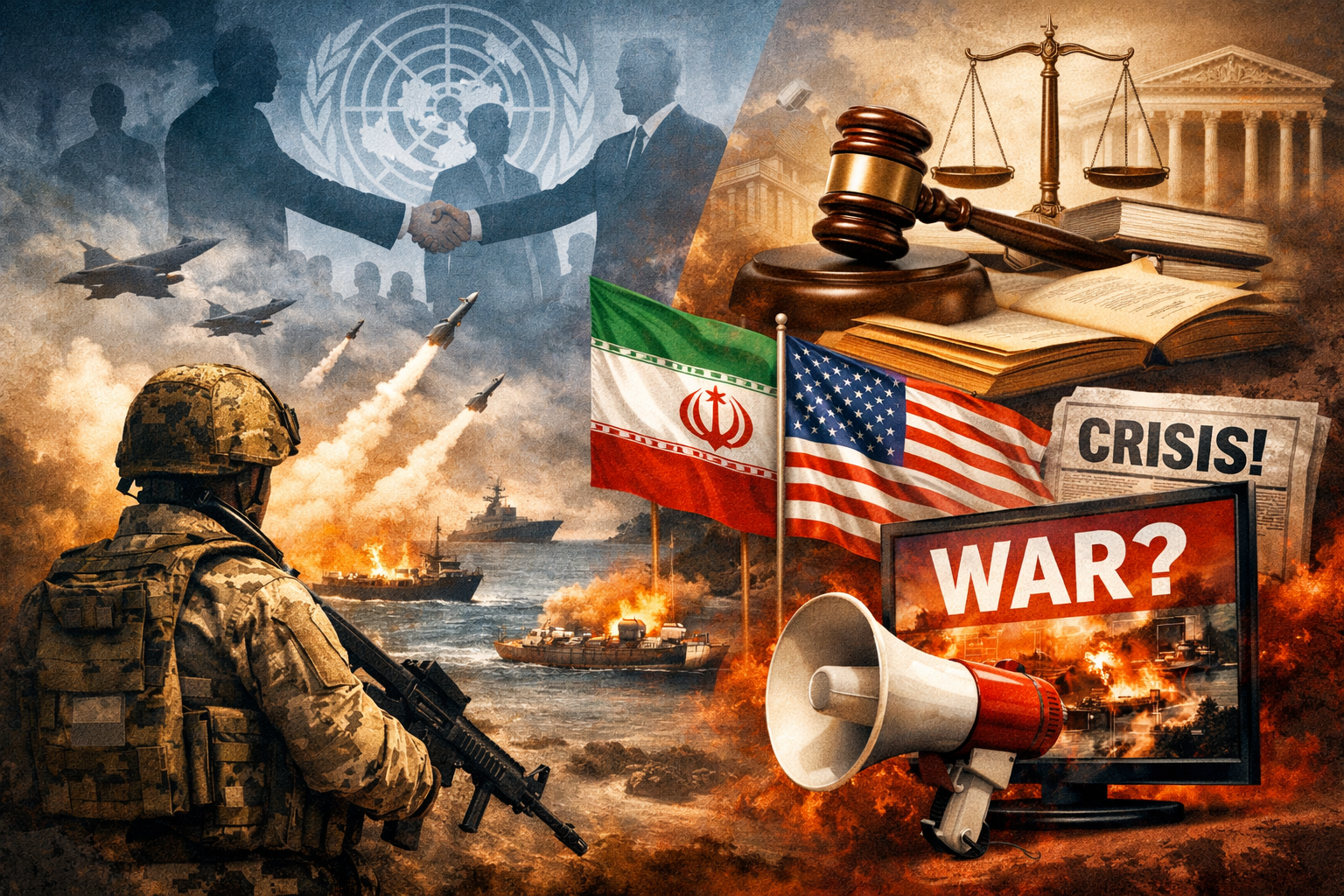
Image Created by ChatGPT with DALL-E, 2026.
In high-intensity international conflicts, crises rarely begin with a formal announcement or an unequivocal declaration of war. They begin, instead, with a sequence of seemingly disconnected events that, once placed in context, reveal a common logic. The central thesis to keep in mind is simple, if unsettling: escalation is not triggered by a single gesture or an isolated mistake; it occurs when different planes of power begin to align. The greatest risk for the public is not the threat itself, but misreading that process. Diplomatic moves, public statements, legal decisions, and military deployments stop operating as separate compartments and start to overlap until a recognizable pattern emerges. Understanding that pattern requires method, because confusing signals with faits accomplis leads either to groundless panic or to irresponsible denial.
In recent days, several developments have once again placed Iran at the center of the geopolitical chessboard. International outlets have reported that the United States is evaluating scenarios for sharper pressure on Tehran, including military courses of action, against a backdrop of diplomatic stalemate and the persistence of Iran’s nuclear program. At the same time, Russia has publicly rejected the use of force and insisted on prioritizing negotiation, a posture driven not by abstract moral considerations, but by the calculus of an actor that perceives escalation risk as real and potentially destabilizing.
Added to this is a European decision that, while framed in technical terms, carries profound political consequences: the designation of the Islamic Revolutionary Guard Corps as a terrorist organization. This step is not, in itself, an act of war. But it reshapes the legal and symbolic framework through which subsequent events will be judged. When a central pillar of the Iranian regime is formally classified as terrorist, the space to demand that it be treated as a conventional state actor narrows, and the international threshold of tolerance for potential uses of force against it rises.
From Washington, moreover, a concrete fact has been emphasized, one that is far from incidental: tens of thousands of US troops are deployed at Middle East bases within range of Iranian missiles and drones. That assertion serves a precise strategic function, because it moves the threat from the abstract plane to a direct national interest. When a state publicly claims that its own forces face immediate risk, the boundary between preventive defense, active deterrence, and offensive preparation becomes deliberately ambiguous. Historically, that ambiguity is the space in which irreversible decisions are made.
Faced with this context, the habitual temptation is to reduce the analysis to an inventory of military capabilities, weapons systems, or deployed platforms, as though conflict could be explained by technical accumulation. That approach offers a false sense of control. Technology matters, but not as a fetish; it matters because it reveals how war is being imagined. The growing centrality of coordination, connectivity, and networked warfare systems indicates that planners are no longer thinking in terms of isolated engagements, but of integrated operations in which information, real-time awareness, and synchronization weigh as heavily as brute force.
The core problem, however, lies not only in Iran’s military capacity, but in its ability to destabilize the global environment even without prevailing on the battlefield. The Strait of Hormuz, through which a substantial share of the world’s energy trade passes, turns any regional tension into a planetary economic risk. The mere threat of interference in that maritime corridor drives up prices, unsettles markets, and pressures governments geographically distant from the conflict. That leverage explains why Iran, even from a position of military inferiority, retains effective deterrent capacity.
In this setting, propaganda and disinformation cease to be rhetorical accessories and become part of the strategic apparatus. Exaggerating damage, proclaiming total destruction, or constructing apocalyptic scenarios is intended to generate internal panic within the adversary and political attrition among its allies. For that reason, distinguishing between confirmed information, plausible hypotheses, and speculative claims is not an academic exercise, but a strategic necessity for societies watching the conflict from the outside.
History offers useful reference points, but it demands caution. There are precedents of preventive strikes against strategic facilities, actions deemed necessary by those who carried them out and, at the time, harshly condemned by much of the international community. The lesson is not that such actions are inevitable or consequence-free, but that even when undertaken under a logic of survival, the diplomatic and political costs can be high and enduring.
The central question, therefore, is not whether any actor will dare to take the first step, but what level of threat each is prepared to tolerate before assuming that cost. Statements that formally keep open the door to dialogue coexist with facts that narrow it in practice, because each day of public confrontation reduces the room for any concession to remain politically viable at home.
This is where the opening thesis comes fully into focus. Public discourse is not a neutral element of conflict. Alarmism turns any outcome into an inevitable catastrophe; triumphalism reduces complex scenarios to simplistic narratives of assured victory. Both extremes corrode collective judgment. Sobriety is neither surrender nor timidity; it is a form of intellectual self-defense. Acknowledging that there is a real threat, that civilian, economic, and regional risks exist, and that not everything can be predicted or confirmed is the only responsible way to face this kind of moment.
The conclusion is clear, and deliberately uncomfortable: escalations are not announced by a single event, nor understood through a single headline. They take shape when legal frameworks, military deployments, political discourse, and domestic wagers begin to align. To ignore that structure in favor of sheer noise is to watch conflict as spectacle. And in strategic affairs, a confused public, intoxicated by noise or trapped in simplistic narratives, is always the most vulnerable, even before the first impact occurs.
Related Topics
Related Posts