
Welcome to the Ongoing Situation
Nu.
One syllable. Infinite disappointment
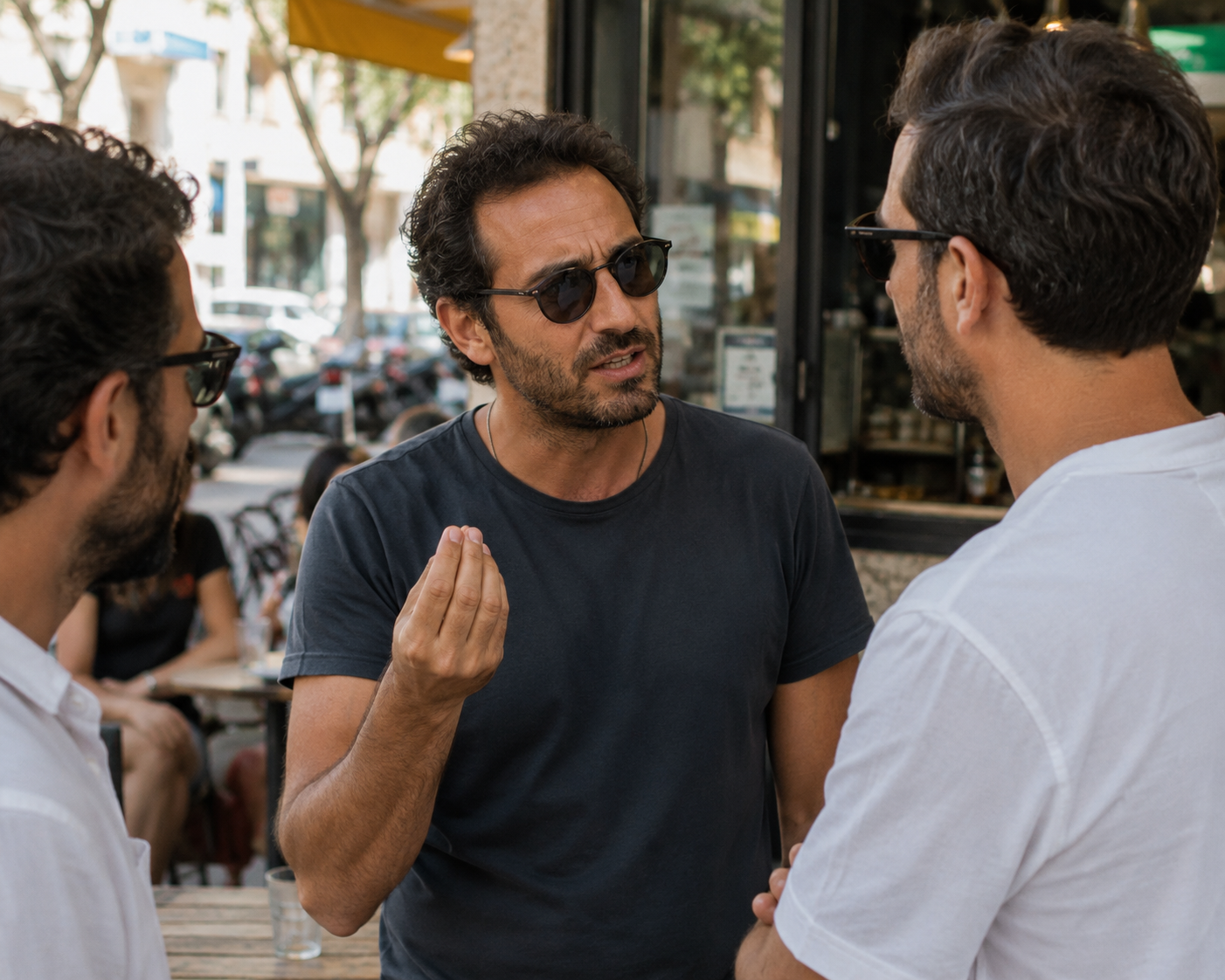
Man making "nu" gesture while in conversation. (Chat GPT, 26-7-2026)
There are languages famous for words that supposedly can’t be translated.
The Germans have Schadenfreude. The Portuguese have saudade. The Japanese have komorebi.
The Jews, especially Israeli Jews, have “nu.”
Technically it’s a word. In practice it’s a question, an accusation, a criticism, an encouragement, a passive-aggressive follow-up email and, at times, a complete performance review.
I learned “nu” young. Very young.
Usually it arrived in rapid succession.
“Nu, Marni! Nu! Nu! Nu!”
Depending on tone, volume and the angle of my father’s eyebrows, this could mean:
“What are you doing?”
“What’s taking so long?”
“Finish your sentence.”
“Answer me.”
“Move.”
“Hurry.”
“Continue.”
Or, on special occasions, all of the above.
Sometimes there wasn’t even another word. Just a hand gesture, a raised eyebrow and a single “Nu?”
Your first thought isn’t, “What does she mean?” It’s, “What did I do?”
If you’ve never encountered “nu,” mazel tov on having lived a comparatively peaceful life.
Its closest English equivalent is probably “Well?” But that’s only true in the same way a tricycle is technically a vehicle. The basic concept is there. The engineering isn’t.
“Nu?” can mean, “Go on.”
It can mean, “Get to the point.”
It can mean, “I know you’re leaving something out.”
It can mean, “Explain yourself.”
It can mean, “You’ve had enough time to think of a better answer.”
Sometimes it means, “I’m already disappointed and you haven’t even finished.”
It can also mean all six simultaneously.
The beautiful thing about “nu” is that it rarely seeks out new information. More often, it expresses disappointment with the speed at which existing information arrives.
English speakers ask questions.
Jews ask, “Nu?”
Imagine someone spending ten minutes telling you about an awkward dinner party. They’ve described every guest, the table settings, the wine, the weather, the appetizers and where everyone parked.
An English speaker waits politely.
A Jew interrupts after thirty seconds.
“Nu?”
Translation:
“I appreciate your commitment to context, but I’d like to reach the point before one of us dies.”
It’s one of the most efficient words ever invented. Why spend an entire sentence saying, “I’m listening, but I suspect you’re burying the lead beneath an unnecessary production,” when one syllable can communicate impatience, skepticism and mild disappointment all at once?
Then there are the dialects.
A cheerful “Nu!” means, “Finally.”
A suspicious “Nuuu…” means, “That story has at least three missing chapters.”
A sharp “Nu?!” suggests you’ve said something requiring clarification, justification and possibly therapy.
Lengthen the vowel and the emotional complexity increases exponentially.
Linguists could spend years studying this.
Jewish mothers didn’t invent “nu.” But they did discover its full potential.
Of course, “nu” belongs to a much larger family of sounds that somehow evolved into a language.
“Oy” isn’t just an expression of pain. It’s a complete medical history.
“Feh” can dismiss a meal, a politician, a television series or an entire ideology without wasting anyone’s afternoon.
“Pfft” means, “I’ve rejected your argument, your reasoning and, while we’re here, your haircut.”
“Psshhh…” is more coveted. It’s genuine approval, delivered so reluctantly you’d think it cost money.
“Tsk” has raised generations of Jewish children without requiring a single complete sentence.
If you removed these noises from Jewish conversation, we’d probably need another three thousand words just to replace them.
Israel, naturally, took “nu” and gave it caffeine.
Here it often means, “The traffic light has been green for almost half a second. Are you waiting for a written invitation?”
It can be heard at family dinners, cabinet meetings and from the car behind you while the light is still yellow.
Which makes me suspect that vocabulary has always been overrated.
Most languages rely on vocabulary.
Jewish conversation often relies on implication: the raised eyebrow, the sigh, the pause that’s exactly a quarter of a second too long, the theatrical eye roll. At family dinners, a single eye roll could generate more anxiety than an entire paragraph.
In fact, the most devastating critiques of my childhood were delivered in complete silence.
I suppose that’s what happens after several thousand years of arguing with one another. Eventually the words become optional. Everyone already knows the subtext.
My son is still too young to understand “nu.” At the moment his vocabulary leans more toward “oy” and “oy voy voy,” which feels simultaneously age-appropriate and about sixty years ahead of schedule.
One day someone in the family will look across the dinner table and simply say,
“Nu?”
Without realizing it, he’ll know exactly what’s being asked.
Not just to continue.
Not just to explain.
But to participate.
To tell the story properly. To stop circling the point. To join a conversation that’s been going on for generations.
For such a tiny word, “nu” carries an enormous amount of emotional luggage.
Then again, Jews have never been accused of traveling light.
Nu.
Related Topics
Related Posts