Miriam Frankel is a writer on religion, politics and culture.
Olami Manhattan Took Me To Poland: Day Six
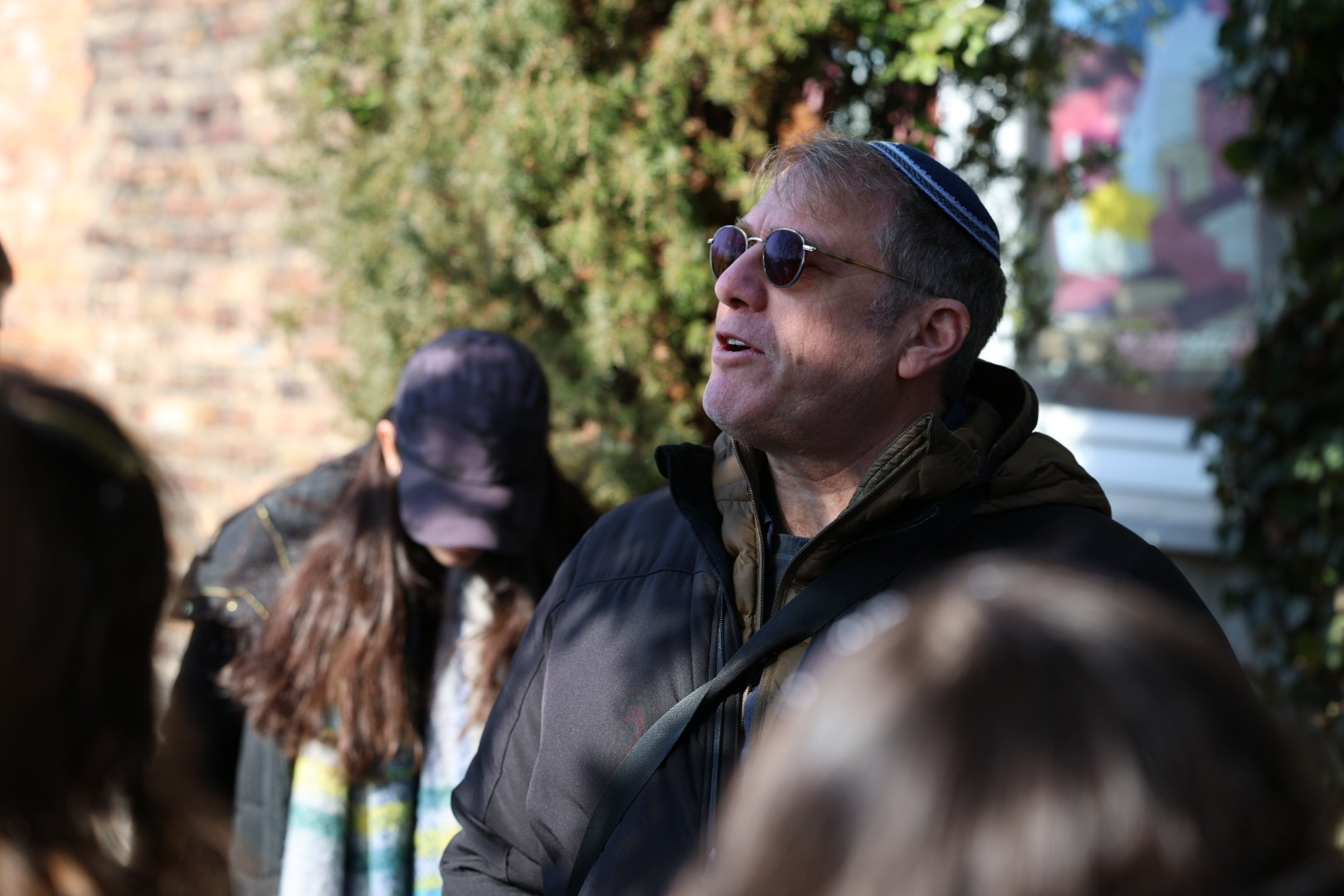
Tzvi Sperber, founder of JRoots, shares the rich history and legacy of Bedzin with the community of Olami Manhattan. (Photo Credit, Margaux Betesh)
I woke early on Friday, sunlight spilling through the skylights of my Hotel Eden room. The sky was clear and calm, an unexpected contrast to the weight of the previous day spent walking the grounds of Auschwitz and Birkenau. By the time we reached Kraków, exhaustion had dulled my senses and I went right to sleep.
To solve my lack of exploring and history learning from the night before, I quickly got dressed and stepped outside. Hotel Eden, tucked down a cobblestone alley in Kraków’s historic Jewish Quarter, occupies three restored 15th-century buildings and feels more like a museum than a hotel. Its green walls, vintage clocks, and posters from past Jewish cultural events lend it a sense of living history. The building itself carries significance, scenes from Schindler’s List were filmed here, and local legend links the site to Isaac Jakubowicz, a poor man whose dream of buried treasure led to the founding of a synagogue that still bears his name.
According to local folklore, Isaac Jakubowicz dreamed of treasure buried beneath a bridge in Prague. He traveled there, found the spot, and waited. When a soldier noticed him lingering and asked why, Isaac shared his dream. The soldier laughed, saying he too had dreamed of treasure, buried under the stove of a Jewish man named Isaac, son of Jacob, in Kraków, but dismissed it as nonsense. Isaac returned home, checked beneath his stove, and found a hidden treasure. Legend holds that he took the money and built a synagogue that still bears his name today. When asked how he acquired his wealth, he replied,
“There are some things that you may be looking for all over the world, but end up finding in your own home. However, before you realize this, you often have to go on a long journey and search far away from home.”
That last line echoed in my mind as I returned to the hotel and settled onto the bus heading to our first destination of the day. Many of the attendees expressed similar feelings throughout the journey, stories of searching far and wide only to realize what they truly sought was within themselves. Once they turned inward, toward their own spirituality and a deeper exploration of Judaism, life became far more light and beautiful than they expected.
We arrived in Sosnowiec, Poland, a city with personal significance for one of our group members, Alyssa Domash. Her grandmother, Fela Lesorgen, was born there in 1925.
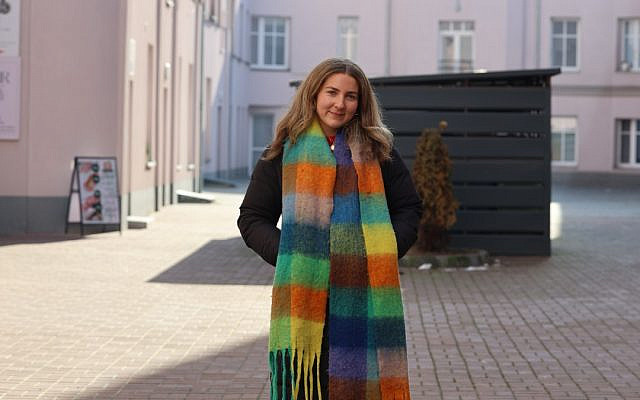
By 1939, Nazi Germany had occupied the area and renamed it Sosnowitz. The community’s synagogue was torched, Jewish businesses were wiped out, and residents were forced into a ghetto. Lesorgen, just a teenager, lived there for two years. To avoid being taken by the Nazis, who routinely rounded up Jewish teens, she hid at her aunt’s house. That home had already been raided once, and she hoped it wouldn’t be targeted again.
But even in the midst of terror, there were moments of normalcy. “Even in the darkest times, they were still just teenagers, doing teenager things, goofing off together,” Domash said.
In March 1943, the Nazis caught Lesorgen. Deported to Waldenburg, a subcamp of the Gross-Rosen concentration camp system where 40,000 Jews were murdered, she was put to work in a textile factory, exhausting and arduous labor for a young girl. A year later, she was moved to Grünberg, another Gross-Rosen subcamp. It was an all-girls camp, and there she worked as a plumber’s assistant.
One day, a plumber slipped her food, a dangerous act of kindness. When the Nazis discovered it, they demanded to know its source. Trying to protect both herself and the man who helped her, Lesorgen lied, claiming a prisoner of war had thrown it to her. The Nazis didn’t buy it. One of them punched her in the face with a heavy ring, an injury that would cause medical complications for the rest of her life.
Lesorgen was banned from plumbing work. But the same plumber stepped in again, risking his own life. He told the Nazis she was the only one who could help him do his job. Somehow, the lie worked. “I can’t say for sure why he risked his life that day,” Domash said. “But I like to think that even in the darkest times, some people just wanted to do good. He saved her life.”
Lesorgen spent 10 months at Grünberg before being liberated in 1945. She returned to Sosnowiec to search for her family. She was considered relatively lucky: her brother and a cousin had survived, but her parents and sister had not.
Sosnowiec’s Jewish population, like the rest of Poland’s, was devastated. Of the 3.3 million Jews living in Poland before the war, just about 380,000 remained after the Holocaust. Communities like Sosnowiec were nearly erased.
Domash reminded us that the trauma didn’t end with liberation. “The suffering didn’t stop with the Holocaust,” she said. Jews were left with nothing, poor, displaced, and forced to start from scratch. Eventually, Lesorgen settled in Munich and then the United States.
As the bus pulled onto the street where Domash’s grandmother once lived, Rabbi Lynn turned to her and simply said, “Welcome home.”
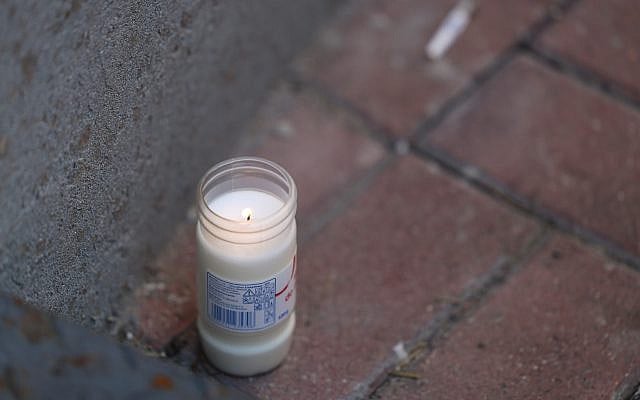
After a brief pause for photos at the front gate of the building, the group moved into the backyard of the apartment complex. There, Domash spoke to the students about how deeply meaningful the moment was for her and lit a memorial candle for her family, including her grandmother Lesorgen, who eventually passed away in 2009.
We left Sosnowiec on schedule, but not before Domash took a final moment to take in what, in another life, could have been her home.
Just minutes later, we arrived in Bedzin, winding through back alleys to what looked like an ordinary, forgotten backyard surrounded by worn-down tenement buildings. Our trip leader, Tzvi Sperber, founder of JRoots, suddenly stopped.
A man leaned over a nearby balcony, staring down at us, his expression mirroring our thoughts: Why were a group of young adults, clearly not from Poland, standing in this quiet, crumbling courtyard?
Then Sperber pointed to the balconies. “These apartments once housed Gerrer Chassidim. During Sukkot, they built their sukkahs out here, in this very courtyard.” A hush fell.
Sperber read from the testimony of a local priest who witnessed the destruction of the Jewish community here:
“Around 8 p.m., I heard several powerful detonations… My housekeeper began knocking; ‘Please, Father, the synagogue is burning. The Germans are murdering the Jews.’ I jumped out of bed, dressed quickly, and ran out into the yard. A huge pillar of smoke, lit by flames, hovered above the synagogue [burning it down]… Between the burning tenement houses I could see the Germans bustling through gardens. Every now and then we heard a terrible scream, then a shot, then silence, then another scream…”
The priest noticed Jews running toward the church, desperate for protection. Without hesitation, he opened the gates, welcomed them in, calmed their fears, and reassured them they were safe within the sanctuary.
Later, a Nazi officer knocked on the priest’s door and coldly informed him that, because of his actions, 42 more people had been executed. The message was clear: by saving Jews, the priest now had blood on his hands.
The bitter irony was not lost on us. The priest would forever be remembered and revered as a righteous non-Jew who risked his life to save Jews during the Holocaust. For this selfless act, he was among the first gentiles awarded the title “Righteous Amongst The Nations” by the Israeli Supreme Court.
While the main synagogue and its counterparts were destroyed, one humble synagogue stayed safe due to its hidden nature. Sperber gestured for us to follow him. “This synagogue is right ahead.”
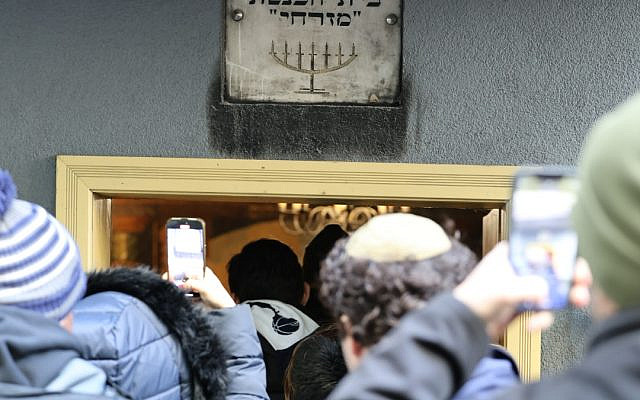
(Photo credit: Margaux Betesh)
Upon entering the room, awe fell over the crowd.
From the outside, it was plain and easy to miss. But inside, the walls came alive.
Paintings and frescoes covered the room: Absalom’s Tomb, Jaffe Street, Rachel’s Tomb. Floral patterns wound across the walls, along with medallions featuring menorahs, spice boxes, and Havdalah candles.
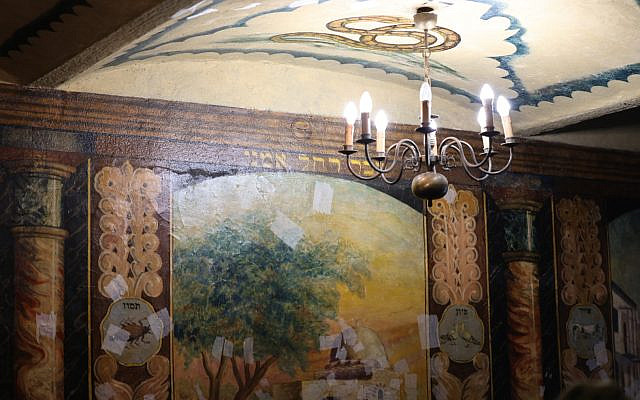
The artist, Altek Winer, had transformed this modest space into something out of a Judaic wonderland. Even fake columns were painted to make the room feel larger than life.
Looking up, the ceiling was similarly ornate. Three barrel vaults held images of the Twelve Tribes of Israel, the Star of David shining in the center. Each month of the year was illustrated with symbolic scenes and details.
Sperber explained the synagogue’s history: founded in the early 20th century by a merchant in his tenement’s cellar, it was the only synagogue in Bedzin to survive the Holocaust. For years afterward, its beauty remained hidden. Though Jews used it to pray for some time after the war, eventually it was repurposed as a basement and coal storage. Only when a survivor returned to Bedzin and found the synagogue where his father once prayed did restoration begin. In 2012, it reopened to the public by request.
As we listened, the group broke into song and dance, spirited and celebratory, the kind of energy one would expect at a wedding. The small space echoed with clapping, singing, and laughter. Round after round, the energy built.
I filmed from the entrance stairs, feeling a sense of pride. New Yorkers, some religious, others newly engaged with their Jewish identity, were here in Poland, participating in a powerful moment of return.
Decades after the Nazis tried to erase Jewish life here, they were gone. Jews were back. This time, they weren’t fleeing or hiding. They were dancing.
Bedzin offered a humbling aura of survivorship and heartbreak, as many Polish cities do, and the next location was no exception.
Sperber led us to another alleyway surrounded by greenery and aged brick. He explained that in 1943, during the final liquidation of the Będzin Ghetto, the Nazis deployed an elite military unit instead of their usual terror tactics. This decision was influenced by the memory of the Warsaw Ghetto Uprising, where Jewish resistance had made it difficult to suppress the population. They wanted to prevent a similar uprising in Będzin.
The brutality was extreme.
Sperber told us, “The owner of the house near where we stand returned to the ghetto during the liquidation to retrieve tools she had left in her shed. Although she was not Jewish, a German soldier warned her, ‘Do you have the stomach to see what you’re about to see?’ She replied, ‘I’m ready.’ When she entered the courtyard, she found piles and piles of bodies, all shot and dead, right where we are now.”
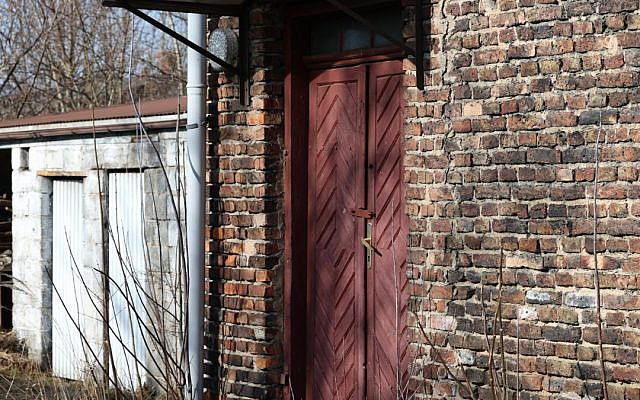
In 1947, Jewish survivors returned and asked if they could place a Holocaust memorial on her house, to which she agreed. The memorial commemorates the terrible battle on August 3, 1943. It honors the Jewish fighters who fought for dignity and independence, and to uphold freedom and humanity for the Polish people.
On a previous trip to Poland, Sperber was shown an old oven and frying pan. The local took the oven’s handles and slid them to the right, revealing a ladder down into a bunker. The Nazis had found the bunker similarly, smashing the oven and discovering the hidden Jews.
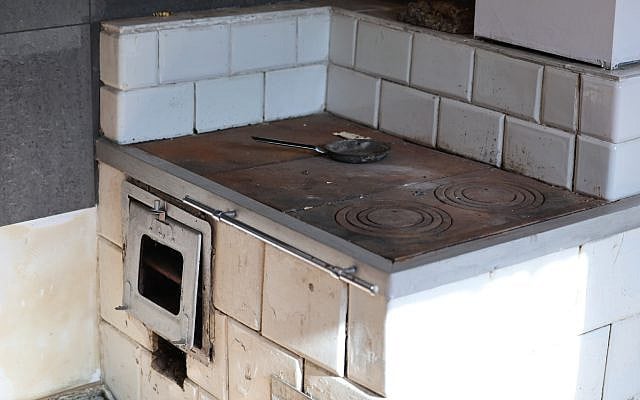
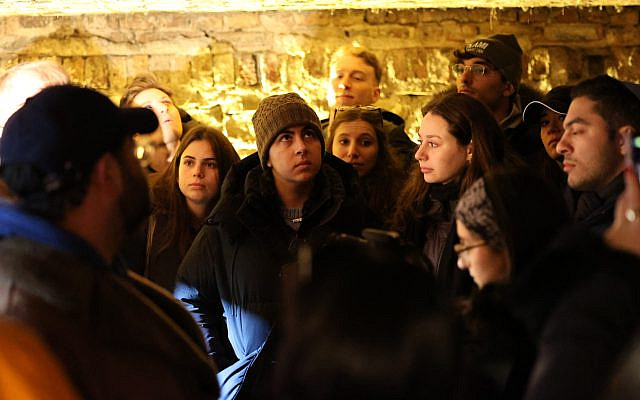
We entered the bunker. Except for a small burst of light from a hole in the wall, it was utter darkness.
Tzvi asked a trip goer to light memorial candles in honor of those lost there. They stood in the center of the bunker surrounded by us in a circle. Once again, we sang, and mourned.
As we drove back to the hotel with just two hours remaining before Shabbat, I approached several attendees to ask if they were open to interviews about the trip. Throughout the journey, we had not found a single moment to film, so all interviews had to be completed today if they were to happen before we left.
The challenge was time, we had only two hours left.
Where to conduct the interviews? We initially considered the hotel, but while charming, it lacked the atmosphere we wanted. With the help of one trip member, Paloma Maia Aisenberg, I set out to scout a location in Kraków’s old Jewish quarter.
We walked through iron gates marked with Stars of David, along streets lined with former Jewish eateries, now stylized as Jewish but lacking kosher observance, and past the Rama Synagogue. In a quiet corner filled with greenery, a striking mural caught our attention. In an almost Chagall-like painting, a Jewish man holds a Torah amid houses and related images painted against blue swirls.
As Aisenberg and I stared, a worker from the neighboring building emerged and said they were open.
We entered, instantly blown away. It was a bookstore, with vintage charm and shelves full of Jewish-themed literature and artifacts. It felt both unexpected and deeply familiar. This was the perfect place to film.
I introduced myself and asked the employee about filming the bookstore, but he offered something even better:
“Upstairs is actually an old synagogue from the 1600s. Do you want to film there?”
“Yes, of course. Absolutely!”
We couldn’t believe our luck.
Carefully, we climbed the narrow wooden staircase, watching our step so as not to disturb delicate books and artifacts. At the top, we passed through a glass-paned doorway into a space that stopped us in our tracks: a beautifully preserved room with a perfectly arched entry and a cozy, warm interior. The past lived here.
I began setting up my camera as the equipment hummed to life and started interviewing students, each moving in their own rite. There was Aisenberg’s account of Kaluzyn’s history, and Eli Zev Mayer’s tale of his grandfather’s heroic role in liberating Majdanek. These stories were alive, and I felt honored to be their witness.
Caught in the rush to fit in each interview before time ran out, I barely noticed the clock, until I glanced up and realized Shabbat began in five minutes.
With the help of the final interviewee, I packed up my gear in record time. Then the two of us sprinted full speed through cobblestone streets back to the hotel, arriving with just three minutes to spare.
The elevator was in use, and I was on the top floor. Breathing heavily, camera equipment slung over my shoulder and still needing a pre-Shabbat shower, I bolted up the stairs.
Now I had two minutes.
I dropped everything. Showered.
Now came the 18 minutes, a sacred window between candle lighting and the official start of Shabbat. A final breath before the world slows down.
And somehow, I made it.
By the time I reached the lobby and lit my candles, others were already gathering to head to Friday night services and dinner.
Shabbat began, and with it, the trip suddenly felt charged with new energy.
Related Topics