Miriam Frankel is a writer on religion, politics and culture.
Olami Manhattan Took Me To Poland: The Final Day
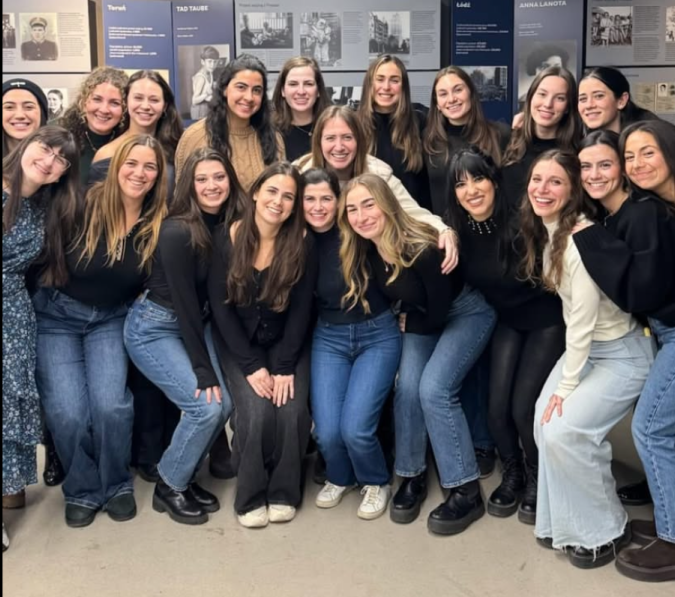
The girls on the Olami trip, after the final banquet.
It was the beginning of Shabbat, the sweet close of a well-traveled Friday. Phones that had been generally on throughout the day were now silenced and packed away, as students fully embraced the spirit of Shabbat, some for the first real time in their lives.
Paloma Aisenberg was one of those students. She approached me with bright eyes and an unmistakable energy, casually saying, “I think I’m really going to keep Shabbat for the first time.” I shared her excitement instantly, there was something uniquely beautiful about this moment. Unlike much of the trip, which often centered around reflection on tragedy and loss, this felt different: it was rooted in kiruv, in bringing people closer to who they truly are.
I was witnessing Shabbat through fresh eyes, and it was breathtaking.
Had I ever really noticed just how radiant the Shabbat candles are? Or how resonant the prayers sound during Kabbalat Shabbat? Has the wine ever tasted as sweet, or the outfits seemed as perfect as they did today?
Perhaps these things had always been so, and I simply hadn’t noticed them before, as Shabbat had gradually become something routine (appreciated, but lived every week). Or perhaps there was something uniquely special about this evening.
Either way, I felt a buzz of energy, and I embraced it.
We made our way into the darkened streets of Krakow’s Jewish Quarter, toward the breathtaking Tempel Synagogue.
Among the many synagogues that once stood in the Kazimierz district, Tempel was one of the few precious survivors, as it was spared destruction when the Nazi’s chose it as a stable.
The main prayer hall, with its ornately decorated ark and rich fabrics, was stunning. Sitting in its pews felt almost magical. Much like I feel a spiritual connection in Israel, I felt that same sacredness here.
I sat beside a friend I’d made on the trip, opening the prayer book only to realize she was struggling to find the place or recognize the Hebrew words. I’ve often felt insecure about my own knowledge of Jewish theology and Hebrew, but that imposter syndrome shattered in that moment. I was fortunate, not only could I read Hebrew and follow along, but I knew the melodies and could pray with ease, as naturally as I could speak English.
I invited her to follow along with me, and soon another girl nearby joined in. Before long, I was surrounded by others, quietly helping them find their way through the prayers in a way that felt genuine and meaningful. I whispered explanations and offered encouragement.
If you’ve ever been on a Shabbaton, or followed this series, you know that at any given moment, it can feel like a wedding celebration, with singing, dancing, and laughter. Tonight was no exception. Taking the hands of my fellow travelers, we danced, jumped, and praised God with joy.
When the service ended, some girls hadn’t yet completed their Amidah, the personal, silent prayer. I stayed with them long after I had finished, so they wouldn’t feel rushed. Their prayers were among the sweetest and most sincere I had ever heard.
Everyone was energized as we stepped back into the alleys and streets of the Jewish Quarter, making our way to the Galicia Jewish Museum for Friday night dinner.
Galicia was beautiful in its own right, with a massive Judaica art mural adorning the exterior and stunning, thoughtfully curated rooms inside. This museum is dedicated to preserving the Jewish culture of Polish Galicia, actively working to challenge misconceptions and falsehoods about Jewish history. Its mission is to foster understanding and unity between Jews and Poles by sharing their intertwined histories and inspiring a better future through that awareness.
As we moved through the evocative exhibits, we eventually reached the back of the museum where a gorgeous Shabbat spread awaited us. Standing near the table was a kind older man who, we later learned, worked at the museum. It didn’t take long for Paloma Aisenberg to strike up a conversation and to her surprise, discover that he was from the same region in South America where her family had resettled.
(Jewish geography, as always, in full effect.)
The dinner began with soulful singing and the time-honored rituals of shabbat. We sang Shalom Aleichem, and Eishet Chayil, with Rabbi Lynn humorously noting that the men seemed to be practicing their serenades for future wives. We made kiddush over rich red and white wines and eagerly dug into the meal.
Much to everyone’s delight, the menu included varenyky, better known as pierogies, and the group’s excitement was undeniable. The flavors were as comforting as the moment itself. I can still taste it months later.
After distributing the benchers to each table setting, we sang zemirot once again. The voices filled the room, carrying the joy of the participants and day to a crescendo.
By the time we got back to the hotel, I was utterly exhausted and collapsed into a chair immediately falling asleep, I didn’t even make it to my bed.
The next morning, Shabbat day, I woke up well past the start of the morning prayer, Shacharit. I prayed quietly in my room before heading down to the lobby, where many of the other late risers were gathered, eating breakfast. We chatted about the trip, the food, and shared stories, savoring the relaxed atmosphere before joining the others at the Galicia Jewish Museum for Shabbat Kiddush, speeches, and another delicious meal.
When lunch concluded, and the rabbis draped their tallitot over their shoulders, preparing to head home but unable to carry due to the absence of an eruv, Tzvi Sperber, founder of JRoots, posed a simple question to the group: Who wanted to take a nap, and who wanted to continue exploring Krakow? It was a playful question, and nearly every hand shot up in eager anticipation. For many on this trip, it was a once-in-a-lifetime experience, and none of us wanted to miss a single moment.
As the group approached the door, a quiet concern settled in my mind: How would I remember everything we’d seen, the meaningful moments, the emotional insights, the layers of history, without the ability to write, film, or take notes, as I had before Shabbat? Taking a breath, I let the thought go and chose instead to focus not on the sequence of each site, but on being fully present in each place we visited.
The walk kept a lighthearted tone, with us sharing Jewish mom stories, talking about old jobs, and debating the best kind of bread. Some proudly chose challah, which, while beloved and beautiful, just doesn’t hold a candle to sourdough (sorry, not sorry). Eventually, everyone was in the debate, and we got so caught up in the moment that we didn’t even notice we had arrived at one of the many Synagogues in Kazimierz.
This synagogue, titled “Synagoga Stara,” or “The Old Synagogue,” was designed by the Polish-Italian architect Mateo Gucci in a Gothic style sometime around the 15th century. True to its name, the Old Synagogue is the oldest building still standing in Poland. The formerly Orthodox prayer site was desecrated by the Nazis in 1939, like many of its counterparts in Poland, and later repurposed in the 1950s as a museum focused on preserving Jewish memory in Kraków.
The museum, with its grandiose interior, holds thick masonry walls and heavy buttressing left over from a time when buildings had to withstand sieges. It’s beautifully filled with what they call “artifacts”, though to me they feel more like items that were used just a minute ago.
In fact, despite the beauty and importance of the museum, I couldn’t help but look at the menorahs, ark covers, and kiddush cups behind the glass and feel like they were in jail, waiting to be broken out and used in our rituals again. I walked over to a docent and asked her if they would ever allow a Jew to light even one menorah here or host prayer. I wasn’t surprised, but I was still disappointed to hear a definitive no.
That odd feeling aside, It was a beautiful museum and I was very happy to have gotten the chance to visit it.
We also visited the Remah Synagogue, which, unlike Synagoga Stara, is still an active place of prayer. Before it gained its current name, the Remah Synagogue was known as “the New Synagogue,” to distinguish it from the Old Synagogue nearby. It was built in 1553 but faced strong opposition from the Church and wasn’t granted official approval by the government until 1556.
The synagogue was later renamed in honor of Rabbi Moses Isserles, one of the most important Ashkenazi Jewish scholars of the 16th century. He’s best known for his commentaries on Jewish law, which appear alongside Rabbi Yosef Karo’s Shulchan Aruch, a foundational legal code that originally reflected Sephardic customs. Isserles added his own interpretations and rulings to represent Ashkenazi traditions, effectively making the Shulchan Aruch a unified text accepted by Jews across different communities.
Though the Nazis looted or destroyed many of the synagogue’s religious furnishings and ritual objects, the building itself was not demolished, but repurposed for secular use, reportedly as a storage facility for firefighting equipment.
After the war, Kraków’s Jewish population began restoration efforts and worked hard to make the synagogue resemble its prewar state. Today, the Remah Synagogue continues to function as a historical site and synagogue visited by Jews and Non-Jews from all over the world.
One participant, Eli Mayer, who spoke Yiddish and Hebrew, was able to convince a group of Ger Hasidim visiting from England to sing for us. The men and women separated, and the men began to sing. Their voices filled the sanctuary from wall to ceiling so powerfully, that I half expected the walls to shake.
The feelings of Jewish pride and spiritual return we experienced in the Remah Synagogue stood in sharp contrast to those at another stop that day: the former Beit Midrash Hevra Tehilim. This historic prayer hall, once a vibrant center of study and worship, is now home to Hevre Café, a trendy spot popular with locals and tourists. While the building’s original Jewish frescoes and decorative elements are still visible, they’re slowly fading and deteriorating with time.
According to several accounts, members of the Jewish community tried to reclaim the building before the café opened but were unsuccessful. While I do recognize that the café owners chose not to paint over or erase the original Judaica, and that they simply found an available space to start a business, there was something deeply unsettling about seeing non-kosher food and alcohol served in a place that once held sacred texts, prayers, and communal life.
What added to the discomfort was learning that the café owners allegedly declined requests to install a plaque or sign acknowledging the building’s Jewish history. The absence of any public acknowledgment was noticeable. It left a bitter taste in my mouth.
Altogether, each place we visited, whether it was the former residence and first school of Sarah Schenirer, founder of the Bais Yaakov movement who pioneered Jewish religious education for girls, or the exterior of the Izaak Jakubowicz Synagogue, whose windows seemed to frown in silent mourning alongside us, was deeply moving. Yet what truly made the day unforgettable wasn’t just the powerful history, but the company that surrounded me and the special atmosphere that Shabbat brought. It was not only educational and meaningful, but also profoundly memorable.
When Shabbat came to an end, we held a beautiful Havdalah and came together once more for the final dinner of the trip, our last special moment together in Poland. I still get emotional thinking about it. Even now, months later, I miss Poland as if it were home. I hope I can visit again someday, but who knows? I didn’t want to leave; I was desperate to stay, but time didn’t allow it. So we gathered one last time to reflect on the incredible journey and to hold space for everyone’s experiences.
Though the food, once again, was delicious, what stood out most to me were the speeches from my fellow trip-goers. Many shared how they had never truly felt connected to Jewish life until finding Olami Manhattan, and how this trip deepened their interest in exploring their heritage. Some expressed deep gratitude just for being there. Others spoke about having only one Jewish parent, and how it wasn’t until this trip that they felt fully, 100%, Jewish, rather than just “half.” I shared how meaningful it was for me to spend Shabbat with everyone, to be here as a guest, and how beautifully I was welcomed into such a tight-knit group.
After many photos, many drinks, and more than a few heartfelt tears, we closed out the night and began preparing for our flights home. And though the planes would take us to the highest physical point, it didn’t come close to the emotional and spiritual heights we reached on this trip.
***
As I sit here at my dining room table, staring at my completed series, I’m blown away to see it finally come to a close. Five months of work, researching, searching for photos, writing, rewriting, and sometimes starting over, has come to an end. I think part of me subconsciously stretched out this process because I wasn’t ready to let it go. Putting down the pen on this series feels like saying goodbye to one of the most meaningful experiences of my life.
Though this is the final installment of the series, it’s far from the last time I’ll think about the experience. In fact, I find myself reflecting on it almost every day and night.
This project would not have been possible without the guidance, support, and generosity of many remarkable individuals and organizations.
I am deeply grateful to the Times of Israel, Rabbi Shmuel Lynn, Mr. Emil Fish, Tzvi Sperber, Margaux Betesh, and all the members of Olami Manhattan for their unwavering encouragement and dedication throughout this journey.
I owe a special debt of gratitude to the non-Jewish guides who so selflessly preserved and shared this difficult history with us. To Ľuboslava Stachová and Przemek “PJ” Jaczewski, thank you for bearing the weight of this painful past and for your tireless efforts to honor the memory of my people.
My sincere thanks also go to Paloma Aisenberg, Eli Mayer, and all the students who entrusted me with their family stories. Your willingness to share your histories made this work profoundly meaningful.
I would be remiss not to acknowledge the countless individuals whose dedication behind the scenes made this trip possible, the bus drivers, security staff, chefs, hotel staff and many others, your contributions were invaluable.
On a deeply personal note, I am forever grateful to my father, David Frankel, for his patient support and for serving as a thoughtful sounding board throughout this process. To my fiancé, Yehuda, my mother, bubbies, sisters, and in-laws-to-be: your unwavering belief in me and constant encouragement sustained me through every step.
Finally, I extend my heartfelt gratitude to the entire Polish and Jewish community who welcomed us with open arms and kindness. Your warmth and generosity helped me grow into a truer version of myself, and I carry the lessons and memories of this journey with me always.
Ta podróż nauczyła mnie, że to więzi między czasem, kulturami i pokoleniami naprawdę nas podtrzymują i nadają życiu sens. Będzie mi Cię brakowało, Europo, do następnego razu.
Related Topics
Related Posts