Looking forward
On Yom Kippur, see Israel in both the darkness and the light
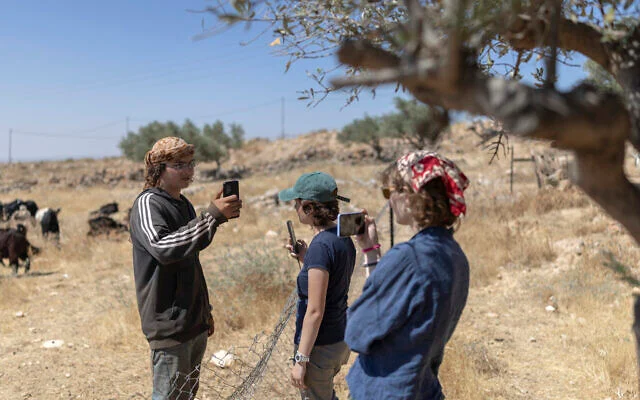
Protective presence activists (R) face off as they film using their mobile phones an Israel settler also filming them with his mobile phone, as he tries to enter the home of a Bedouin family in the West Bank, east of the Palestinian city of Ramallah, just outside the village of Taybeh on June 22, 2026. (ilia YEFIMOVICH / AFP)
This year, let us acknowledge the terrible acts our People have committed as well as the efforts of those struggling courageously to stop them
Tonight, while we stand amongst our communities and put fist to chest to account for the sins committed by our People in this year now passing, many of us will add a few more. We assaulted. Battered. Chased off, destroyed, eviscerated, foreclosed, ganged up on innocents this year. We harangued, insulted, jeered, and even killed. Mutilated animals. Nabbed. Openly paraded our iniquities. Praised them even from the highest levels of our government. Questioned why the world got upset when a documentary film recorded what our ministers have been saying all along. Removed long-time residents from their farmlands instead of the newcomers who wanted to usurp them. Stole land. Told each other we did nothing wrong. Upset our closest allies. Violently resisted attempts to return law and order. Woke up to a world that rejects us. Zigzagged instead of dealing directly with the problem.
One of the great strengths of the nation named after the traditional, ancestral, and unceded territory of Judea is our ability to take responsibility for our actions. To account for our sins collectively, to shoulder the amassed weight of our misdeeds and commit to addressing them. We do not shy away from judgement. We do not believe faith alone will cleanse us from sin. We believe that facing our actions and making an active effort to turn from their destructive path (tshuva) – along with verbalized acknowledgement of our accountability (tfila) and acts of loving kindness (tzdeka) – are the three ways we, as a collective, can live up to our expectations of ourselves in the coming year.
We do so when things are objectively good for our People, and when they are objectively bad. While Israel flourished and a new Temple was built in our ancient capital we remembered our inequities. When Rome destroyed our Temple and took our best and brightest survivors as slaves for their citizens we took responsibility for our actions. When we fought against all odds against invading armies that sought to squash our dreams of independence we paused to remember our sins. When we felt a gap in our chests because our loved ones were still held by demons in the tunnels of Gaza we still prayed for forgiveness and acknowledged our responsibilities.
Which is why now, despite all we have been through, despite the global campaign to delegitimize Israel, to fan the flames of fanatical hatred of the Jews, to amplify the antisemitic canards that have captivated so many in centuries past, we must acknowledge our responsibilities and hold ourselves accountable for the terrible, growing violence visited by our People upon innocents in Judea and Samaria. As Jacob Ner-David shares in Prophecy’s fourth issue, our military and police forces have stood idly by as families are gassed in their homes, fires lit in buildings with residents still inside, “women pushed to the ground, and rocks thrown at young children.”
We must acknowledge and take responsibility and hold ourselves accountable for these terrible deeds even if our own hands neither lit the fire nor threw the stone. And in doing so, we must commit ourselves to ensuring that such violence does not persist, that justice, justice shall be pursued so that we may live and thrive in our land.
And I believe that while doing so we need to keep in mind that the work to address this violence, to account for and correct for these sins, is already being done by people like Jacob. By people like Aliza Inbal, whom I profile in the last chapter of Being Israeli. Like Meredith Mishkin-Rothbart, like the hundreds if not thousands of Israelis who participate in Protective Presence, who volunteer to support Palestinian families across Judea and Samaria. Who come out with and support organizations such as Torat Tzedek, Rabbis for Human Rights, Bnei Avraham, Standing Together, and the many other efforts Jews have founded or joined to do the work required to overwhelm the bad and protect the good.
These are joined by the dedicated, weekly work done by Israelis who have protested for four years against this government, who have invested in and personally taken real action to have Israel live up to our founding ideals despite global condemnation, despite the boycotts and divestments and sanctions, to fix the broken and mend the torn. Those of us who have not given up in bad times, those of us who have redoubled our efforts to make things good. Those of us who could not make it in person to the territories and supported those who did by acknowledging them in public or sending them resources to support their efforts.
We need to remember these efforts not to cleanse ourselves from the bad, but to give us the strength to continue to do good. Because if we only remember the bad and do not acknowledge the good we will fall into despair, and despair serves no one. Because it is alluring to join the global chorus of critics but that does not make those critics right, because people like Jacob and Aliza and Meredith prove that for each act of violence there is an act of loving kindness seeking to prevent it when possible, or provide salve for the wounds inflicted. Because those who only see Israel in the faces of our worst are just as wrong as those who only see Israel in the faces of our best. Because to fix requires hope, and hope requires the spark we can fan into a fire to light the way. Focusing on the darkness alone ignores the light that prevailed despite terrible winds that continue to batter our people.
When we put fist to chest tonight, my hope is that we acknowledge the bad, and the good. That we stand before each other, before the Eternal, with both the weight of responsibility upon our shoulders, as well as the knowledge that we have the strength to bear it. I pray we will remind ourselves that alongside those who have done so much harm this year, we have not all been bystanders to it. That as many – if not more – sought to care for the innocents in our midst as acted callously towards them. And that while that does not absolve us from the responsibility for the pain caused, it shows us that we can overcome this year, that we can rehabilitate following this election, that we can pursue justice, justice as we ourselves would have wished as strangers in a strange land.
Related Topics
Related Posts