
One day, everyone will have this book at the back of their closet

Novelist Omar El Akkad’s new nonfiction book about the Gaza conflict, “One Day, Everyone Will Have Always Been Against This,” which recently won the 2025 US National Book Award, encapsulates everything that is wrong with the state of political discourse, intellectual culture, and Western elites who favor feeling good about themselves over civilizational survival.
The book was first published one year ago this month. Why write about it now? Because it is still, to this day, the #1 best-selling book on Amazon in the category “Middle Eastern Politics,” and #3 in the category of “Democracy.”
So what’s wrong with El Akkad’s heartfelt memoir? Let’s begin with the title itself. It is a naked appeal to peer pressure: If you are not part of the “pro”-Palestine movement now, you inevitably will be some day, and if that glorious day of dawning, God forbid, never comes — if, in other words, you continue to hold out stubbornly for the right of one tiny Jewish state to exist in a world of 56 Muslim-majority states, many of them actual “settler colonial ethnostates” — then you are on “the wrong side of history,” as the balaclava-clad mobs tirelessly proclaim. “Shame on you,” they bellow at their antisemitic demonstrations, those who themselves in their naked hatred feel no shame at all, nor any self-awareness that their actions, which they proclaim with proud self-absorption place them on “the right side of history” are in actuality indistinguishable from that of the average Berliner or Viennese Durchschnittsmensch in 1938.
(Incidentally, the prefix “pro” is in quotes because the recent ceasefire agreement, conspicuously uncelebrated by the demonstrators, and the subsequent murders of Palestinian dissidents by Hamas, also ignored, proved that the protesters were never “pro” Palestine at all.)
The title is, in other words, a form of shaming. It also is incredibly presumptuous, a classic example of the logical fallacy of “begging the question,” or assuming the truth of a conclusion in the premise of an argument. The conclusion, of course, is that “this” — which is to say Israel’s defensive and preventative war against Hamas and jihadist terror — is something that one must be ashamed of before, or perhaps instead of, even considering the arguments that support this assertion.
To be clear, the pivotal “this” in the title is not the barbaric October 7 massacre, nor the attempts by naive or hateful Westerners to justify it or deny it, nor the 18 years of rocket fire from Gaza into Israeli communities that preceded it, nor the stabbings and car rammings and bus bombings of the First and Second Intifadas, nor the massacres of Persians, Christians, Hindus, Druze, Yazidi, Alawites, Jews, African animists, and other minorities by radical Islamist groups currently taking place worldwide.
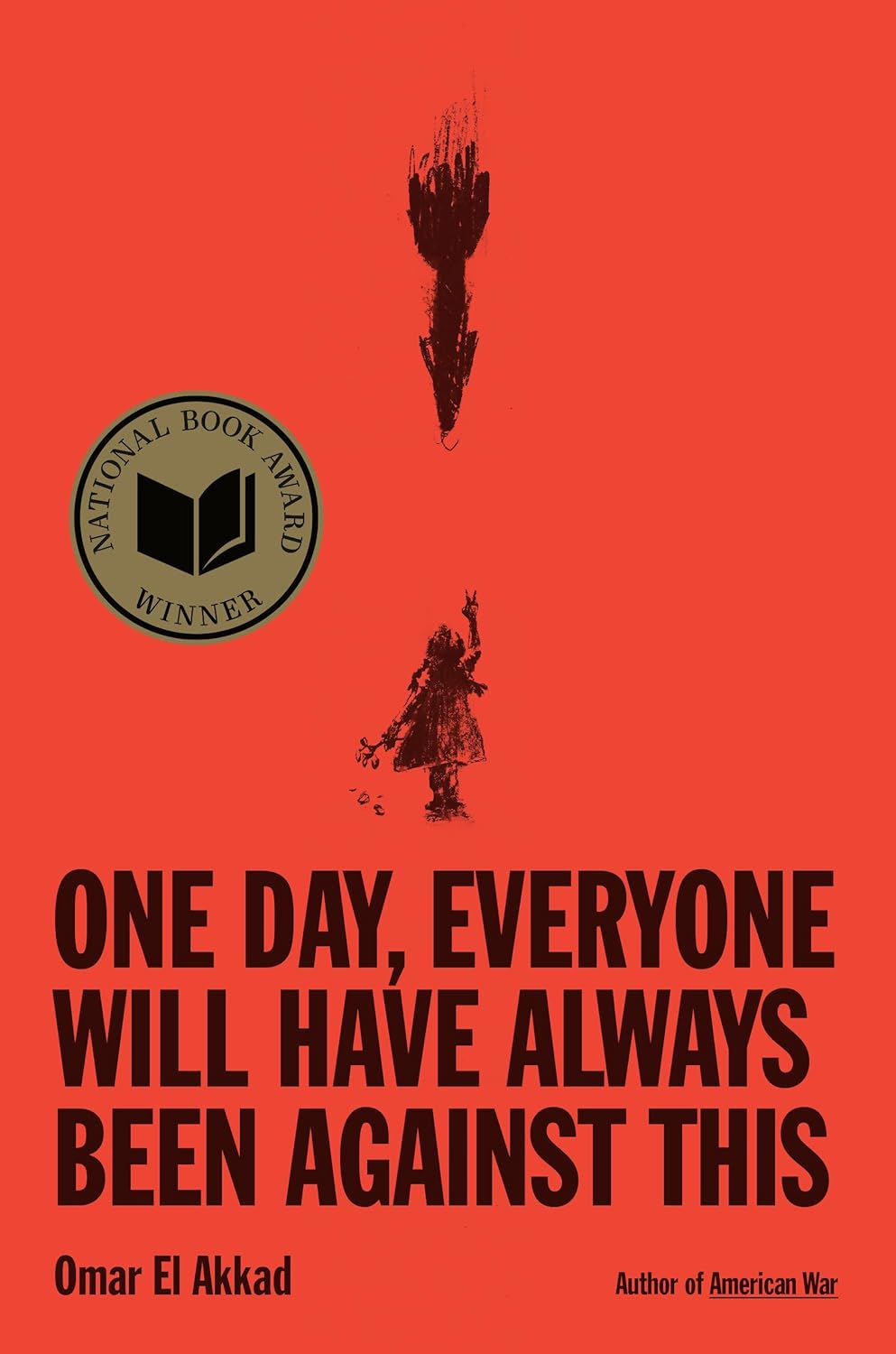 No, the “it,” according to El Akkad, is solely Israel’s war against Hamas and other Iranian-backed terror groups. We know this immediately (for having the warmth and comfort of a simple and predetermined conclusion before embarking upon a new book is the classic hallmark of both the manipulative polemicist and his gullible readers) because the orange-sherbet-colored cover of the book features the image of a plummeting missile headed directly at the head of a cute little pigtailed girl looking up hopefully, making a peace sign with one hand, and holding a frail little flower in the other, with not a single terror tunnel or terrorist in sight. This is pure sentimentalist trash, not least because there never was a single Gazan, or for that matter a single “pro”-Palestinian protester, who ever made any such peace sign, or who called out for a genuine peace, as opposed to the one-sided “peace” that they actually advocated for: the peace of a unilateral Israeli ceasefire, the peace of Israeli surrender to jihadi terror, the peace of a judenrein Middle East, the peace of mutilated Jews in their graves.
But let us move beyond the awkward title and cartoonish cover illustration. What does the journalist and fiction writer El Akkad, author of the acclaimed novel American War, actually say inside “One Day…”?
The crux of El Akkad’s thesis is, as he himself writes, “One of the hallmarks of Western liberalism is an assumption, in hindsight, of virtuous resistance as the only polite expectation of people on the receiving end of colonialism. While the terrible thing is happening — while the land is still being stolen and the natives still being killed — any form of opposition is terroristic and must be crushed for the sake of civilization. But decades, centuries later, when enough of the land has been stolen and enough of the natives killed, it is safe enough to venerate resistance in hindsight. I tell stories for a living, and there’s a thick thread of narrative by well-meaning white Westerners that exalts the native populations in so many parts of the world for standing up to the occupiers, makes of their narrative a neat reflexive arc in which it was always understood, by the colonized and (this part implied) the descendants of the colonizer, that what happened was wrong. It’s a comforting thing, this narrative, and at my most susceptible to whatever the West is, I want so dearly to partake in it. But it’s a fiction, the most malicious kind: a fiction of moral convenience.”
As anyone who has ever attended a theatre production in North America can attest, those smug and smarmily insincere “land acknowledgments” that the theatre is in fact situated on the territory of now mysteriously absent indigenes (though the theatre owners have absolutely no intention of giving the land upon which the theatre is situated back to anyone) are a perfect encapsulation of these retrospective “moral conveniences” that El Akkad so rightly mocks. And, read this way, El Akkad’s title — though it is still presumptuous — takes on a new dimension, one of bitter sarcasm, for it is only “one day” — some distant day in the future when it is morally and financially safe to do so — that people will gather the courage to denounce what is supposedly plainly wrong today.
The problem, of course, is that El Akkad has chosen precisely the wrong target for the performative denunciations that he wants people to engage in today, right now, immediately: the only fully free and democratic state in the entire MENA region; the only one with full civil liberties and comprehensive human rights laws and institutions; the one state where the Christian population is growing; the one state where Jews are safe and well-protected; the one state where LGBTQ people are safe and welcome; and the one state with more religious freedom for all sects of Islam and its various doctrinal offshoots than any other country in the region.
The irony of El Akkad’s excoriation of Western liberals is palpable, for the Gaza war is the least-ignored conflict in the world today, and the one most likely to elicit thunderous denunciations from the liberals and literati that El Akkad criticizes. (Liberals love to be lectured about how morally deficient and hypocritical they are; they eat it up; they just never do anything about it.) There is another irony in El Akkad’s thesis, for of all the groups in the world currently at the mercy of actual or putative oppression, the one group that is the least “virtuous” or “polite” and by far the most “terroristic” is the jihadists of the disputed regions we call Palestine.
El Akkad refers cannily to the “slaughter” that occurred in “the fall of 2023,” but by leaving out the specific date, October 7th, he deliberately makes the question of who committed what slaughter ambiguous. It is true that he correctly calls the October 7th massacre a bloodbath, but he immediately vitiates the power of this appellation by claiming it was “orchestrated by exactly the kind of entity that thrives in the absence of anything resembling a future.” Ah, but what then of the future handed to the Palestinians in 1948, when they were ruled by their Arab brethren, or to the Gazans in 2005, when every trace of a Jewish presence was evacuated? And what was the despair at a hopeless future that drove the Arabs to commit a similar massacre of Jews in Hebron in 1929, or at dozens of other junctures stretching back to the seventh century, when there was no modern Israel at all?
El Akkad complains — not without justification — that Fox News is “an entity that more than any other has normalized the practice of severing any relationship between the truth and what one wishes the truth to be.” But what then of the other ruptures from reality committed by the propaganda organs Al Jazeera or the BBC and its Arabic service, or the countless Gazan journalists whom El Akkad claims were “wiped out” by the Israeli military but forbears to mention were merely play-acting as members of the press while doing double-duty as Hamas terrorists? It is no wonder that El Akkad continually and falsely accuses Israel of committing “genocide,” for if one’s only sources of news are these highly duplicitous news services, it becomes an inescapable, albeit completely false and slanderous, conclusion that Israel’s preventative war against Hamas can be described as such.
El Akkad claims — in keeping with his premise of the retrospective acknowledgment of guilt that he wishes to convert to immediate outrage — that “in time, there will be nothing particularly controversial about using these words [he is referring here to ‘occupation’ and ‘genocide’] to describe the things they were created to describe.”
Here again, El Akkad is appealing to the unknowable judgement of an imagined future to make a case for something that is unprovable in the present for the simple reason that it does not exist. Four numbers serve to buttress this point: 15 million, 12 million, 7 million, and 40,000. These numbers are, respectively, the numbers of text messages, recorded phone messages, leaflets, and personal phone calls by the IDF designed to keep non-combatants away from combat zones, just a few of the dozens of examples of actions taken by Israel that no actual genocidal entity has ever in human history taken.
As is often the case in anti-Israel screeds, it is not enough to slander the IDF and Israel in general. The Palestinians must be elevated to the position of veritable angels on Earth. “Alongside this ledger of atrocity,” El Akkad grandly pronounces, “I keep another.” He then goes on to list acts of kindness and selflessness by and for Palestinians, including “the puppet-maker who, injured and driven from his home, kept making dolls to entertain the children.” For the Palestinians, you see, “respond overwhelmingly with love.”
Yes, he really wrote that.
Thus in El Akkad’s telling, Palestinians are being punished “merely for their electoral choices” (the election of Hamas) and because they are “a politically powerless contingent of Brown people” and not, no not at all, because of decades of rocket fire and suicide bombings and massacres, which are themselves a form of “collective punishment” directed against the Jews and Arabs of Israel, but that El Akkad insincerely asserts is visited solely upon the Palestinians.
Near the conclusion of his book, El Akkad writes, “One day it will be considered unacceptable, in the polite liberal circles of the West, not to acknowledge all the innocent people killed in that long-ago unpleasantness… The truth and reconciliation committees are coming.” One wonders if this moral appeal to the future will work out exactly as El Akkad wishes, given the likelihood that future historians will assess the claims of “genocide,” “widespread famine,” and “mass graves” as either gross exaggerations or outright libels and lies.
I do concur with his statement in the book’s final paragraph that “none of this evil was ever necessary,” but believe firmly that the “unnecessary evil” was that of the Palestinians who could have had a free and independent state at multiple points after the end of the Ottoman Empire if that had been what they really wanted, rather than the mass murder and ethnic cleansing of the Jews from their ancestral homeland.
I once had an elderly professor who spoke with amused contempt of the Western Left’s infatuation with Mao Zedong, the Chinese dictator whose actions killed an estimated 40 million to 60 million human beings. Back in the ’60s, before the naive Western Left had fully absorbed the scope of Mao’s evil, college students and ordinary suburban liberals took to carrying around a small collection called “Quotations from Chairman Mao Tse-Tung,” informally called “Mao’s Little Red Book,” for its bright red cover. About a million copies were sold in the US and you could see earnest young people everywhere carrying it and studying it. It was a way of exhibiting one’s historical awareness and moral rectitude, and opposition to the supposedly decadent West — in other words, it was about feeling good about oneself and playing at rebellion, just like the keffiyeh cosplayers of today.
But within a few short years, the book “ended up at the bottom of people’s closets,” in my professor’s words, and by now, they are, nearly all, dust. El Akkad, with all of his emphasis on the moral judgement of the future, should be aware that his little orange book — along with the keffiyehs and the balaclavas and all the other signals of violence disguised as virtue — awaits the very same fate.