Greek Jewish roots. New York voice. Unfiltered perspective.
At 95, She Refuses to Do Nothing. What About Us?
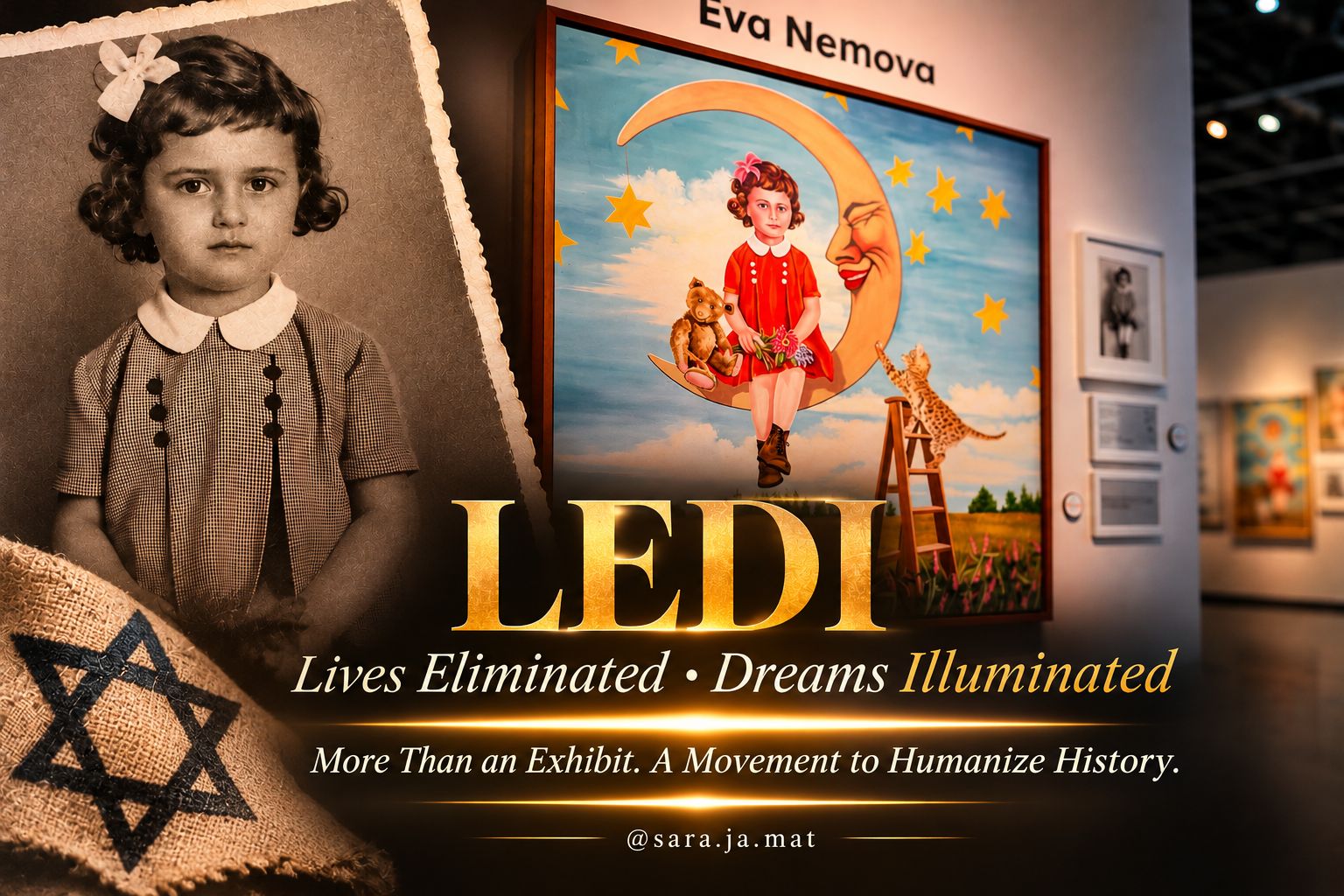
How a Holocaust survivor, her son, and an exhibition of stolen futures are challenging the world to move beyond remembrance.
“The one thing I will not accept is to do nothing,” Lusia Rosenzweig Milch said.
I wrote down her words as her son played the recording for my mother and me. Her animated film, My Mother’s Eyes, which she wrote and narrated, won a New York Emmy in the teen (13-19) category.
Lusia is 95. She survived the Holocaust. She is still telling her story, still educating, still insisting that what happened to her family must matter to people who never knew them.
There is something deeply uncomfortable about a woman who has endured so much still shouldering the responsibility of teaching us. What are we doing with what she is telling us?
The question my mother wanted to ask
My mother, Anna, and I were on our way to a private showing of Lives Eliminated, Dreams Illuminated (LEDI), at Mana Contemporary in Jersey City. My father, Prof. Asher J. Matathias, had passed away only weeks earlier.
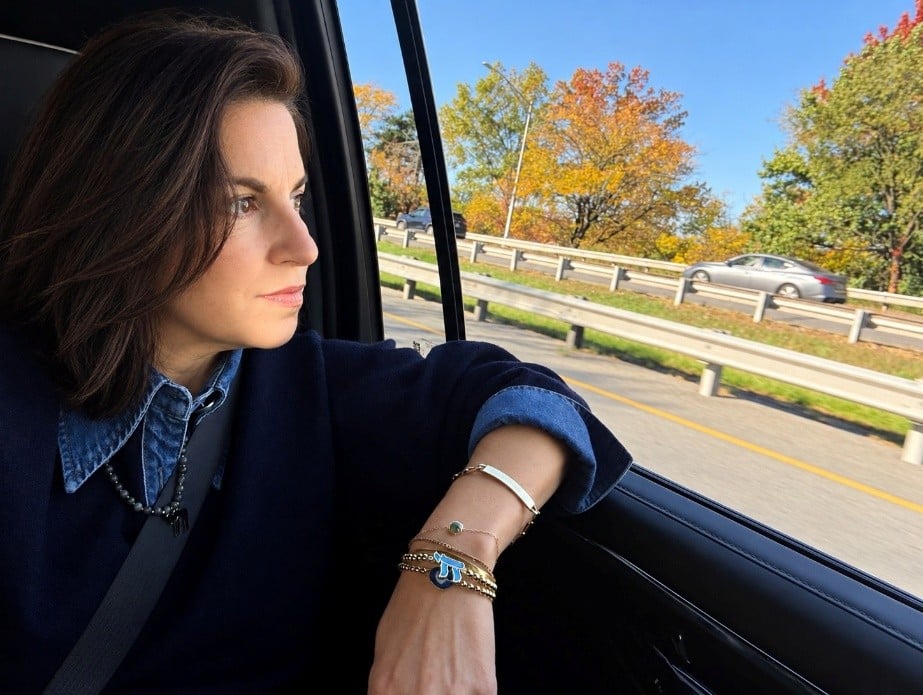 On the way to Jersey City with my mother, thinking about my dad.
Photograph from the author’s collection.
For years, I had accompanied him to lectures where he spoke about surviving the Holocaust in Greece. I knew what it felt like to sit in the audience and watch people listen to my dad. I was still learning what it felt like to walk into a room like that without him.
I can still hear my father speaking on International Holocaust Remembrance Day earlier this year:
“Soon there will be no survivors left to speak.”
He warned that the loss of witnesses would give deniers more room to spread their lies. Then he placed the responsibility before his audience:
“So the responsibility will belong to you. You will become the witnesses. You will become the guardians of truth.”
At LEDI, those words felt painfully close. I was there with my mother, missing my father, learning about another survivor whose son was helping her testimony reach a new generation.
My father had told his audience that this responsibility would become theirs.
Now, without him beside us, I felt the weight of it myself.
In Jersey City, we met Lusia’s son, Dr. David M. Milch, LEDI’s founder and chairman.
When my mother learned Lusia’s film had aired on PBS, she wanted to know when. My dad watched programs like that. Had he seen it? Weeks earlier, we could have called him from the gallery and asked.
The mother’s eyes that told her to run
The title of Lusia’s film, My Mother’s Eyes, carries an unbearable intimacy. She remembers her mother, Necha, and her cooking, which she considered the best in the world. Then came the day a man the family had counted on for shelter threatened to kill them.
Her mother gave her a look she understood immediately: “Now is the time. Leave us! Run! Save yourself!”
Her mother and four-year-old sister were murdered. Lusia survived by assuming the identity of a Ukrainian peasant girl, eventually reaching America and rebuilding her life as a Jew.
Watch Lusia’s testimony on PBS
After the Emmy, she told the New York Post: “This is our victory. For Hitler and his gang, this is my revenge.” A girl who had to hide who she was lived to tell the world her story in her own voice.
There is no award that can compensate for what was stolen. But there is power in that victory, and responsibility in hearing it.
What if we remembered their lives instead of only their deaths?
LEDI doesn’t simply ask visitors to learn about people who were murdered. It asks them to encounter people who lived.
The central question is devastatingly simple: What might their lives have been?
Not merely how they died, but everything they were denied the chance to experience.
Through 23 paintings, LEDI reimagines the lives and unrealized dreams of 28 Jewish girls and women targeted by the Holocaust, 27 who were murdered and one who survived.
American artist Lauren Bergman draws from historical photographs, placing the girls and women in imagined worlds of beauty and possibility. Israeli composer Ella Milch-Sheriff composed the music, and it is not background music. Each piece grows out of a painting, the photograph that inspired it, and whatever is known of the life behind them. It works like a soundtrack, helping to tell the story and guiding how you feel as you look.
A face preserved in a black-and-white photograph becomes someone you stop to consider. The painting invites you to see not only who she was, but who she might have become.
We are accustomed to seeing Holocaust victims in black and white: photographs of persecution, suffering, and death. We know what was done to them. But how often are we asked to imagine the lives they might have lived?
LEDI moves us beyond the black and white of what was, into the vibrant colors of what could have been.
The childhoods, friendships, loves, families, and futures that were stolen before they had a chance to unfold.
The paintings do not claim to document futures that happened. They invite us to recognize the futures that were denied.
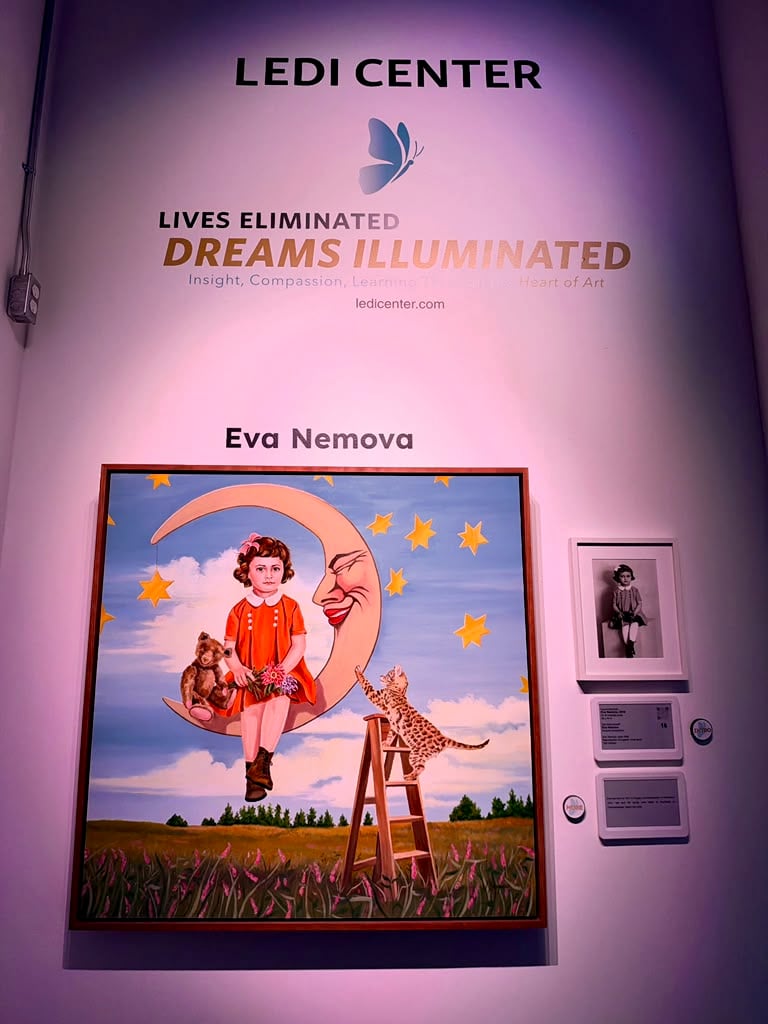 Eva Nemova’s painting alongside her archival photograph. Courtesy of LEDI.
Standing before Eva Nemova’s portrait, I looked at the flowers Bergman placed in her hands. In the original studio photograph, taken around 1939, her little hands rest in her lap. Someone once dressed this child, fixed her hair, and took her to have her picture made.
Such an ordinary moment. Such an enormous loss. The Nazis did not simply take Eva’s life. They took every birthday she would never celebrate, every friendship she would never form, every ordinary morning she would never wake up to experience.
A child was murdered. So were all the ordinary years that should have belonged to her.
Suddenly, history was no longer a number. It was a little girl who should have had a future.
The most uncomfortable question of all
During our visit, David described a historical photograph he discusses with students. A woman is being chased down a street. People are holding sticks. Some of them are boys. David asks students to look closely: How old are those boys? Could they be the same age as the students?
I found myself considering an even more uncomfortable question: Who would I have been in that photograph? The woman being chased? The person holding the stick? The person watching? Or the person willing to intervene?
We would all like to imagine ourselves as the courageous one. But courage is easy to claim when the danger is confined to a history book. What happens when the person making the cruel joke is your friend, and speaking up might cost you your place in the group?
Hatred does not begin with a weapon.
It begins long before that.
With a stereotype repeated until it sounds like truth. A joke that humiliates someone because of their religion. A rumor passed along without question. A person reduced to a label until others stop seeing the human-being standing before them. The LEDI content illustrates this clearly.
Then comes the moment when someone must decide whether to participate, remain silent, or speak up.
These are not questions reserved for Jewish children. They belong in every classroom, every home, and every community.
Because the first lesson in confronting hatred is learning to recognize it, even when it comes from people we know, people we like, or people we are afraid to challenge.
And the second is understanding that doing nothing is also a choice.
The Holocaust is Jewish history. The responsibility to recognize and confront hatred belongs to all humanity.
That is what makes LEDI so relevant to the world we are living in.
It challenges us to recognize hatred before it becomes violence and to consider what we will do when confronted with it. You do not need to wait until someone you love becomes the target of hatred before deciding that silence is no longer an option.
This is where Holocaust education becomes more than the study of history. It becomes preparation for the choices we make today.
A painting, a photograph, and a son who refused to look away
Bergman’s paintings grew from her response to the 2017 white supremacist rally in Charlottesville. In March 2019, David encountered her work at New York’s Pierre Hotel. First the color and beauty caught his attention. Then he noticed the historical photographs beside the paintings. One was Eva Nemova.
David, a physician, philanthropist, and son of Holocaust survivors, acquired the collection through his foundation and commissioned additional work. He introduced Bergman to his cousin, composer Ella Milch-Sheriff. Art and music became a shared language for reaching people emotionally.
This was also family history. Lusia is David’s mother and Ella’s cousin. Ella’s parents, now deceased, survived the Holocaust as well and lived in Israel until their passing. Their story is the subject of the film Past Life which David produced. At LEDI, while looking at Lusia’s painting, Family Picnic Memories, you see a reimagined picnic of Lusia’s family is together, it’s a picnic she never got to have. Looking at it with my mother, I thought about how little it usually takes for a mother and daughter to spend an afternoon together. We had simply gotten in the car.
It was devastating to realize why I could see those things. Someone had to paint them.
The beauty does not erase the horror. It exposes the theft.
The boots Bergman gave Tema
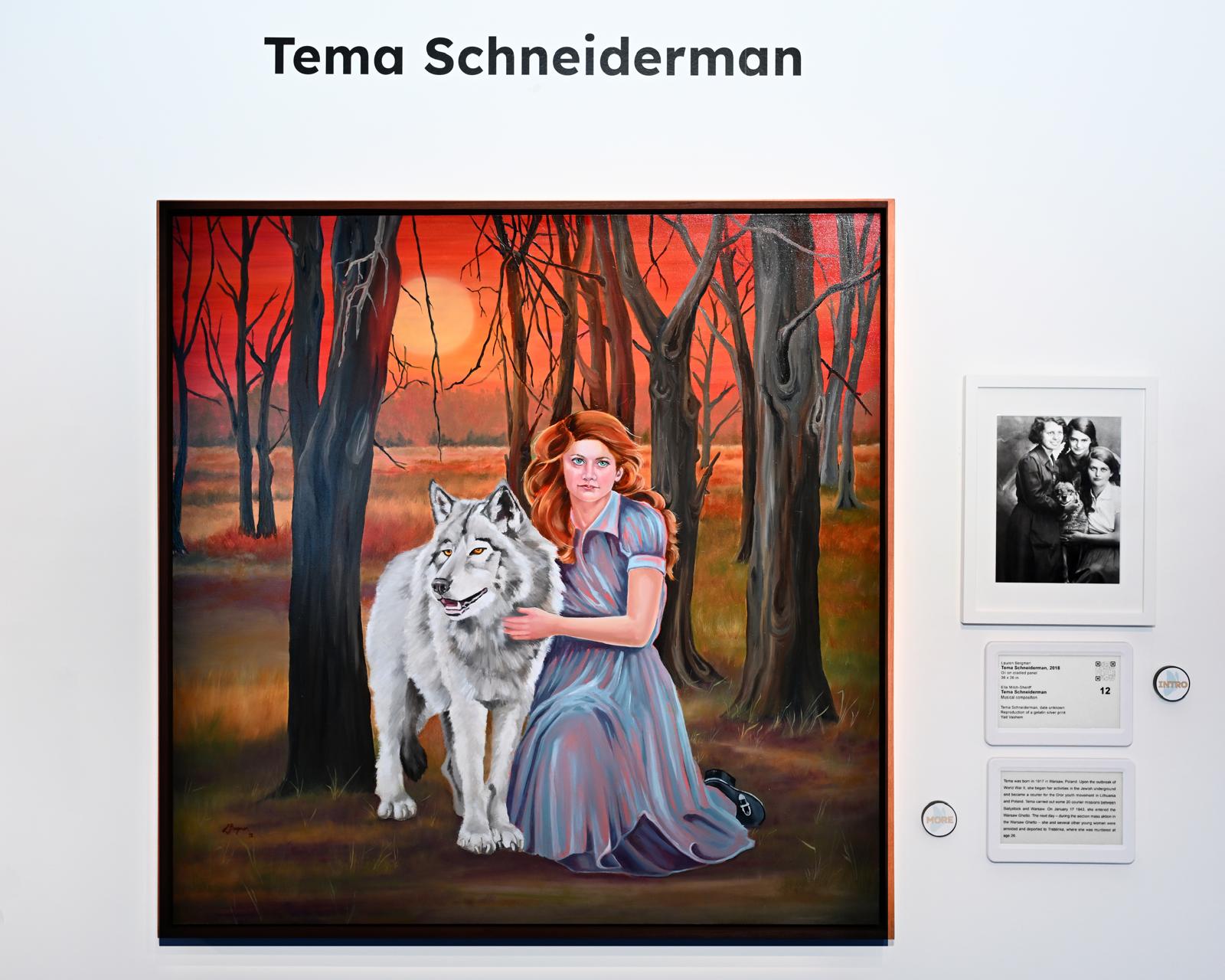
Lauren Bergman’s portrait of Tema Schneiderman beside an archival photograph.
Courtesy of LEDI.
In an archival photograph, three young women pose with a dog. One is Tema Schneiderman, a courier for the Jewish underground who carried messages and weapons between Białystok and Warsaw during the war. She made roughly twenty courier trips. In January 1943, she entered the Warsaw ghetto, where she was arrested and deported to Treblinka and murdered.
In Bergman’s painting, a white wolf stands beside her, representing her friends. But what caught my eye were the motorcycle boots. As was explained to me, Bergman gave Tema those boots because she thought Tema was a “badass.” And she sure was.
Through my headphones, I learned that the red sky reminded Ella Milch-Sheriff of the partisans’ song her father used to sing at bedtime. She worked a phrase into the music she composed for Tema. Of all the things I wished I could tell my dad about that day, this was one. A song a father sang to his little girl had found its way to me in a gallery in Jersey City.
When technology brings history to life
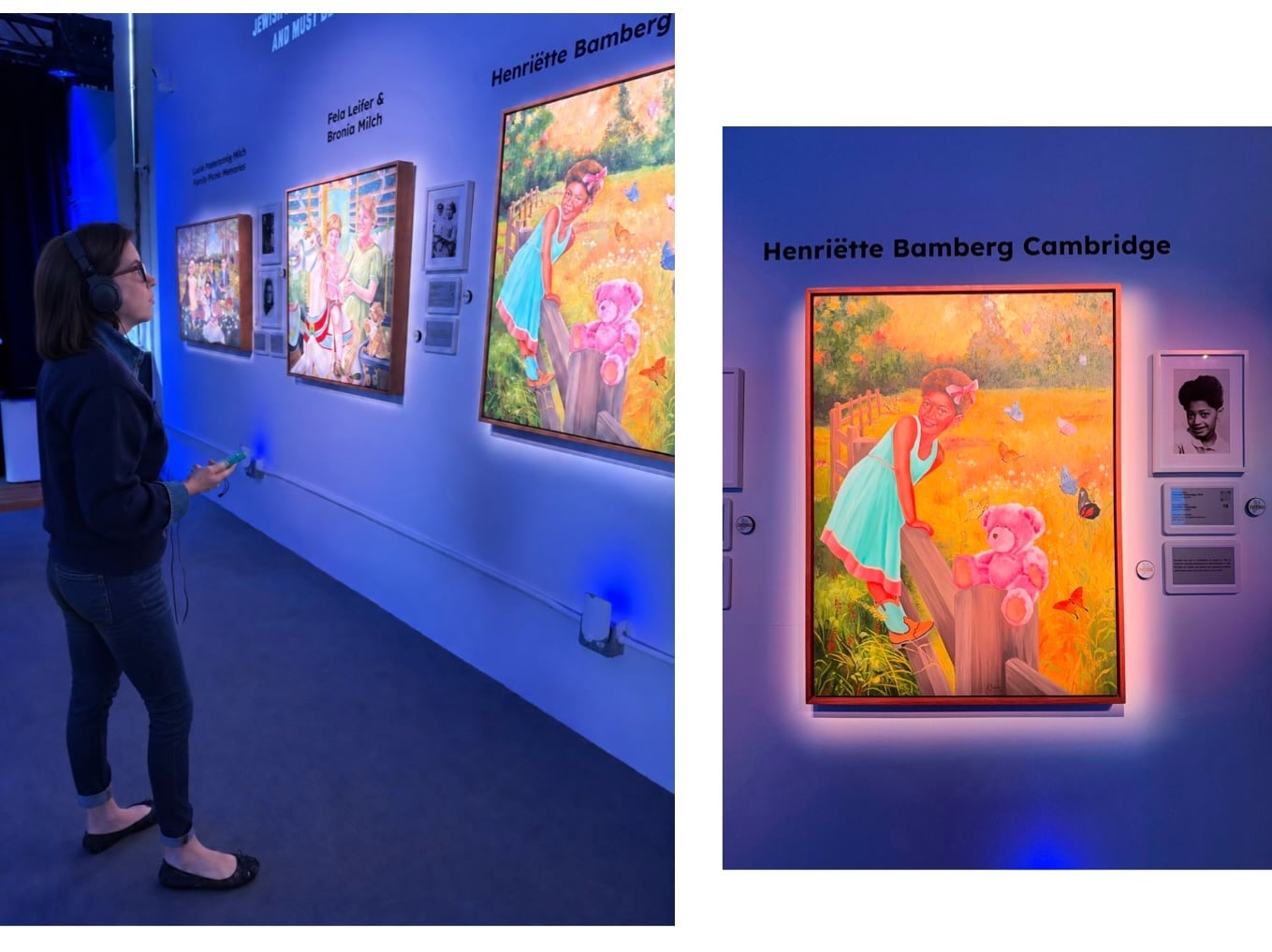 Photos: Author’s personal collection (left); courtesy of LEDI (right).
LEDI uses technology not to replace history but to bring visitors closer to the people behind it. I listened to the audio guide before Bergman’s portrait of Henriëtte, whose black-and-white photograph inspired a painting filled with butterflies and color.
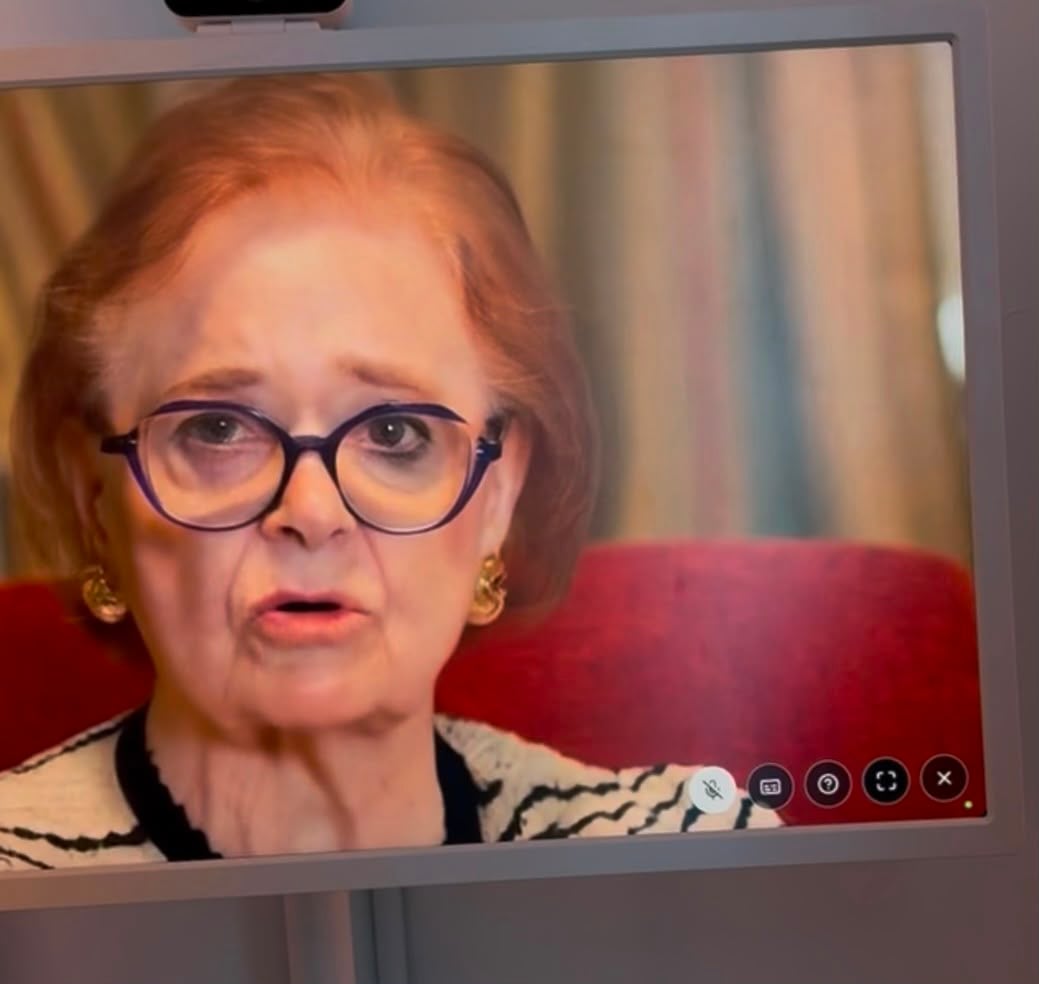 Virtual Lusia: visitors ask questions and receive responses based on recorded testimony. Photograph from the author’s collection.
At another station, “Virtual Lusia” lets visitors ask questions in their own words and receive AI-generated responses drawn from her recorded testimony. During our demonstration, a response invited us to imagine being fifteen. I have a teenage son. I know how much of his day revolves around soccer, school, and friends. By fifteen, Lusia had already spent years trying to survive.
In the film, you hear what Lusia chose to tell you. At the interactive station, a student gets to decide what to ask. After my mother wondered whether my dad had seen the film, I understood what it means to be able to ask a question while there is still time.
With a tap on an iPad, the team brought Tema’s portrait to life on a unique LED screen that hangs on the wall like a framed painting. My mother and I watched her tell us about her work as a resistance courier. The iPad does not create the animation. It cues it, the way it cues the entire exhibition, which runs as one automated experience. The animation itself was made in Adobe After Effects, with a great deal of careful work, and an AI tool was then used to sync Tema’s lips to her words. I was told this may be the last time the team does it that way. AI can now do it all.
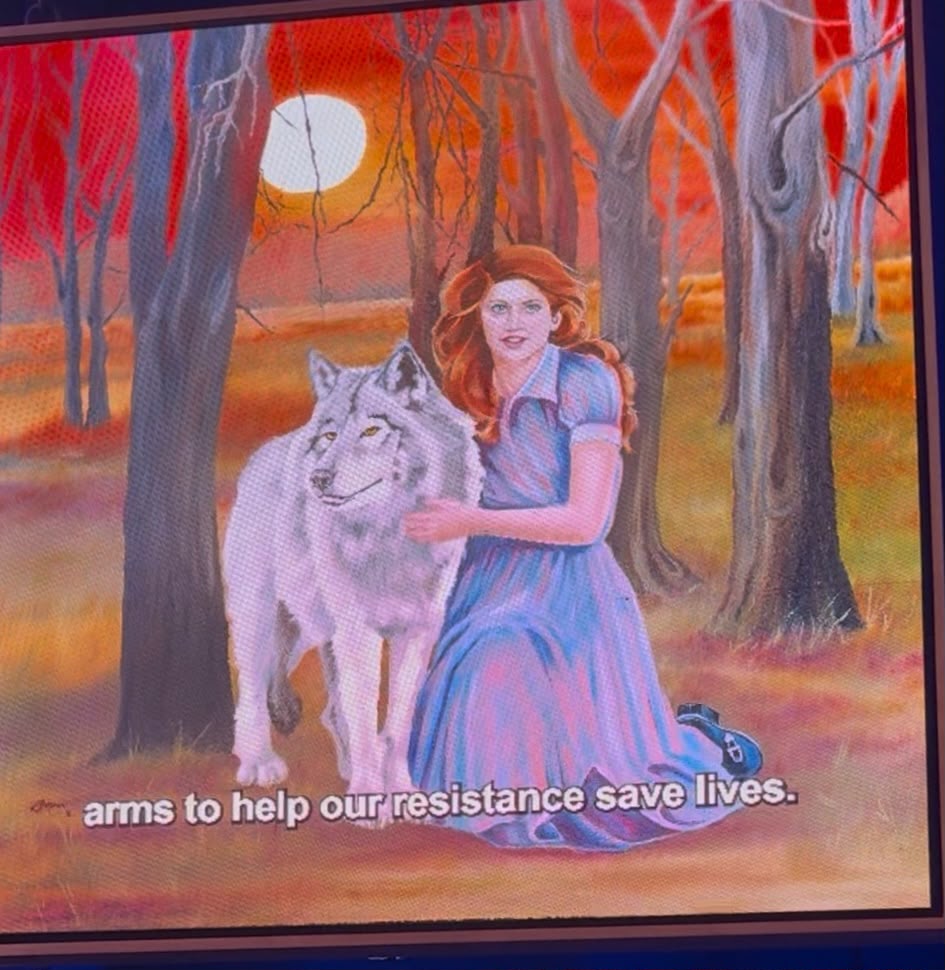 Animated portrait of Tema on a gallery screen. Photograph from the author’s collection.
Then I met Tema again in LEDI’s Roblox experience, Checkpoint Hearts Moments. Standing with the controller, I told Adam Holz, LEDI’s Director of Production, that my 14-year-old son, Alex, would appreciate this. For once, on a trip to learn about the Holocaust, my kid might be the one showing me around.
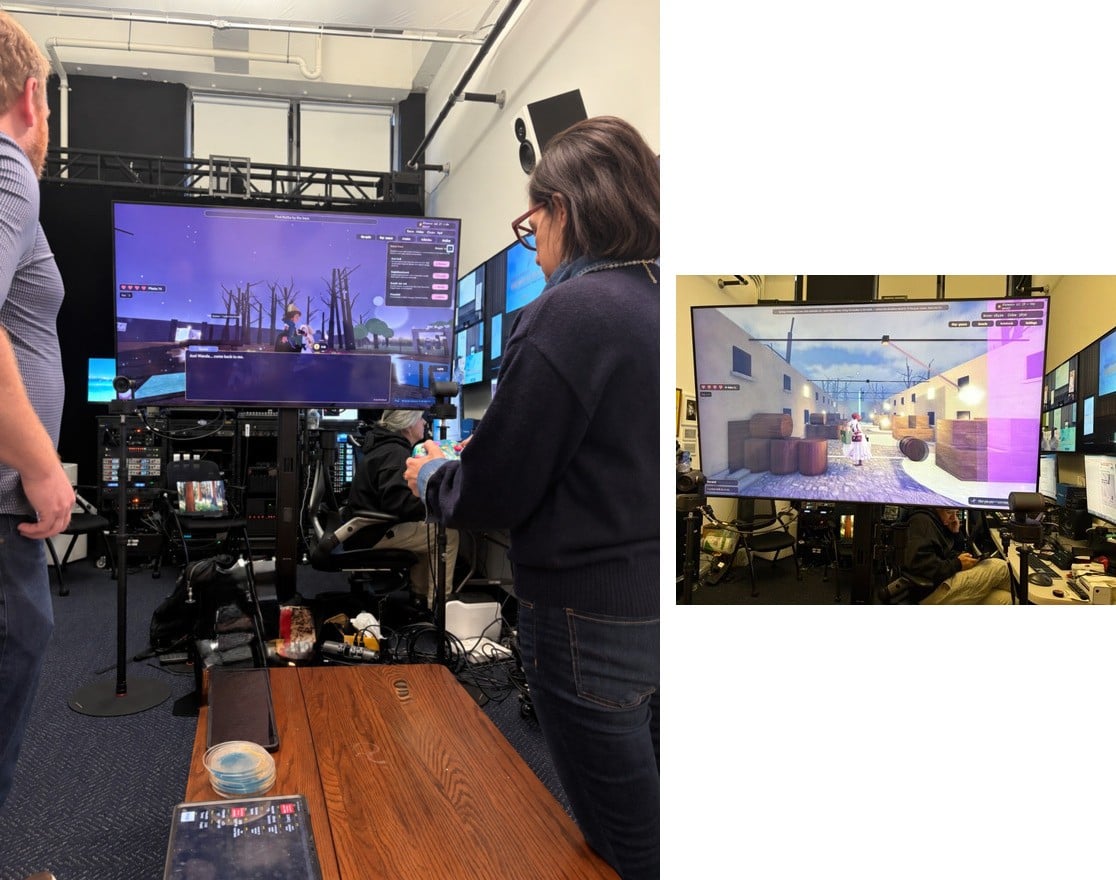 Playing the Roblox experience inspired by Tema’s courier work.
Photographs from the author’s collection.
I could show him Tema’s boots in the painting. He could tell me what he noticed in the game. We would be talking about the same courageous young woman. The team, including Director of Technology Gabriel Kurzlop, is also developing a virtual tour guided by Tema. And a version of the game made for older audiences is coming soon to iPhone, iPad, and Apple TV. LEDI has also released a music video, Checkpoint Hearts, that reimagines Tema’s life.
Technology earns its place when it helps someone recognize the person behind the image and leaves them wanting to understand more.
What happens after the visit?
LEDI’s most important question may be what happens when visitors leave. Do they simply remember what they saw? Or are they more willing to act when confronted with prejudice and hatred?
LEDI wants students to become upstanders, not bystanders. An upstander recognizes when someone is targeted and chooses to respond, in a classroom, a workplace, a group chat, or a conversation where a cruel assumption goes unchallenged.
The visit is not the end of the lesson. LEDI has produced a series of seven animated shorts on the roots of antisemitism, and teachers show one of them, Manetho’s Narrative, to their students back in the classroom, after the visit and before the students answer LEDI’s exit survey. It tells the story of what LEDI calls the first anti-Jewish narrative in a way that relates to the students and their lives. As the team puts it, you have got to meet them where they are.
LEDI says it has reached more than 29,600 students so far. According to LEDI’s reported student-impact findings, 96.6 percent of respondents said they gained a stronger understanding of prejudice and oppression; 95.2 percent recognized how art builds empathy; and 78.6 percent felt more confident standing up for someone in their community.
Those are encouraging responses. But the real test comes when the people doing the laughing are friends, when silence would be easier, when doing the right thing requires courage. Holocaust history must be taught in its specificity and enormity. Within that education, students can also learn to recognize how people are excluded, dehumanized, and persecuted. This is not merely preparation for a test. It is preparation for life.
If the world cannot come, bring LEDI to the world
An extraordinary exhibition means little if the people who could benefit never experience it. LEDI’s in-person educational program offers free admission for students and educators, with bus reimbursement available and lunch provided. Its curriculum, led by Executive Director of Education Alexandra Cirone, connects Holocaust history with prejudice, propaganda, empathy, and personal responsibility. Duval County Public Schools in Jacksonville, Florida, has adopted it as its official Holocaust curriculum, with Jersey City following suit. The full curriculum is also available online in an interactive, gradable version for schools worldwide.
Online lessons reach classrooms, while LEDI in a Box, a portable exhibition with miniature paintings, archival photographs, audio guides, and educational materials, can travel to schools and communities. There is now a second version built around six screens, and both can be shipped to schools. LEDI’s new app, LEDI TV, brings all of its content, in English and German, along with a virtual classroom of interactive videos, to Apple TV, iPhone, and iPad. LEDI also plans international educational programming, including a pilot in Germany that opens at a school near Berlin on December 7.
A principal can arrange a visit. A teacher can bring the program to students. A parent can begin a conversation that continues at dinner. For current visiting information and school programs, see LEDI’s website.
You don’t have to be Jewish. You only have to be human.
Near the end of our visit, my mother and I stood with David for a photograph in front of the paintings of his family. Behind us, Bronia Milch rides a carousel horse with Fela Leifer beside her. Nearby is Lusia’s family picnic. The three of us are smiling. I’m glad we have that picture. I wish my dad could have stood in it with us.
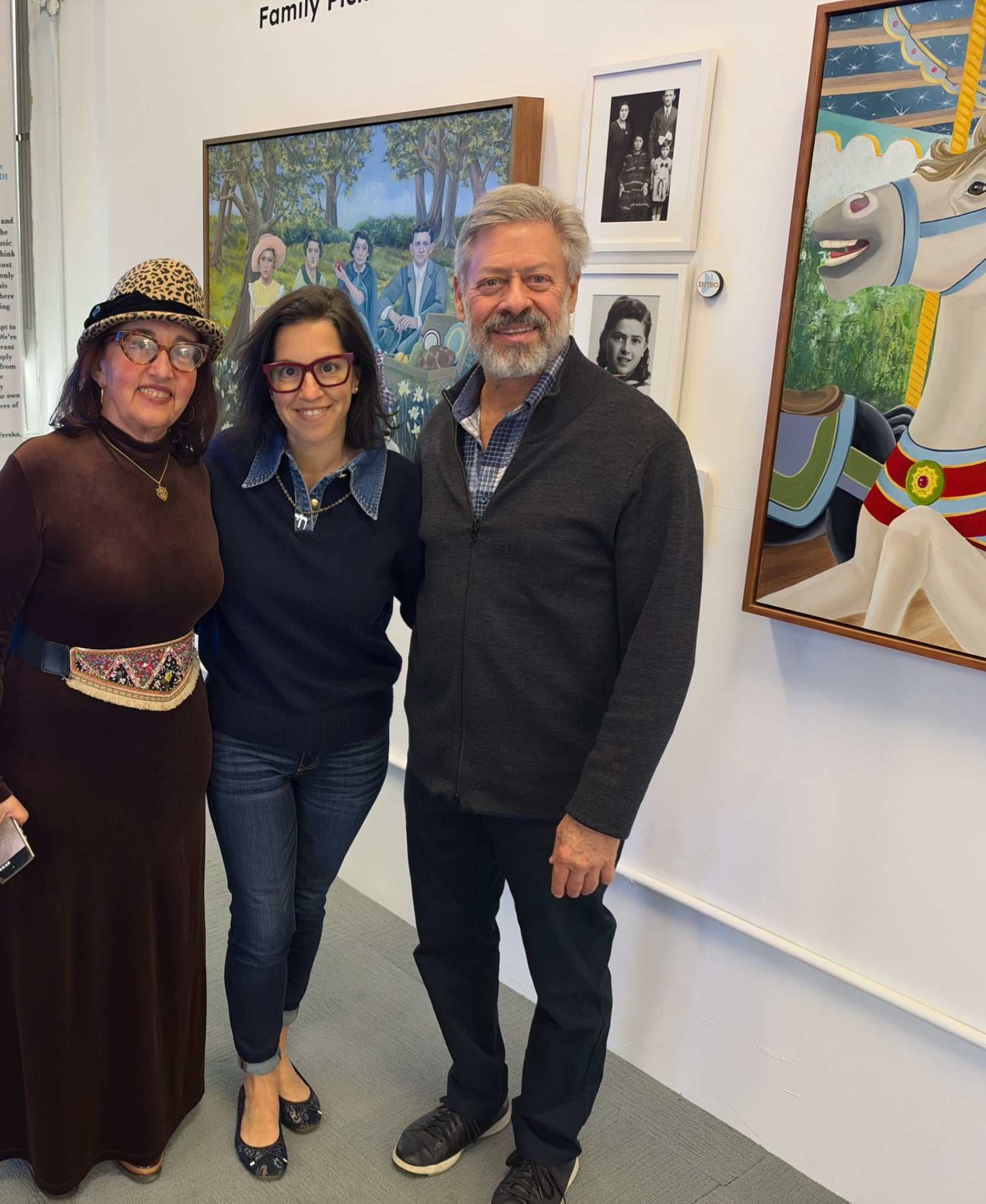 My mother, Anna Matathias, Dr. David M. Milch, and me in front of the Milch family paintings at LEDI. Photograph from the author’s collection.
As I write these words, a Facebook memory appears. Two years earlier, my father had written about an exhibition of Holocaust survivor portraits at our local library, where my mother and I had joined him. He spoke of preserving their stories and advancing Holocaust education, writing, “I am appreciative to have done my part.” And now, here I was, standing with my mother before another collection of portraits. Only this time, he wasn’t beside us.
He had spent his life making sure the world remembered those who survived. Now I was standing before the faces of those who never had a chance.
I grew up listening to my father teach the Holocaust. I thought I knew what to expect when I walked into LEDI. I didn’t expect to leave a changed woman, or to spend the drive home wishing I could tell my dad everything I had seen.
I want other families to have that experience. Not only Jewish families. Not only descendants of Holocaust survivors. Not only people who already understand this history.
I want Christian families, Muslim families, people of every faith and those of no faith to walk through these doors. I want teachers to bring students, parents to bring teenagers, and people who think the Holocaust has nothing to do with them to stand before Eva’s portrait and consider the life she never got to live.
I want a child who comes because of Roblox to leave knowing Tema Schneiderman’s name and understanding that courage is not merely something we admire in history. It is something we must practice.
I want those conversations to continue on the drive home, around the dinner table, and the next time someone hears a hateful remark and must decide whether to challenge it.
You do not need to be Jewish to recognize the humanity of a Jewish child. You do not need to share someone’s religion to defend their right to practice it. And you do not need to have suffered injustice yourself to recognize the responsibility to confront it.
You don’t have to be Jewish to visit LEDI. You only have to be human.
Bring your children. Bring someone who thinks they already know this history. Bring someone whose family never taught it.
Give these faces your attention. Listen to Lusia while she is here to tell you.
My father left us with these words: “And you do not need to have lived through the Holocaust to carry its lesson. You need only conscience — and courage.”
At 95, Lusia refuses to do nothing.
My father spent his life teaching us why.
Now the responsibility belongs to us.
What will we do with what she has given us?
Related Topics
Related Posts