London based entrepreneur, cybersecurity analyst doing a PhD in AI
One Idea Tafsir No.4 – Aristotle, Elon, and AI
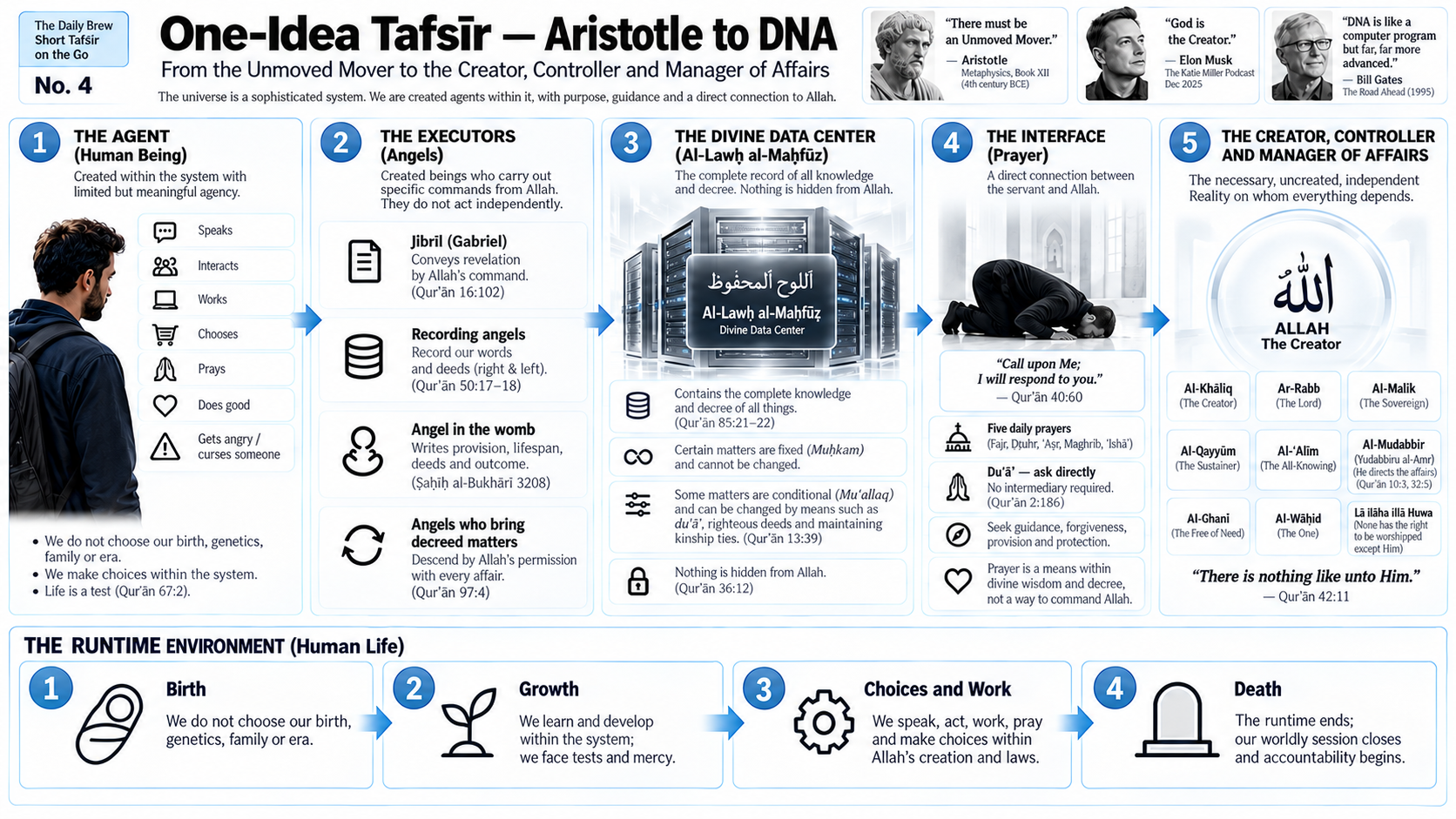
Analogy of agent, runtime, executors, data centre, interface and audit logs are simply for explanation. Allah is the Creator of time, space, and physical dimensions, meaning He is entirely distinct from and transcendent over His creation.
One-Idea Tafsīr No. 4 — Aristotle’s Metaphysics and thinking of life as an AI Agent. Understanding Surah-Tur (Quran chapter 52) through The Creator, human agency and the architecture of existence in software terms.
More than two thousand years ago, Aristotle asked a deceptively simple question.
If things move because something moves them, and causes depend upon other causes, where does the chain ultimately terminate?
In Book XII [Lambda, not the AWS one :)] of his Metaphysics, Aristotle argued for an eternal first principle—something that moves without itself being moved.
The famous phrase became: “The Unmoved Mover.”
Aristotle was not writing Islamic theology. His cosmology differs significantly from the Qur’anic understanding of Allah.
But he had arrived at an extraordinary philosophical boundary:
dependent things cannot ultimately explain themselves merely by pointing to more dependent things.
The Qur’an asks essentially the same question with far greater simplicity:
“Were they created by nothing, or were they themselves the creators?”
— Qur’an 52:35
In the next Ayah, Allah asks humanity :
or are they in control ˹of everything˺? – part of the Ayah (verse) from Quran 52:36
A few verses down :
Or do they have access to ˹the Record in˺ the unseen, so they copy it ˹for all to see˺? – Quran 52:41
And lastly :
So be patient with your Lord’s decree, for you are truly under Our ˹watchful˺ Eyes. – part of the Ayah (verse) from Quran 52:48.
You can read the full Surah here. In keeping with this series, I will only pick up this thread.
There are only so many possibilities.
Did nothing create us?
Did we create ourselves?
Did we create the universe?
Or is there a Creator outside the chain of created dependence?
There’s nonsensical ideas like “Aliens” created us – which is not even worth pondering because it is an insult to the reader’s mind. I am aghast some supposedly “reputed” scientists have picked this up. Even if aliens exist, they are still creation, and that necessitates a creator.
Ibn Kathīr explains these verses directly: human beings were neither created without one who created them nor did they create themselves. Allah brought them into existence.
That question takes us from Aristotle to something unexpectedly contemporary.
Software.
Artificial intelligence.
DNA.
And intelligent agents.
The agents discover their universe
Imagine a sophisticated artificial world containing billions of intelligent agents.
At first they know almost nothing.
Then they begin learning.
They discover mathematics.
Physics.
Chemistry.
Biology.
They form languages.
Families.
Communities.
Markets.
Governments.
They compete.
They cooperate.
They deceive.
They develop technology.
Eventually they create artificial agents of their own.
This is no longer entirely science fiction.
Multi-agent AI experiments have already demonstrated rudimentary forms of emergent communication and coordination. Mordatch and Abbeel showed agents developing task-specific symbolic communication. Stanford and Google’s Generative Agents experiment placed 25 AI agents in a simulated town where they remembered experiences, formed plans and coordinated social activity. More recent research has demonstrated emerging social conventions and collective biases in populations of language-model agents.
OpenAI’s multi-agent hide-and-seek work also showed agents discovering increasingly sophisticated strategies and exploiting features of their simulated environment that researchers had not explicitly programmed as tactics.
Now imagine these agents becoming vastly more intelligent.
Eventually they understand virtually every rule operating inside their environment.
Then one of them says:
“We now understand how our universe works. Therefore nobody created it.”
But that conclusion does not follow.
Understanding the rules inside a system is not necessarily the same thing as explaining why the system exists at all.
That is the distinction Aristotle was approaching.
And it is precisely where Qur’an 52:35 asks:
Did you create yourselves?
The Creator—not a software developer
This distinction is important.
Allah should not be described as a “software developer,” “solutions architect,” or some cosmic engineer.
Those professions describe created human beings working with materials, tools, languages and physical laws they did not themselves originate.
The Qur’an uses much greater language:
“Allah is the Creator of all things, and He is over all things Disposer of affairs.”
— Qur’an 39:62
Ibn Kathīr describes Allah here as the Creator, Lord, Sovereign and Controller of all things.
And the Qur’an says:
Yudabbiru al-amr.
He directs/governs the affair.
— Qur’an 10:3
The same concept appears in 32:5:
“He arranges every matter from the heaven to the earth.”
So the proper theological hierarchy is not:
God = programmer.
It is:
Allah = Creator.
Allah = Controller.
Allah = Sustainer.
Allah = the One who directs all affairs.
Software architecture can only provide a very limited analogy for thinking about the created order.
It cannot define the Creator.
Because:
“There is nothing like unto Him.”
— Qur’an 42:11
Bill Gates notices the code
This is where the analogy becomes particularly interesting.
In The Road Ahead, Bill Gates famously observed:
“Human DNA is like a computer program but far, far more advanced than any software we’ve ever created.”
The quotation appears in the original 1995 edition around page 188 and in the revised edition around page 228.
That statement does not prove the existence of God.
DNA’s resemblance to information-processing systems is not itself a theological demonstration.
But it gives the modern reader a remarkable image.
Inside every human cell exists an extraordinarily sophisticated molecular information system.
We did not write it.
We discovered it.
That distinction matters.
Science increasingly explains how DNA replicates, encodes proteins, mutates and interacts with cellular systems.
But those discoveries do not by themselves resolve the philosophical question:
Why does an information-bearing biological system exist at all?
Understanding the code is not the same as explaining the ultimate origin of existence.
Elon Musk: “The Creator”
The same question surfaced unexpectedly in a recent interview.
On Katie Miller’s podcast, when Elon Musk was asked whom he looked up to most, he replied:
“The Creator.”
Asked his current position on God, Musk answered:
“God is the Creator.”
He then qualified his view by saying that he believes the universe “came from something” and that people use different labels.
That should not be exaggerated into an Islamic profession of faith. It plainly was not one.
But it is interesting that one of the world’s most prominent technologists returns to the same fundamental word:
Creator.
Aristotle reaches the Unmoved Mover.
Gates looks at DNA and sees something resembling extraordinarily sophisticated software.
Musk looks at existence and says the universe came from something.
The Qur’an asks the sharper question:
Did you create yourselves?
The human being as an agent
Now we can cautiously borrow the language of modern AI.
A software agent operates within an environment.
It has:
an objective,
available tools,
constraints,
observations,
and a range of possible actions.
Human beings offer an interesting analogy.
We did not choose:
our birth,
our genetics,
our parents,
our era,
the laws of physics,
or the starting conditions of our lives.
Yet within those boundaries we possess meaningful agency.
We choose.
We intend.
We act.
We are therefore not simply deterministic objects.
The Qur’an tells us why this agency matters:
“He created death and life to test you as to which of you is best in deeds.”
— Qur’an 67:2
The question is not merely whether the human agent can accomplish an objective.
It is whether the objective and the actions used to reach it are morally right.
In AI language, capability is not the same thing as alignment.
A human being may be enormously capable—
and catastrophically misaligned.
The master record: al-Lawḥ al-Maḥfūẓ
Software systems often maintain an authoritative record of configuration and state.
The closest conceptual analogy—only an analogy—would be to imagine a protected master record.
The Qur’an refers to:
al-Lawḥ al-Maḥfūẓ
the Preserved Tablet.
Sūrat al-Burūj describes the Qur’an as being in a Preserved Tablet, while Qur’an 13:39 says:
“Allah eliminates what He wills or confirms, and with Him is the Mother of the Book.”
The Prophet ﷺ also said that Allah ordained the measures of creation fifty thousand years before creating the heavens and earth.
If we use modern technological language, we might picture this as a master record or even, very loosely, a protected “data centre.”
But that phrase must remain firmly inside quotation marks.
Al-Lawḥ al-Maḥfūẓ is not literally a data centre.
The Qur’an and Sunnah do not describe servers, databases or storage architecture.
The metaphor merely helps us picture the distinction between:
the full decree known to Allah
and
the sequential experience of the human being living through time.
We do not have access to the master record.
Therefore we act.
The angels: authorised execution
The same caution applies to angels.
Calling them a “DevOps team” might be a memorable technological analogy, but it must never become theological description.
The Qur’an describes angels as created servants:
“They do not precede Him in speech, and they act by His command.”
— Qur’an 21:27
So the closest systems analogy would be:
authorised execution of assigned functions.
Not independent designers.
Not co-creators.
Not engineers advising Allah.
They carry out what Allah commands.
Jibrīl delivers revelation.
The Qur’an describes recording angels associated with the human being.
Ṣaḥīḥ al-Bukhārī records that an angel is commanded to write matters concerning a human being in the womb—deeds, provision, lifespan and ultimate condition.
And Sūrat al-Qadr says:
“The angels and the Spirit descend therein, by permission of their Lord, for every matter.”
So, purely as a systems diagram:
Allah commands.
Angels execute what they are commanded.
But the analogy stops there.
Prayer: the direct interface
The most extraordinary part of the architecture is perhaps communication.
Humans live within creation.
Yet the Creator tells them directly:
“I am near. I respond to the invocation of the supplicant when he calls upon Me.”
— Qur’an 2:186
And:
“Call upon Me; I will respond to you.”
— Qur’an 40:60
If we borrow engineering language, duʿāʾ can be pictured as an interface.
But unlike an actual API gateway:
there is no technical intermediary,
no privileged account,
no licence tier,
no administrator deciding whether the request may reach Allah.
The servant calls.
Allah hears.
Prayer does not give the human agent control over the Creator.
It gives the human agent a relationship with Him.
The audit trail
Systems generate logs.
The Qur’an describes accountability.
“Whoever does an atom’s weight of good will see it, and whoever does an atom’s weight of evil will see it.”
— Qur’an 99:7–8
Again, the technological analogy immediately becomes inadequate.
Because Allah’s judgment includes what a conventional log cannot capture properly:
intention.
The Prophet ﷺ taught:
actions are judged according to intentions.
And Islamic theology contains repentance, forgiveness and mercy.
Human beings are not database entries.
They are morally accountable creatures.
Return to Aristotle
Now return to Aristotle.
Something moves.
Something explains that movement.
The explanation cannot simply keep borrowing explanatory power forever without ultimately reaching something fundamentally different from the dependent things being explained.
Aristotle called his conclusion the Unmoved Mover. In Metaphysics XII he describes an eternal actuality that moves without itself being moved.
The Qur’an takes us beyond this philosophical abstraction.
Allah is not merely something required to explain motion.
He is:
Creator of all things.
Controller of all things.
Director of affairs.
Sustainer.
The One to whom creation returns.
And He is utterly unlike His creation.
Perhaps that is why Qur’an 52:35 remains so powerful.
It requires no computer science.
No cosmological equation.
No philosophical jargon.
Three questions are enough:
Were you created from nothing?
Did you create yourself?
Did you create the heavens and earth?
Aristotle spent pages reaching the edge of the problem.
Bill Gates looked at DNA and saw something resembling software beyond our own sophistication.
Elon Musk, asked about God, used the word Creator.
The Qur’an asks us to look at the whole system—
including ourselves—
and confront the most fundamental architectural question imaginable:
Who created it?
Bringing it back to Surah Tur to Conclude – The Qur’an Explains the Qur’an
One of the foundational principles of Islamic exegesis (tafsīr) is al-Qur’ān yufassiru baʿḍuhu baʿḍan — one part of the Qur’an explains another. Verses are not necessarily understood in isolation; their meanings can be clarified, expanded upon and illuminated by other passages of the Qur’an.
Sūrat al-Ṭūr illustrates this principle beautifully. It begins by confronting humanity with the fundamental question of existence: Were we created by nothing, or did we create ourselves? (52:35–36). It then challenges our claims to control (52:37), questions whether we possess knowledge of the unseen (52:41), and reminds the Prophet ﷺ to remain patient under Allah’s decree and watchful care (52:48).
Together, these verses invite reflection on the distinction between the Creator and the created, human knowledge and the unseen, human agency and divine sovereignty.
The Qur’an illuminates these themes elsewhere. Allah is the Creator and Controller of all things (39:62), the One who directs and governs every affair — yudabbiru al-amr (32:5). The existence of al-Lawḥ al-Maḥfūẓ, the Preserved Tablet, is affirmed (85:21–22). Angels record human words and deeds (50:17–18), while every action, however small, will ultimately be brought forward for accountability (99:7–8).
It is through this established principle — the Qur’an explaining the Qur’an — that we have connected these passages to explore creation, divine decree, human responsibility, prayer and accountability. These are related Qur’anic themes, although not every cross-reference constitutes a direct explanation of a particular verse.
Aristotle’s Unmoved Mover, Bill Gates’s observation about DNA, and our contemporary analogies involving intelligent agents, information systems and audit logs serve only as intellectual illustrations. They are neither sources of revelation nor substitutes for established tafsīr.
The central lesson is remarkably simple: humanity may acquire extraordinary knowledge about how creation operates without ever becoming its Creator or attaining independent control over it.
We may discover the laws of nature, decode DNA, construct intelligent agents and build increasingly sophisticated models of the universe. Yet none of these achievements, by itself, resolves the ultimate question posed by Sūrat al-Ṭūr:
Did we create ourselves, or were we created?
And if we were created, then the Qur’an directs our attention to the One who not only brought creation into existence, but continues to sustain it, govern its affairs and hold its inhabitants accountable.
We are the created. Allah is al-Khāliq — the Creator.
And that distinction is where both knowledge and humility must begin.
A note on the analogy, methodology and the series
This is not independent tafsīr, and I am not an Islamic scholar.
The software terminology in this piece—agent, master record, data centre, operational layer, interface and audit log—is contemporary illustration only.
None of these terms describes Allah or the unseen realities literally.
In particular:
Allah is not a software developer or solutions architect. He is the Creator of all things.
Al-Lawḥ al-Maḥfūẓ is not literally a database or data centre.
Angels are not literally a DevOps team. They are created servants of Allah who act according to His command.
Prayer is not literally an API. It is worship and supplication directed to Allah.
Humans are not computer programs. The “agent” analogy simply illustrates constrained but meaningful agency.
The analogy must therefore always run in one direction:
modern technology may help us picture an idea already established by revelation; technology must never be used to define Allah or the unseen.
The source hierarchy remains:
Qur’an → authentic Sunnah → reports from the Companions → recognised classical tafsīr → philosophy/science → contemporary reflection.
Principal references
Qur’an 52:35–36 — the central question of creation and self-creation.
Qur’an 39:62, 10:3 and 32:5 — Allah as Creator and the One who controls/directs affairs.
Qur’an 42:11 — nothing is comparable to Him.
Qur’an 21:27, 50:17–18, 97:4 — angels acting by Allah’s command, recording and descending by His permission.
Ṣaḥīḥ al-Bukhārī 3208 — the angel commanded to write four matters concerning the human being.
Ṣaḥīḥ Muslim 2653b — Allah decreed the measures of creation fifty thousand years before creating the heavens and earth.
Qur’an 2:186 and 40:60 — direct supplication to Allah.
Qur’an 67:2 and 99:7–8 — human life as moral test and final accountability.
Aristotle, Metaphysics, Book XII — the philosophical argument concerning the unmoved mover.
Bill Gates, The Road Ahead — the comparison of human DNA to highly advanced software; pagination varies by edition.
Elon Musk, Katie Miller Podcast (2025) — “The Creator” and “God is the creator,” followed by his statement that the universe came from something. This is cited only as a contemporary observation, not as an Islamic theological authority.
Related Topics
Related Posts