London based entrepreneur, cybersecurity analyst doing a PhD in AI
One Idea Tafsir No.5 – The Engineering Masterclass
Check the video at 7:13 to 11:54 for Eagles and Wingtip vortices application to the Airbus A380.
This article reflects on what Biomimicry can teach us about creation and I pick 4 specific examples.
If you have less time, Check the video at 8:43 to 9:55 for the video on Eagles and Wingtip vortices.
The Daily Brew — One-Idea Tafsīr No. 5
Sūrat al-Ghāshiyah (Chapter 88): Nature’s Engineering Masterclass
What can a camel teach an engineer? Why are climbing shoes inspired by mountain goats, aircraft designers studying owl feathers, wind-turbine engineers examining humpback whale fins, and aeronautical engineers learning from the wingtips of soaring eagles?
In this fifth instalment of One-Idea Tafsīr, we explore biomimicry—the science of learning from nature to solve human engineering problems.
Sūrat al-Ghāshiyah invites us to look beyond the familiar and contemplate the extraordinary features of creation. Modern science allows us to examine those features in remarkable detail, revealing ingenious biological adaptations that inspire technologies we use today.
The central idea is simple: humanity is still learning to engineer solutions from the natural world it did not create.
This is a contemporary reflection inspired by the Qur’an and classical tafsīr, not a substitute for scholarly interpretation. Its purpose is to encourage curiosity, contemplation and gratitude to Allah, al-Khāliq—the Creator.
Imagine entering a modern engineering laboratory.
Two scientists are examining the airflow around an aircraft wing. On one screen is a detailed computer simulation. On another, a magnified image of an owl’s feather.
They are trying to solve a difficult engineering problem: how can aircraft become quieter?
Their inspiration is an animal that has been flying almost silently through forests for thousands of years.
Elsewhere, engineers are studying the hooves of mountain goats to improve climbing shoes, the flippers of humpback whales to improve wind turbines, and the wingtips of soaring birds to improve aircraft efficiency.
There is a name for this approach.
Biomimicry: learning from biological structures and processes to solve human engineering problems.
But the Qur’an invites us to consider creation through an even deeper question.
In Sūrat al-Ghāshiyah, Allah asks:
أَفَلَا يَنظُرُونَ إِلَى الْإِبِلِ كَيْفَ خُلِقَتْ
“Then do they not look at the camels—how they are created?”
— Qur’an 88:17 (complete verse; Saheeh International translation)
You can read the full Surah (Chapter of the Quran) here.
Notice the instruction.
Look at the camel.
Consider how it is created.
The Qur’an then directs our attention towards the sky, mountains and earth (88:18–20).
Ibn Kathīr explains that these familiar creations demonstrate Allah’s power and greatness, inviting humanity to contemplate what surrounds us.
Let us apply that invitation to five extraordinary examples of biology—and the technology humanity has developed by studying them.
1. The camel: An extraordinary desert survival system
Consider the camel.
A large animal travelling through landscapes characterised by heat, sand and scarce water.
Its anatomy contains several remarkable adaptations.
The feet: Broad, cushioned feet spread the animal’s weight over soft sand, helping prevent excessive sinking. Their structure is very different from the narrow hooves of many other large mammals.
The eyes: Long eyelashes and protective eyelids help defend against windblown sand.
The nostrils: Camels can narrow or close their nostrils to reduce the entry of sand. Their nasal passages also help conserve moisture from exhaled air.
The hump: Contrary to popular belief, the hump does not store water. It primarily stores fat, which can be metabolised when food is scarce.
The kidneys: Highly efficient water conservation enables camels to produce concentrated urine and minimise unnecessary fluid loss.
The coat and body temperature: Insulation and the ability to tolerate fluctuations in body temperature help reduce heat stress and water expenditure.
The camel’s adaptations offer useful parallels for engineering challenges involving off-road traction, insulation and water conservation.
But we should distinguish a biological resemblance from a documented invention. Not every desert tyre or water-efficient system was directly copied from camel anatomy.
The key observation remains extraordinary:
The camel is not equipped with one desert survival feature. Multiple anatomical and physiological systems work together.
This is the animal the Qur’an specifically asks us to contemplate.
2. The mountain goat: Nature’s climbing shoe
Now leave the desert and climb into the mountains.
The North American mountain goat, Oreamnos americanus, negotiates steep, narrow and irregular rocky surfaces with astonishing confidence.
The secret begins with its hooves.
Each has two principal digits, forming a split or cloven structure.
A hard outer keratin edge engages tiny ledges and projections.
A softer inner pad conforms to irregular rock and generates friction.
The toes can spread, helping the hoof accommodate uneven footholds.
But the hoof is only one component.
Short, sturdy limbs, powerful shoulders and neck musculature, together with the coordinated action of joints and soft tissues, help the animal climb.
A 2016 biomechanical study examined a mountain goat ascending a 45-degree slope and demonstrated the importance of hindlimb propulsion and forelimb-assisted lifting.
Now consider what human engineers have done.
In 2024, footwear manufacturer INOV8 introduced its ROCLITE GTX hiking range with outsole cleats explicitly inspired by mountain-goat hooves.
The design borrowed aspects of the split-hoof shape to improve traction and water dispersal on wet rocks.
This is not merely a theoretical similarity.
A manufacturer studied an animal’s foot and incorporated its mechanical principles into commercial footwear.
3. The owl: Teaching Airbus how to reduce noise
An owl can approach its prey with remarkably little flight noise.
How?
Part of the answer lies in its feathers.
Many owl species possess three distinctive features associated with quiet flight.
Comb-like leading-edge serrations: These influence how air encounters the front of the wing.
Soft trailing-edge fringes: These modify airflow as it leaves the wing, helping suppress noise.
Velvety feather surfaces: Fine structures on the feathers contribute to the owl’s specialised acoustic properties.
Together, these adaptations help reduce sound generated by turbulent airflow.
Engineers investigating quieter aircraft have taken notice.
Airbus has publicly described studying owl-inspired technologies, including brush-like fringes and specialised surface coatings.
Researchers have also tested owl-inspired serrations and feather-like structures for reducing aerodynamic noise.
An important distinction: Airbus studying these designs does not mean the feathers have already been copied into every Airbus aircraft. Some applications remain research concepts.
Nevertheless, the principle is compelling.
A creature that hunts quietly offers researchers a potential solution to one of aviation’s persistent problems.
4. The humpback whale: Improving wind turbines
Consider the humpback whale.
Despite its enormous size, it can perform surprisingly agile manoeuvres underwater.
One fascinating adaptation appears along the front edge of its pectoral flippers.
These are called tubercles.
They are rounded bumps arranged along the flipper’s leading edge.
Rather than presenting a completely smooth surface, the bumps influence the movement of water across the flipper.
Under certain conditions, they help maintain lift and delay the loss of effective flow around the surface.
Engineers realised that a similar principle might benefit wind-turbine blades.
Wind turbines operate in air rather than water, but both systems involve fluid moving across lifting surfaces.
Researchers have developed and tested blades with whale-inspired leading-edge bumps.
Studies show that particular configurations can improve performance, especially in some conditions where airflow would otherwise separate from the blade.
However, the benefits depend on the blade design and operating conditions. A whale-inspired modification is not universally more efficient.
The central innovation is clear:
An adaptation found on a whale’s flipper can inspire improvements to machines designed to harvest wind energy.
5. The eagle: The inspiration behind aircraft winglets
Watch an eagle soaring.
Its outer flight feathers can spread into distinct, finger-like tips.
These arrangements influence airflow around the wingtip.
Aircraft engineers face a related problem.
Air moving around the tips of aircraft wings produces vortices that contribute to aerodynamic drag.
Drag means more energy is required to maintain flight.
One important solution is the winglet: an upward or otherwise specially shaped extension at the end of an aircraft wing.
NASA engineer Richard Whitcomb developed influential modern winglet designs during the 1970s.
NASA records that his work was partly inspired by his observations and analysis of airflow around the wingtips of soaring birds.
The resulting designs also depended on substantial aerodynamic theory, wind-tunnel testing and engineering development.
Modern winglets reduce induced drag and can improve fuel efficiency.
They are now familiar features of commercial aircraft.
The eagle’s separated wingtip feathers and an aircraft’s rigid winglet are not identical structures.
But they address a related aerodynamic challenge.
Once again, observing nature helped inform human engineering.
6. And what about the human foot?
There is another remarkable example much closer to us.
Look beneath your own heel.
Under the heel bone is a specialised fat pad, containing numerous fat-filled compartments surrounded by fibrous tissue.
Its structure helps absorb and distribute impact during walking.
The foot’s arches, supported by bones, ligaments and tendons, contribute to load-bearing, stability and elastic energy storage.
The plantar fascia provides further support during movement.
The foot therefore acts as a complex mechanical structure, combining shock absorption, flexibility and propulsion.
Modern footwear designers study these anatomical properties when developing cushioning, arch support and impact-management systems.
Not every shoe is an example of direct biomimicry. But anatomical research remains fundamental to footwear engineering.
The point is that we ourselves contain remarkable biological systems that engineers are still learning to understand and accommodate.
7. The Qur’anic invitation: Look, study and reflect
Return to Sūrat al-Ghāshiyah.
The verse does not tell us to invent an aircraft or develop climbing shoes.
Nor does it provide technical instructions for aerodynamic design.
Its message is more fundamental.
Look at creation.
The original audience knew camels.
They encountered them regularly.
Yet the Qur’an asks them to reconsider something familiar.
Ibn Kathīr describes the camel as an extraordinary creature: powerful yet manageable, capable of carrying great loads while providing milk, meat and useful fibres.
The verse invites contemplation of the Creator’s power.
Modern science allows us to investigate that same natural world in unprecedented detail.
We can magnify an owl feather.
Measure the forces acting through a goat’s hoof.
Visualise fluid flow around a whale flipper.
Analyse an eagle’s wingtip.
Or examine the microscopic compartments beneath the human heel.
These investigations reveal physical mechanisms and help us develop technologies.
They do not, by themselves, establish a scientific proof of divine creation. Biomimicry is an engineering method, while belief in Allah as Creator is a theological conviction informed by revelation.
For the believer, however, discovering the workings of creation can become an occasion for gratitude and reflection.
The Qur’an’s invitation to observe is compatible with asking careful scientific questions and following the evidence wherever it leads.
Overall Principle : Nature teaches. Humanity learns.
The camel survives demanding desert conditions.
The mountain goat climbs steep cliffs.
The owl flies quietly.
The humpback whale manoeuvres through water.
The eagle soars efficiently.
The human foot absorbs the repeated impacts of daily movement.
Across these examples, the same pattern emerges.
Biological structures perform useful functions. Scientists investigate those functions. Engineers sometimes borrow the underlying principles to solve human problems.
What once appeared to be simply an animal’s unusual physical feature becomes the starting point for a technological innovation.
This brings us back to the Qur’an.
“Then do they not look at the camels—how they are created?”
— Qur’an 88:17
Perhaps the great lesson of this verse is that we should never become so accustomed to the natural world that we stop contemplating it.
The closer we look, the more there is to investigate.
And for the believer, every such investigation offers another opportunity to reflect upon Allah, al-Khāliq—the Creator.
Sometimes that reflection begins with a telescope pointed toward the stars.
Sometimes with an aircraft in a wind tunnel.
And sometimes, just as the Qur’an asks us to do, with a camel.
Note on method
I am not an Islamic scholar. This article is a contemporary Qur’anic reflection intended to encourage further reading, not an independent scholarly tafsīr.
Sūrat al-Ghāshiyah 88:17 specifically mentions the camel. The mountain goat, owl, humpback whale, eagle and human foot are modern scientific illustrations of the broader invitation to contemplate creation.
Scientific explanations, documented engineering applications and theological reflections have been distinguished throughout.
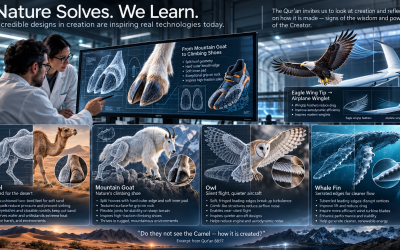
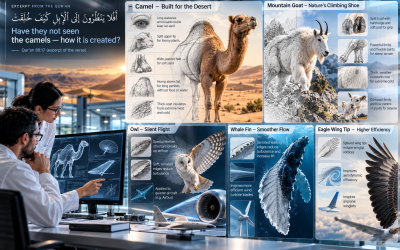
Images for illustration only. AI generated and may inadvertently contain mistakes, or inaccuracies and some shapes are not anatomically accurate or as per engineering drawings. For explanation only.
Further Biomimetic Engineering Information below
3. Whale Fin Tubercles used in Wind Turbine Design here.
4. Inov8 Hiking Shoes inspired by Mountain Goat –
Quote from article by Inov8:-
“The shape of the new outsole cleats are inspired by the cloven hooves of the mountain goat.
“Cloven hooved mammals have an almost finger-like dexterity and their split hooves – together with a hard outer shell and soft inner pad – provide incredible traction in their steep-sided, precarious habitats. We’ve looked to replicate this split hoof shape in our design.
“Our significant research also shows that the split design helps better disperse underfoot water and so provides better grip on wet rocks.
“The outsole combines with the other design elements to make the new ROCLITE shoes and boots super-nimble, sticky and light, weighing 365g and 425g respectively.”
This should give everyone a chance to pause, reflect and think about saving the natural environment and the multiple species and subspecies which are being subject to war, logging companies, Google’s Data Centre in Finland amongst other things.
Principal references
Qur’an and classical tafsīr
Biology and engineering
- University of Nairobi — Camel Husbandry, Health and Welfare Handbook
- INOV8 — Hiking Footwear Inspired by Mountain Goats
- Lewinson & Stefanyshyn (2016) — Mountain-Goat Climbing Mechanics
- Airbus — Biomimicry: A Fresh Approach to Aircraft Innovation
- Schmidt & Redonnet (2024) — Wind Turbine Blades with Whale-Inspired Tubercles
- NASA — Richard T. Whitcomb and Winglet Development
- NCBI — Anatomy of the Human Foot’s Medial Longitudinal Arch
- Research on the Human Heel Fat Pad
Related Topics