
Writer covering Israel–Africa, Jewish affairs, and Israel worldwide
One Israel Says Sorry. The Other Says Never Again.
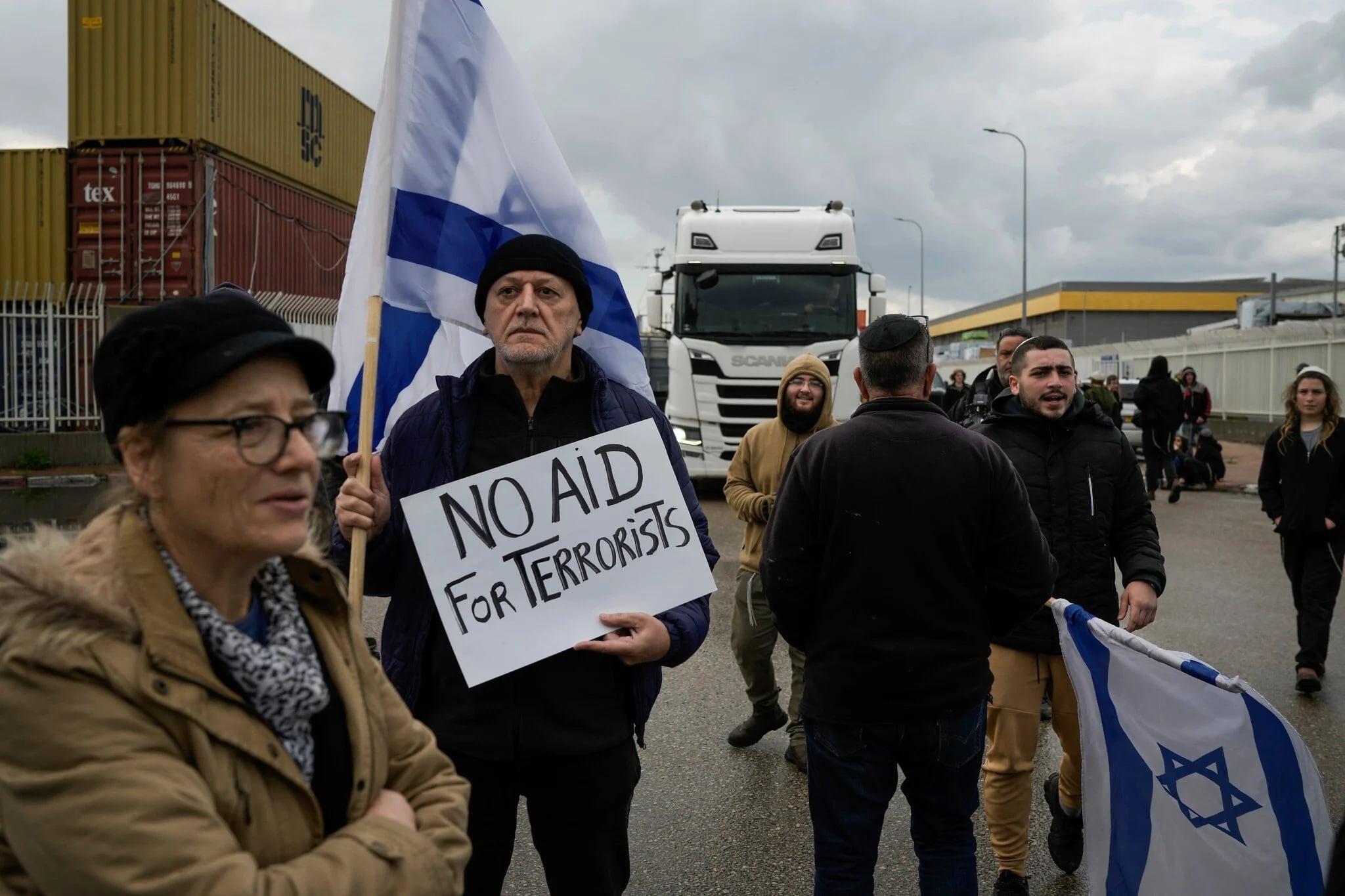
File - Protesters block the exit of Ashdod port to stop trucks they claim are carrying humanitarian aid destined for the Gaza Strip, in Ashdod, February 1, 2024. (AP Photo/Leo Correa)
One Israel wants to be loved. The other would settle for being left alive. It is a difference in priorities that becomes rather important when your neighbours have organizations that regard your disappearance as a political objective.
I have come to recognize two sharply contrasting sides of Israeli society. One seems perpetually convinced that Israel must have done something wrong. Whenever a security crisis erupts, it looks inward for the Israeli policy that needs correcting, the settlement that needs dismantling, the territory that needs surrendering, or the concession that might finally persuade its enemies to reconsider their hostility.
The other side begins with a less comforting possibility: that Israel’s enemies have ambitions of their own, that Jewish sovereignty is not something to apologize for, and that survival in the Middle East requires more than good intentions and favourable international opinion.
The difference is not merely political. One side is uncomfortable with an Israel that is big, strong, or unapologetic. The other sees no virtue in making the Jewish state smaller merely to reassure people who remain hostile to it regardless.
I find the first instinct particularly revealing because of its faith in the power of Israeli concessions to transform the intentions of Israel’s adversaries. Give up territory, remove settlements, improve economic conditions, replace the government, and perhaps the hostility will finally disappear. If the formula fails, one can always conclude that Israel did not concede enough, did not withdraw far enough, or did not elect a sufficiently agreeable prime minister.
It is a remarkably convenient doctrine. Israel can never be generous enough to prove it wrong.
Consider Gaza. In 2005, Israel dismantled settlements and withdrew its military presence. The side favouring disengagement hoped that removing Israeli communities would reduce friction, improve security, and create new political possibilities. The side opposing the withdrawal warned that abandoning a permanent presence without eliminating the threat from armed organizations could leave Israel more vulnerable.
Hamas seized control of Gaza in 2007. Rocket attacks and the construction of a formidable terrorist infrastructure followed, culminating in the October 7 massacre of 2023.
No one can establish with certainty what would have happened had the settlements remained. But the outcome should have shattered any assumption that removing Jewish communities would, by itself, remove the hostility directed at Israel. The Jewish communities were dismantled; Hamas’s ambitions survived rather comfortably.
This is where the contrast between the two sides becomes especially important. One looks at Gaza and asks what Israel must change to make the Palestinians less hostile. The other insists that Israel must first understand the organizations openly committed to its destruction and judge its policies accordingly.
The difference is between treating Israeli conduct as the principal explanation for an enemy’s intentions and treating those intentions as a strategic reality that Israel must confront.
The same divide appeared in the policy of allowing Gazans to work in Israel before October 7. One side regarded work permits as an instrument of stability: employment would improve living standards, give Gazans something to lose, and reduce the attraction of violence. The opposing instinct questioned whether economic incentives could neutralize a movement whose ideological commitments extended far beyond economic grievances.
October 7 exposed the danger of assuming that economic interdependence necessarily produces moderation. Gazans who had worked in Israel gathered intelligence assisting the preparations, and some even participated directly in the massacre.
A work permit cannot guarantee peaceful intentions. An economic incentive cannot substitute for security intelligence. And a government cannot afford to confuse the hope that an enemy will choose prosperity with proof that it has abandoned its ambitions.
The contrast becomes even more pronounced in Judea and Samaria. One side sees the settlements primarily as diplomatic liabilities, obstacles to a political agreement, and sources of friction. The other sees a territory at the heart of Jewish history, containing places such as Hebron and Shiloh that have been central to Jewish religious and national memory for millennia.
I find it strange when Jewish residence in these places is discussed as though the historical connection were an embarrassing inconvenience. Jewish attachment to Judea and Samaria did not begin in 1967, and it was not invented by contemporary politicians. The international community may condemn the settlements, and the legal and political disputes are serious, but foreign disapproval does not erase Jewish history.
The two sides differ in what they fear most. One worries that retaining territory will deepen Israel’s isolation and obstruct a future agreement. The other worries that surrendering territory would create new vulnerabilities while signalling that pressure can force Israel to retreat.
These are consequential questions, not matters that can be resolved by assuming that a smaller Israel must necessarily be a safer Israel.
Yet the apologetic instinct often seems to extend beyond territorial questions into Israel’s relationship with the wider world. One side is acutely concerned with European condemnations, United Nations resolutions, and the damage that international criticism might inflict on Israel’s reputation. The other asks whether the proposed policy will actually protect Israeli lives.
International approval cannot become the supreme measure of national policy. A condemnation issued in a distant capital cannot dismantle a terrorist tunnel or guarantee the safety of an Israeli family. Israel does not have to choose between being responsible and being strong. It does, however, have to reject the idea that strength itself is something shameful.
This is the deeper difference I see between the two sides: one appears more comfortable with an Israel that is small, restrained, and constantly explaining itself; the other accepts a large, powerful, and unapologetic Jewish state. The latter simply refuses to accept that Jewish sovereignty must be accompanied by permanent guilt.
A country should not surrender territory merely to demonstrate its generosity. Decisions about borders and settlements must be assessed through historical claims, security requirements, legal obligations, and the rights of people who live there. But there is a world of difference between making a strategic decision and treating the very idea of Jewish national strength as a moral problem.
October 7 should have made that distinction impossible to ignore.
Israel must examine its mistakes without turning self-criticism into the belief that its own existence or strength is the underlying cause of every threat. It must be capable of rejecting concessions when they merely reward hostility. It must distinguish diplomacy from appeasement, restraint from paralysis, and national confidence from recklessness.
Above all, Israel should never assume that becoming smaller, quieter, and more apologetic will automatically make its enemies less determined to defeat it.
There is a difference between wanting peace and believing that peace can be purchased by surrendering enough of what one holds dear. The first is a legitimate national aspiration. The second is a dangerous gamble.
Israel can keep surrendering pieces of itself, of course. Perhaps one day its enemies will be kind enough to let it keep the pieces that remain.
Related Topics
Related Posts