
ปรีชาญาณ วงศ์อรุณ
‘One-Plus-Two-State and A-Canal Solution’: One More Solution to the Israel-Palestine Conflict?
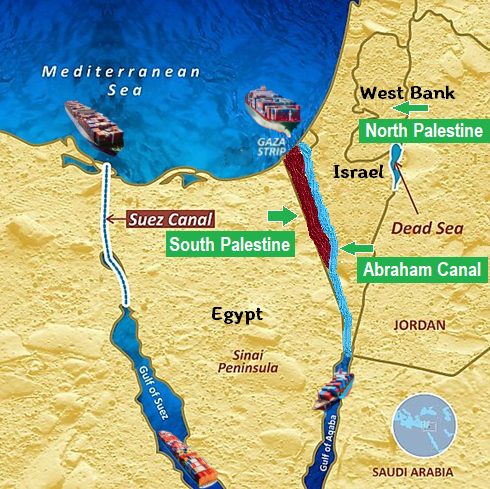
A proposed “The Day After” map. (Source: Modified by the author from Worldatlas)
At present, Gaza and the “Palestine Question” are the biggest challenges in the Middle East—just as the “German Question” was for Europe after World War II. The main issue is: What should be done with Gaza and the future of Palestine once the war with Israel ends?
Israeli leaders have been criticised repeatedly—particularly by the Biden administration—for lacking a concrete “Day After” strategy. Just two weeks into his second term, Donald Trump shocked the world with a plan to restore and take over Gaza by relocating over two million Palestinians to Egypt and Jordan and transforming Gaza into the “Riviera of the Middle East.”
This idea was met with widespread resistance from Arab states and European nations. In response, Egypt introduced a counterproposal, known as the “Arab Plan,” which firmly rejected any forced relocation of Palestinians. This plan has received backing from nearly all Arab and Muslim-majority countries, along with major European powers. Still, none of the proposals so far have managed to deliver a comprehensive, long-lasting solution that garners mutual support from all stakeholders.
This article therefore proposes another alternative called the “One-Plus-Two-State and A Canal Solution”— a multifaceted strategy that addresses political, economic, and security concerns.
Establishing a Palestinian state has long been the hardest political challenge. For decades, the “Two-State Solution” has gained overwhelming support globally as the most realistic path to lasting peace in the region. France and Saudi Arabia are set to co-host a major conference at the UN General Assembly in New York on July 28-29 to push for this solution to become a reality, after it was postponed last month when Israel launched a military attack on Iran.
Key figures like UN Secretary-General António Guterres and Norway’s Foreign Minister Espen Barth Eide have questioned: If the two-state solution isn’t the best option, then what is?
A possible answer: the “One-Plus-Two-State Solution” or “Three-State Solution”—one Israeli state and two Palestinian states. While this idea isn’t entirely new, this proposal brings a new approach.
In reality, the physical distance of at least 40 kilometers between the West Bank and the Gaza Strip, which have been separated since 1948, poses a major challenge for any future Palestinian government. Former Israeli prime minister Ehud Olmert proposed in his 2008 peace plan connecting the two territories by constructing a tunnel or highway (through Israeli land), but this solution is now considered unfeasible.
Since the “October 7” attacks in 2023, the prospect of a unified Palestinian state (one country with two territories) may now resemble the failed case of East and West Pakistan after World War II, rather than the current examples of Oman or Brunei, which—despite being split into two parts—face no serious administrative obstacles.
Therefore, instead of a single Palestinian state with two territories, the first phase may begin by dividing and establishing Palestine into two separate states—namely, North Palestine and South Palestine. Although they are distinct political entities, in international sporting events such as the Olympics, the World Cup, the Asian Cup, and the Asian Games, these two states could unite and compete under the name “Team Palestine.”
The long-term objective, as part of a second phase, would be the political reunification of a single Palestinian state (Palestine Reunification)—a goal that would depend on, or be deferred until, Israel is confident that a future Palestinian state no longer poses a threat.
Of course, the West Bank is the rightful location for a legitimate Palestinian state in the North. But the key question is: how suitable is Gaza, in its current state, to serve as the foundation for a southern Palestinian state? From Trump’s perspective, Gaza has been so extensively destroyed that it is almost uninhabitable for Palestinians. If offered a better alternative, many may be willing to move to a safer, more attractive location.
According to UN estimates, it could take up to 40 years to demolish and rebuild Gaza, with as many as 21 years needed just to clear the rubble—an area fraught with hazards such as buried explosives and toxic substances.
Therefore, if a new life, a new future, and renewed hope are to begin, it may be necessary to consider relocating, finding new territory, and redrawing the map of the Gaza Strip in practical terms—identifying a place where a new city could be built quickly and efficiently, without the need for time-consuming demolition. The key question is: what area qualifies as “the right piece of land” that President Trump envisions?
One option that would require negotiation and a land swap is to draw a line through the centre of Gaza down toward the south, parallel to Egypt’s Sinai Peninsula. This area could be approximately 100 kilometres long and 3 to 5 kilometres wide (see map). It could potentially become the narrowest country in the world. The advantage is that this territory could be developed immediately into new urban zones—avoiding the two-decade delay that would come with demolition and clearance.
This new territory would be comparable in size to the current Gaza Strip—or possibly even larger—if Egypt is willing to give up part of the Sinai Peninsula for the establishment of the new Palestinian state, in exchange for substantial economic benefits.
The next question and objective is the economic solution: How can South Palestine survive and become economically self-sufficient? The proposed answer is the “Abraham Canal”—a project that would provide sustainable employment and long-term income for Palestinians, particularly those in South Palestine.
At the same time, Israel has long dreamed of constructing a commercial canal, most notably the Ben-Gurion Canal project—nearly 300 kilometers in length—which would require a massive budget that has so far been beyond Israel’s financial capacity.
From an Israeli perspective, the Abraham Canal is essentially a reimagining of the Ben Gurion Canal—relocated from its original proposed route through the center of the country to the west. It would connect the southern Israeli port city of Eilat to Deir al-Balah, which is located in central Gaza. This would create a second maritime shipping route parallel to the Suez Canal, linking the Red Sea in the south to the Mediterranean Sea in the north—and generating enormous benefits across multiple sectors.
Economically, the Abraham Canal would become a major source of income for South Palestine, providing most Palestinians with food, jobs, and sustainable income throughout the year—from the start of construction through to its long-term operation. It would be extremely unlikely that any Palestinian group would wish to “break their own rice pot.”
It is believed that with the advancement of modern technology and innovation, China will be able to build houses and infrastructure, as well as dig canals quickly and complete them in a short period of time. Additionally, the vast amount of debris may be useful for building the Abraham Canal.
Commercially, once it becomes a one-way system allowing for faster shipping, the Abraham Canal will not be a competitor that Egypt needs to worry about. Instead, it will serve as an additional source of income for both Israel and Egypt, especially given their extensive experience in operating the Suez Canal. Egypt will play a key role in the administration of the Abraham Canal—a privilege and benefit granted in exchange for ceding part of its territory in the Sinai Peninsula to Palestine.
In terms of security, the Abraham Canal will serve as both a permanent natural border and a buffer zone to help prevent cross-border intrusions. With a width of 400 meters and a depth of 50 meters, it will be even more difficult for any armed group to invade Israel and carry out an attack like the October 7 incident. And this is the security solution Israel needs most.
Symbolically, the construction of the Abraham Canal will deepen the significance of the word ‘Abraham’ and redefine the Palestinian vision of ‘From the River to the Sea’—which refers to the area from the Jordan River to the Mediterranean Sea—into ‘From the Canal to the Sea.’ The Abraham Canal will pave the way for greater prosperity and a brighter future for Palestinians, as well as for Israel, Egypt, and other Arab nations.
Meanwhile, as the ‘big brother’ of the Arab world, Saudi Arabia is seen as having both the potential and a crucial role in driving this vision forward and fostering sustainable peace in the region.
Under Vision 2030, one of Saudi Arabia’s main goals is to further develop the western side of the Red Sea and reduce its reliance on oil revenues—particularly through initiatives like the Neom City Project. In this context, the Abraham Canal will strongly support the future of a new Saudi Arabia. It is believed that Saudi Arabia and its Arab allies are ready—with the necessary potential, capital, and shared interests—to jointly invest in the Abraham Canal project and develop the Gulf of Aqaba’s connection point into a ‘Golden Pentagon’ that could transform the region.
Secondly, as the host of the 2034 World Cup, Saudi Arabia could use the world’s most popular sporting event—especially in the Middle East—as part of its long-term peace strategy. As a special gesture and incentive, it could consider sharing the first round of the tournament with one of the 12 groups (48 teams total) co-hosted by three countries: Northern Palestine (since Southern Palestine will already have the canal, with Saudi Arabia providing the stadium), Israel, and Egypt.
If FIFA were to expand the tournament by 16 teams to a total of 64, it would open up the possibility for Saudi Arabia to host matches in additional countries—including Syria, Yemen and Iran, provided they are not directly or indirectly involved in conflict with the host nation— making 2034 a particularly significant year for the Middle East as a whole.
In the hope that by then, the two Palestinian states will have achieved the status of ‘normal states’ like other nations, this would be a precious gift that Saudi Arabia offers to both Palestinians and Israelis. Just as the world supported South Africa by awarding it the 1995 Rugby World Cup and the 2010 FIFA World Cup after the end of its globally condemned apartheid regime, this gesture could transform a battlefield into a marketplace, a desert into a commercial canal, and a conflict zone into a zone of cooperation—making 2034 the most special and remarkable year for the Middle East.
It would inspire great dreams and renewed hope for Palestine, Israel, and other nations in the region—nations that must now begin to think and act differently to build a bright new future.
Related Topics
Related Posts