
Founder & Principal, Line of State
Orban’s Hungary Votes Under Moscow and Ankara’s Shadow, Tomorrow May End Him
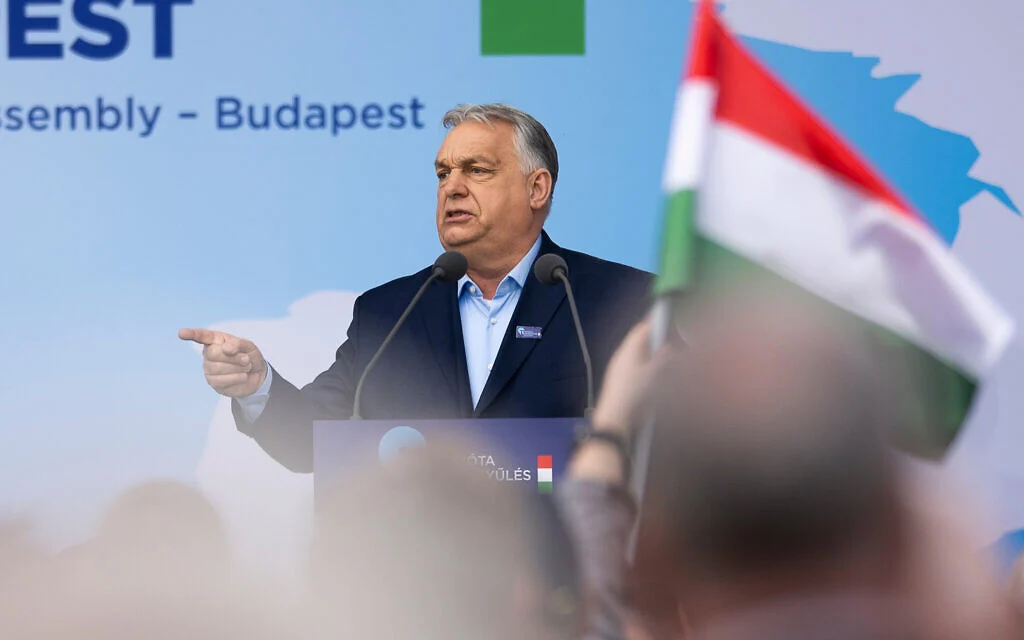
Hungarian Prime Minister Viktor Orbán speaks during an assembly of European far-right parties with Orbán’s Patriots for Europe group, in Budapest, Hungary, March 23, 2026. (AP Photo/Denes Erdos)
Hungary votes tomorrow, but the outcome may already be set. Orban did not just reshape politics, he built a system that answers outward. Moscow provides leverage. Ankara gains entry. The method tested in Washington now operates where resistance is weakest. This is not governance. It is control of rules, narrative and time. Israel should read it clearly. A state that runs channels to Moscow, Ankara, Tehran and Doha while trading European leverage is not a partner. It is a breach. If the system holds, the vote will confirm it. If it breaks, it ends him. And that end will not be a loss. It will be a correction. For Europe. For Israel. And above all, for Hungary itself.
On Sunday, Hungary is not voting for a parliament. It is voting who decides.
199 seats split between 106 constituencies and 93 list seats. The numbers are clear. The conditions are not. Polls put Peter Magyar’s Tisza ahead of Viktor Orban’s Fidesz; Median projects 138-142 seats, IDEA gives Tisza 50% among decided voters against 37%. ODIHR finds a polarized system saturated with fear, with blurred lines between state and campaign and a biased media environment. An advantage in the polls. Structural asymmetry favoring the government.
This is not illiberal democracy. It is a mechanism that weakens gatekeepers, bends rules, and consolidates state, party, capital, and media until no boundary remains. The 2026 V-Dem report is clear: Hungary leads the deterioration of electoral authoritarian regimes. Checks were removed, electoral quality damaged, press freedom curtailed. Since 2018 — an electoral autocracy. Transparency International places it at the bottom of the Union. Within the EU, the legality of releasing billions remains under examination because the reforms are absent.
This is not style. It is rules. These elections are not local. They test whether a state can escape a mechanism built from within or remain within it.
Polls show a double digit lead for Tisza, at times near a constitutional majority. The system is not neutral. Constituency design, financing, and diaspora voting give Fidesz structural asymmetry. This is not victory. It is decisiveness.
If Orban loses and respects the result, a mechanism built to control outcomes retreats. If not — the template is familiar: delegitimizing results, flooding claims, narrative dominance, and extraordinary measures to hold an outcome that was not granted.
Not chaos. Method.
Not Washington – what was learned from it.
Those backing Orban reveal a method. J.D. Vance did not come to Budapest for a visit; he came to intervene, publicly calling for the continuation of the rule of the man who turned Hungary into a pro-Russian brake inside NATO and the EU. Donald Trump gave personal patronage and broke a long American habit of avoiding open meddling in foreign elections.
What 2020 tested in the United States became a template: contest results, construct a stolen-election narrative, pressure institutions, and instrumentalize uncertainty. Vance legitimizes its use in a system where restraints have already eroded.
The Kremlin aligns. A study cited by Reuters identified coordinated Telegram activity promoting pro-Orban narratives originating in Russia. Trump’s Washington and Putin’s Moscow converge on the same outcome – weakening Europe’s capacity to decide and act.
Not an embrace. Convergence.
American legitimacy for contesting results is not a view. It is latitude. It signals how one acts when one loses.
The Capitol was not an event.
It was a precedent.
Not replication, but proof of concept: results can be challenged, power preserved, rules bent. In the system built in Budapest – media control, institutional erosion, centralization of power – these tools do not stop. They embed.
The question is not whether there will be a Capitol in Budapest.
The question is whether the conditions that made Washington 2020 possible already exist there.
They do.
And that is a choice of side – on the wrong side of Europe and of the free world.
Moscow’s interest does not need interpretation. Orban blocked a major loan to Ukraine, threatened sanctions, and turned the European veto into permanent leverage. A recording exposed by Reuters shows Foreign Minister Peter Szijjarto offering to pass to Sergei Lavrov an internal EU document. This is not proximity. It is penetration. Trust in Brussels has eroded to the point that states restrict intelligence sharing with Budapest out of fear of breach.
The Moscow link is infrastructure. Dependence was not reduced. It was hardened: gas through TurkStream, Turkish guarantees of flow, and Paks II – a Russian foothold in Hungary’s economy: Rosatom contract, Russian state loan, long-term fuel lock-in, technological dependence, operational reliance. In September 2025, the Court of Justice annulled the Commission’s approval of state aid, citing procurement failures. The project is Russian and structurally defective.
Not sovereignty.
A mortgage.
Orban sold energy sovereignty, but ceded dependence. A state tying its baseload, financing, and nuclear future to Russia during war is not protecting itself. It is securing Russian leverage.
Erdogan is not a secondary partner. Under Orban, Hungary gives Ankara platform, route, and conduit. In December 2025, ties were elevated to strategic cooperation of highest priority. Sixteen agreements followed, including defense. 4iG signed with Nurol and Aselsan on armored vehicles, weapons systems, counter-drone capabilities, and air defense, alongside links to the Turkish wealth fund. This is force projection inside Europe.
Hungary is a conduit. In 2019, Budapest opened the European office of the Organization of Turkic States. In 2024, the EU clarified Hungary has no mandate. In 2025, the Turkish Republic of Northern Cyprus was defined as inseparable. In Gabala, recognition was staged: Ersin Tatar presented as president. The EU rejected it. This is ceremonial laundering.
This strengthens a state undermining Greece and Cyprus. Commission documents describe operational disruption: non-recognition of Cyprus, obstruction of NATO cooperation, disruption of energy projects, links to the unrecognized entity, and violations in the Greek sphere. Hungary relieves pressure on a state challenging the European order.
A legal breach. Article 4(3) requires sincere cooperation; Article 24(3) requires solidarity. This fails both.
For Greece and Cyprus, this is subversion from within.
The price for Hungary is clear. Most of the public supports the EU, yet policy moves in the opposite direction. Some 18 billion euros – roughly 8% of GDP – remain frozen. The deficit is above 5%, debt above 70%, and the credit rating is on the edge.
Sold sovereignty. Produced dependence.
Promised stability. Delivered polarization.
Even if Orban loses, the mechanism remains. Institutions stay aligned. A narrow majority brings instability and prolonged struggle. Political Capital and CSIS outline a template: fraud claims, interference narratives, stolen elections, emergency powers.
Not conjecture. Method.
Israel must avoid confusing rhetoric with interest. Benjamin Netanyahu praised Viktor Orban, and UN votes made him convenient. One layer. Beneath it – pattern.
After the 2024 pager attack against Hezbollah, Hungarian officials reportedly signaled Tehran willingness to share findings. Not publicly, but via a backchannel moving from investigative cooperation to transfer of sensitive information. Budapest positions itself as a hub engaging all sides, even in Israeli operations against Iranian proxies.
Hungary deepened ties with Turkey and Qatar.
Not relationships. Practice.
Building policy on this is a strategic error. Not because Orban conceals, but because he does not.
Behind closed doors in Jerusalem, there is no disagreement. A leader who deepens dependence on Russia, integrates into the Turkish project, opens channels to Iran, and builds a Qatar axis while trading EU vetoes is not an ally. He is a breach.
Hungary functions as a Trojan horse: Russia through energy and veto, Turkey through legitimacy and cooperation, Trumpism through political foothold. Not an episode. An architecture.
Votes are cheap. Infrastructure, dependence, legitimacy are currency. Orban operates consistently in one direction.
If it breaks, it ends him.
For Israel, the day after Orban is not a threat. It is correction. A Europe aligned against Russia, curbing Turkish encroachment, leaving no openings – because it has seen what enters through them.
Related Topics
Related Posts