Our new delicate Simchat Torah dance: A time to weep, a time to rejoice
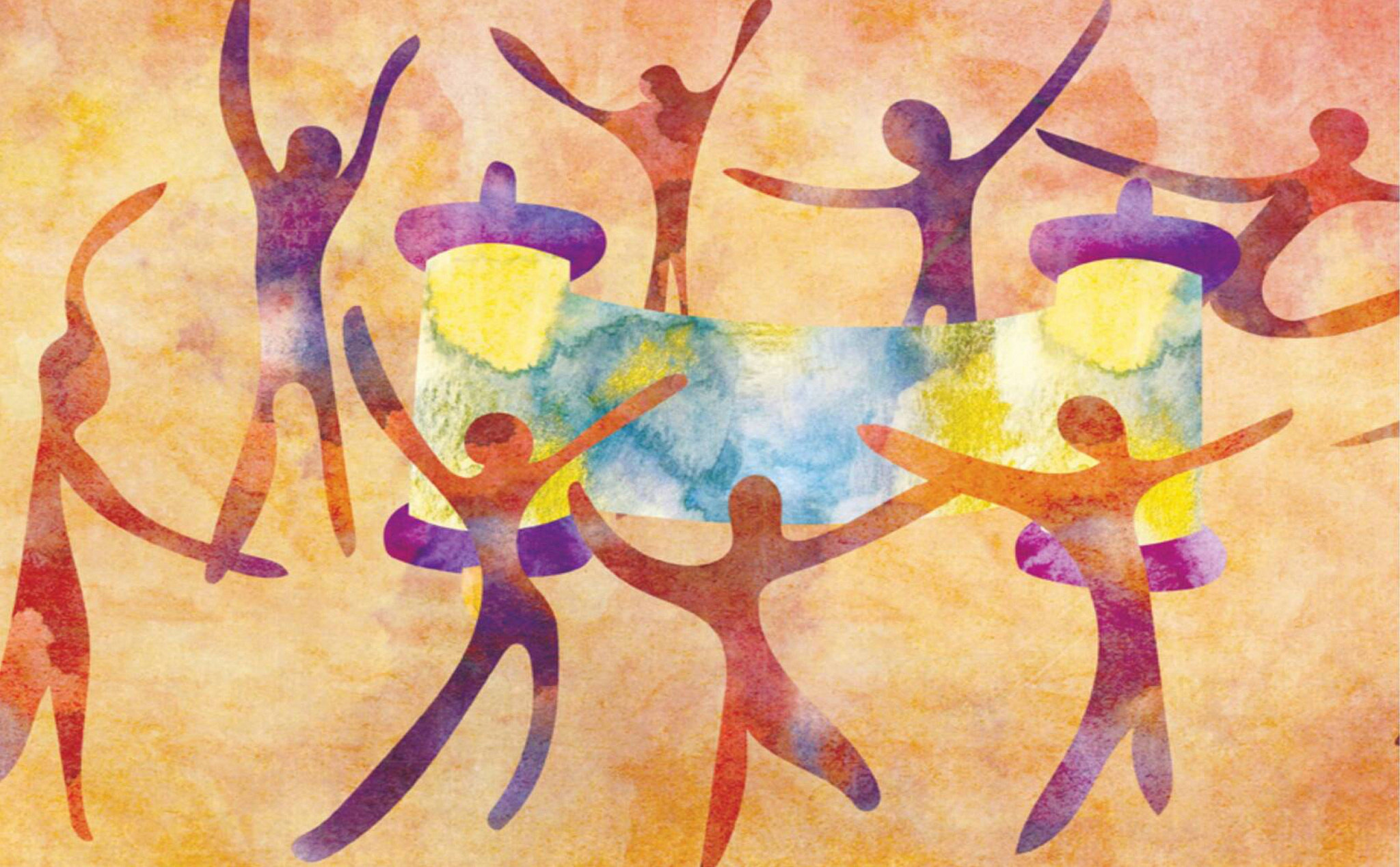
As we approach our third Simchat Torah since our great catastrophe, a now familiar question arises: how can we celebrate?
While this year is not quite as searingly painful as the first two — thankfully, we are no longer plagued by the agony of our precious brothers and sisters being held in brutal captivity — the day remains deeply fraught. The relief of their return does not erase the devastation wrought upon our collective psyche, nor does it fill the emotional crater left behind.
On that morning, we were thrust back into the darkest chapters of our history, subjected to unbridled savagery from a position of terrifying vulnerability. The most basic assumptions we had leaned on for decades were dismantled in a matter of hours: the inviolability of our homes, the faith that our leaders and defense forces would shield us, and even the presumption that our sovereign state was an immutable fact. In the shadow of our lingering anguish — manifest by empty seats, scarred landscapes, and shattered families — how do we lift the Torah scrolls and dance? And looking ahead, how will we ever genuinely celebrate this day again?
A resonant response emerges from the book of Kohelet (Ecclesiastes), read on the intermediate Shabbat of Sukkot. The book is widely seen as our canon’s most cynical, marked by its refrain that everything is hevel (fleeting, elusive, futile), and its assertion that there is “nothing new under the sun.” Arguably, it is also our most perplexing sacred text, given its many internal contradictions:
- Death is preferable to life (4:2–3); yet a living dog is better than a dead lion (9:4).
- Simcha (joy) is hollow vanity (2:2); yet there is nothing better under the sun than to eat, drink, and rejoice (8:15).
- Chochma (wisdom) surpasses ignorance as light surpasses darkness (2:13); and yet much wisdom brings much grief (1: 18, 2:15).
Traditional commentators have long sought to reconcile these tensions. The Talmud resolves the conflicts by viewing each statement as a partial truth contingent upon circumstance. For example, the simcha praised by Kohelet refers strictly to the joy of performing a mitzvah, whereas all other types of simcha are futile (Shabbat 30b). Under this harmonizing lens, Kohelet is rendered safely contradiction-free.
Another approach treats the book as an intellectual journal of sorts — a philosophical experiment recorded in real time by an earnest philosophical investigator (See the introduction to Sefer Megillat Kohelet, by Moses Mendelssohn (1770: Berlin). We are given access to the investigator’s unfolding observations, as hypotheses are constructed, evaluated against observation, and discarded or refined as the evidence demands. Here, the contradictions simply reflect the shifting stages of the author’s search.
Yet neither explanation feels entirely true to the raw, jagged honesty of the text, especially when read through the prism of our recent trauma. It seems far more likely that Kohelet’s contradictions are deliberate — neither logical knots waiting to be untangled, nor the abandoned drafts of an evolving thinker. They are the very crux of the book’s message: human existence is inherently, inescapably contradictory.
For a book canonized within our sacred Tanakh (after Tannaitic debate whether it “defiles the hands” – whether it achieves canonical scriptural status – as recorded in Mishnah Yadayim 3:5), this was an extraordinarily daring premise. Equally radical is the fact that Kohelet undermines its own premise, that there is “nothing new under the sun.” In fact, there is something new and it is to be found at the very core of the book that claims otherwise. In an undeniably novel way, Kohelet posits that life’s contradictory realities can exist side by side with no need to force a false resolution.
This perspective sheds fresh light on the celebrated poem of Kohelet’s chapter 3. Its rhythmic cadences — “a time to be born, and a time to die; a time to plant, and a time to uproot” — are typically read as a taxonomy of alternating seasons: first one, then the other, neatly sequenced along the arc of a lifetime. But in keeping with Kohelet’s deeper ethos, these pairings need not be mutually exclusive binaries. Life routinely demands that opposing seasons inhabit the very same hour, even the very same breath.
Here lies the perspective we so desperately need as Simchat Torah approaches this year, and which we will need to return to in years to come.
Kohelet does not ask us to harmonize the irreconcilable, nor does Jewish tradition demand that we feign emotional coherence. When we encircle the bimah, our “time to dance” will be inextricably bound up with our “time to mourn.” Our feet will move in rhythm, but our steps will be heavier; our voices will rise in song, but they will crack with the weight of memory. Tears of sorrow will fall alongside tears of gratitude for survival; and the warmth of community will stand directly beside the chill of absence.
On the day we conclude the Torah and immediately roll it back to the beginning, we are reminded that endings are never tidy and beginnings are rarely clean. We do not dance because the darkness has lifted, but because we refuse to let the darkness have the final word. Kohelet grants us sacred permission to bring our whole, yet fractured selves into the room — holding boundless grief in one hand, genuine joy in the other, and refusing to let go of either.