Historian, Librarian, Educator, and Artist
Painting as a Holy Gathering: Shai Azoulay at 55
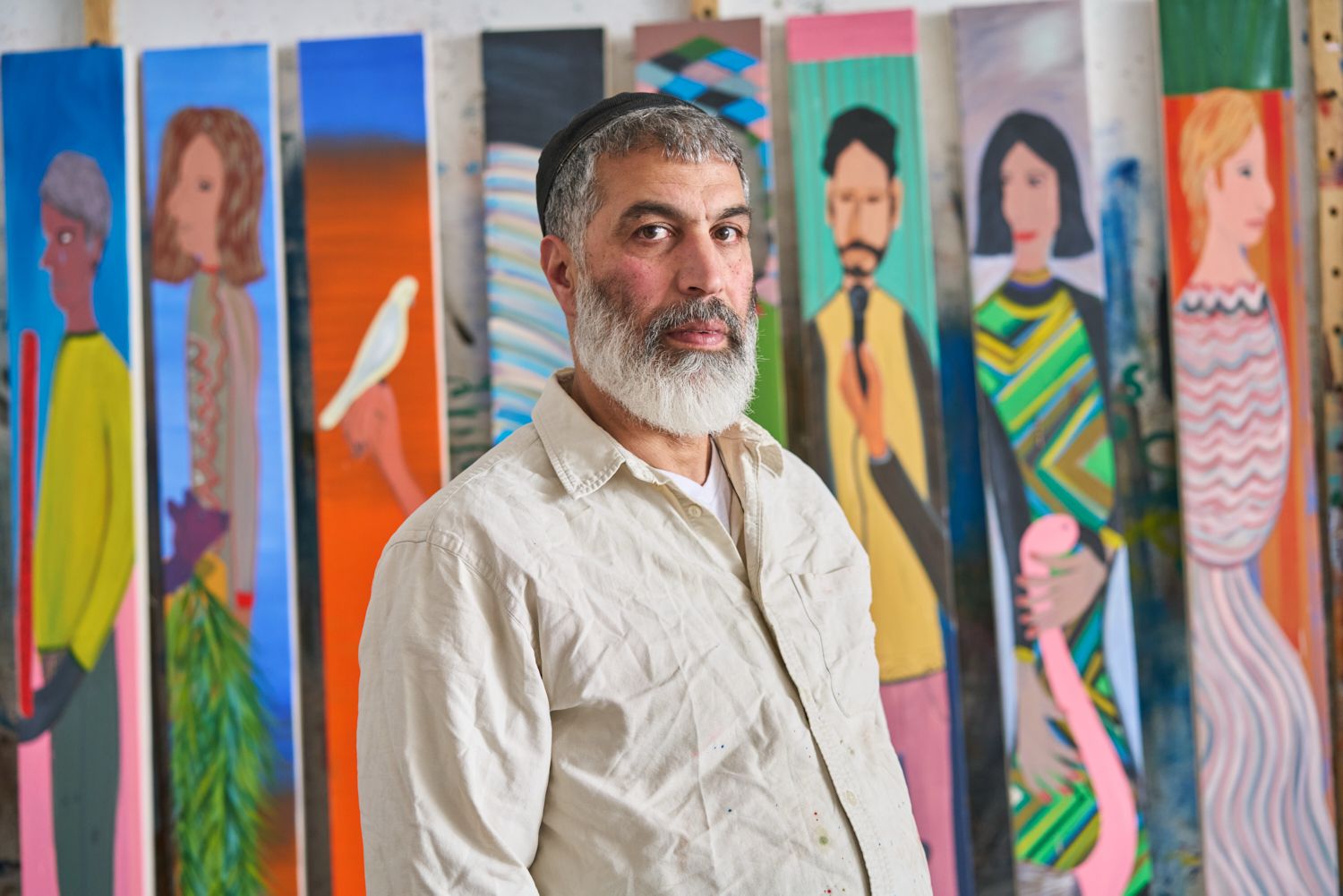
Shai Azoulay in front of LEV, 2026, at the Ramat Hasharon Gallery for Contemporary Art. Photo courtesy of Yaakov Israel / Shai Azoulay.
Joy, faith, and Jewish memory in the paintings of Shai Azoulay
By Bonnie K. Goodman, BA, MLIS
Artist talk: Friday, June 12, 2026, at 11 a.m. at the Ramat Hasharon Contemporary Art Gallery. Exhibition on view through August 8.
In The Holy Gathering, Israeli artist Shai Azoulay turns Rabbi Nachman, biblical memory, faith, and post-October 7 rupture into paintings where joy carries the weight of longing.
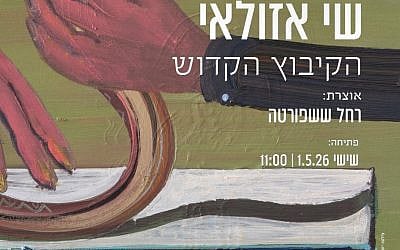
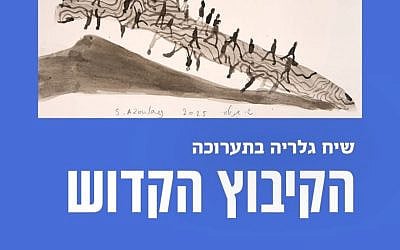
Poster for the artist talk with Shai Azoulay and curator Rachel Sasporta, Friday, June 12, 2026, at 11 a.m., at the Ramat Hasharon Gallery for Contemporary Art. Image courtesy of the Ramat Hasharon Gallery for Contemporary Art.
Shai Azoulay does not call his new exhibition a retrospective. He is careful about that. The Holy Gathering, his current body of work presented within the exhibition cluster A Tail Never Forgets at the Ramat Hasharon Contemporary Art Gallery, does not attempt to summarize his career or arrange his paintings into a neat chronology. Yet arriving as he turns 55, and as his work appears in several artistic contexts at once, it inevitably invites a broader look at the path that has brought him here.
“This exhibition is not a retrospective,” Azoulay says, “but it certainly includes various bodies of work from recent years.”
That distinction matters. Azoulay is not standing outside his work, looking backward with the coolness of a career survey. He is still inside the studio, still working, still searching, still allowing figures, symbols, colors, failures, stories, jokes, prayers, and anxieties to gather around him. The exhibition becomes less a retrospective than a threshold: a place where the forces that have long animated his painting come together with unusual clarity.
Those forces include Rabbi Nachman of Breslov and Jewish mystical storytelling; the discipline of daily studio practice; humor and humility; faith and doubt; the visual legacy of art history; and the experience of being an Israeli painter in dialogue with the wider world. Azoulay’s paintings remain colorful, theatrical, and often joyful. But their lightness is not simple escapism. It is a way of carrying what might otherwise be too heavy to bear directly.
The larger exhibition, A Tail Never Forgets, curated by Rachel Sasporta, brings together the work of Tessy Cohen-Pfeffer, Shai Azoulay, and Shirly Bar Amotz. Its curatorial frame is psychological and spiritual: a world of hybrid animals, invented figures, monsters, memories, fears, longings, humor, and inner creatures. In her text on Azoulay’s section, The Holy Gathering, Sasporta describes his work as “fantastic, colorful and joyful paintings,” mostly large in scale and filled with symbols, in which enigmatic figures appear alongside simple, everyday ones.
For Sasporta, Azoulay’s paintings are rooted in Jewish sources and in “the philosophical world of Rabbi Nachman of Breslov and the stories he told.” Like the figures in those stories, she writes, Azoulay’s characters “do not rely on rational narrative logic,” but resemble “dream images and products of an associative unconscious.” They are created through intuitive movement of “line and stain,” drawn from biblical and cultural archetypes, and placed in dialogue with the history of art. Their humor is never merely comic. As Sasporta observes, they express an inner reality that moves “between decline and rise,” touching on “questions of faith and doubt, loneliness and hope.”
In Azoulay’s case, that world becomes The Holy Gathering: a gathering of figures, stories, archetypes, and spiritual energies drawn from Jewish memory and the painter’s own interior life. Sasporta connects the title to Rabbi Nachman’s Rosh Hashanah gathering in Uman, but the motif of gathering also becomes a visual structure in Azoulay’s work: thirty-two elongated anonymous figures gather into what she calls “a multifaceted congregation,” while another work places passengers behind a beaded curtain on a bus, caught in “an enigmatic tumult of shared existence.”
Even when the exhibition turns darker, Sasporta sees the same search continuing. In the ink drawings, she writes, “the events of recent years” seem to have seeped into Azoulay’s landscapes, forming “a visual journal of hard times.” Whether in joyful paintings or more joyless drawings, she notes, Azoulay’s work remains accompanied by “a sense of longing” — a yearning for “a wondrous simplicity” rooted in spiritual and religious experience and translated again and again into contemporary, everyday life.
Seen in installation, Azoulay’s paintings intensify this sense of gathering. The long, narrow canvases of LEV (2026), composed of thirty-two panels, stand almost like a procession of witnesses: elongated faces, birds, trees, vessels, anonymous figures, fragments of landscape, and flashes of saturated color arranged in vertical bands. They do not function only as isolated images but as presences placed side by side, each carrying a portion of story, memory, or mood. In the gallery, the works create a rhythm between individual figure and collective assembly, between portrait and procession, between the singular inner image and the larger community of images gathered around it.
Color is central to the emotional force of the exhibition. Azoulay’s reds, blues, greens, oranges, pinks, and yellows are not merely decorative or cheerful; they establish mood, rhythm, and spiritual temperature. The colors often arrive before the narrative does. They make the paintings feel open, generous, and immediate, but they also complicate the scenes they contain. A brilliant blue can suggest expansiveness or distance; a red curtain can turn a studio into a stage; a field of orange can hold both warmth and unease. In Azoulay’s work, color becomes one of the ways feeling enters the painting before meaning settles into language.
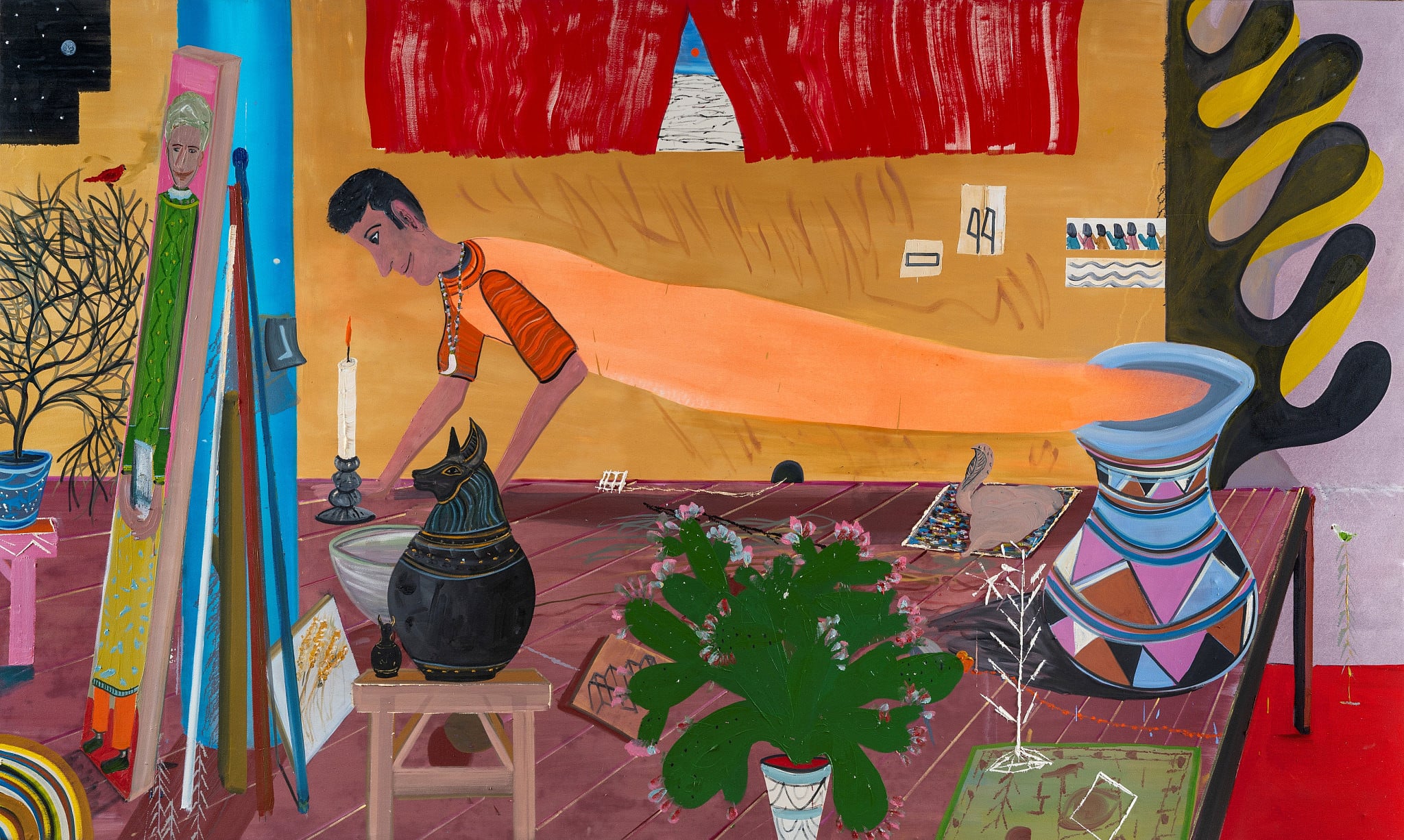
In Joseph (2024), Azoulay depicts the biblical interpreter of dreams not as a distant patriarch but as a theatrical, hovering presence. He appears almost genie-like, emerging from a decorated vessel, holding a candle, while the artist’s studio becomes a stage: red curtain, Egyptian motifs, murals, plant forms, and objects that seem at once domestic, painterly, biblical, and symbolic. The story of Joseph is not illustrated in a conventional sense. It is reactivated inside the space of the studio, as if biblical memory were still alive, theatrical, and capable of appearing in the room.
In Plomp (2021), a large diptych, Azoulay evokes Rabbi Nachman’s story of the Plomp, or water pump, in which desire expands beyond proportion until loss follows. The painting’s busy interior world — with suspended objects, fragments, vessels, lines, figures, and signs — becomes a space of psychic overflow. The image feels less like a single narrative scene than a mind or room crowded with impulses, symbols, and unresolved longings.
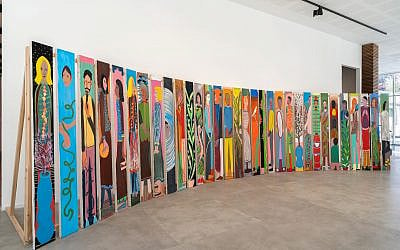
In LEV, thirty-two elongated panels gather into a multifaceted congregation. Their narrow format turns each figure into a vertical presence, almost like a witness, a banner, or a standing soul. Together, the panels form a painted assembly: part procession, part prayer quorum, part chorus of inner figures. In Azoulay’s hands, gathering becomes a broader painterly structure: people, stories, fragments, symbols, memories, and states of consciousness assembled without resolving into a single explanation.
Curator Vera Pilpoul sees that layeredness as central to Azoulay’s artistic force. “Shai Azoulay is a total artist — authentic, deeply rooted in faith,” she wrote in May 2026, describing him as capable of creating painterly worlds in which “thought, imagination, and belief are nourished by Jewish sources while continually opening themselves toward the here and now.” For Pilpoul, his paintings “forge a remarkable dialogue between Jewish tradition, art history, ancient civilizations, and a distinctly contemporary gaze,” often marked by subtle humor. In the Ramat Hasharon exhibition, she observes, “the mythical, the biblical, and the everyday become inseparably intertwined.”
Pilpoul’s description sharpens what makes Azoulay’s paintings so resistant to easy interpretation. Their symbolism is visible, but not fully decoded; their stories are legible, but never closed. As she notes, Azoulay’s work draws the gaze inward, “into a space charged with visible and hidden symbolism alike” — a space that invites contemplation, interpretation, and prolonged looking while still preserving something “elusive and unresolved.”
That refusal of simple explanation is central to Azoulay’s art. His paintings are figurative, but they are not realist. They are narrative, but the narratives are unstable. They are spiritual, but not pious in the conventional sense. They are playful, but not lightweight. They often appear naive or childlike at first glance, with simplified figures, flattened spaces, awkward bodies, and strange proportions. Yet the awkwardness is deliberate. It is part of a sophisticated painterly language that allows Azoulay to enter regions of experience too elusive for academic realism: longing, prayer, inner contradiction, religious searching, and the fragile comedy of being human.
Born in Kiryat Shmona and later raised in Arad after his family relocated during the prolonged Israeli-Lebanese conflict, Azoulay studied at Bezalel Academy of Arts and Design, where he received both his BFA and MFA. He has since exhibited widely in Israel, Europe, and the United States, and teaches younger artists at Bezalel. His work has appeared in major institutions and galleries, and his representing gallery, Zolla/Lieberman Gallery in Chicago, is marking its 50th anniversary this season with a group exhibition in which he is included. He is also among the Israeli artists participating in A Plate of Hope and Color, a Tel Aviv exhibition supporting the Lone Soldier Center in Memory of Michael Levin.
His work also speaks to European modernism, especially Matisse’s color and interiors, Chagall’s floating figures and Jewish dream imagery, and the irreverent energy of contemporary “bad painting,” in which deliberate awkwardness and distortion become expressive tools. But Azoulay is not merely quoting art history. He is absorbing it, playing with it, and placing it inside his own spiritual theater.
Yet for all the public recognition, Azoulay describes his practice in humble, daily terms. Asked what feels most continuous in his work, he does not begin with exhibitions, awards, or institutional milestones. He begins with showing up.
“I feel that my persistence in coming to the studio every day characterizes my artistic practice more than anything else,” he says, “and I am grateful for that.”
That daily persistence is important because Azoulay’s paintings can look spontaneous, improvisational, even mischievous. But behind their looseness is a serious discipline. The studio is the place where images are allowed to wander, fail, mutate, and begin again.
Fellow artist Raquel Sanchez, who first encountered Azoulay’s work online and later visited him in his Talpiot studio, sees that discipline as central to who he is. “I consider him a mentor,” she says, “not because we do the same kind of art, but because I appreciate so much who he is as an artist.” For Sanchez, Azoulay’s seriousness lies not only in individual works but in his understanding of art as a calling. “He has the right stuff that it takes to be an artist,” she adds, “knowing that that’s a life, and not necessarily a painting.”
At 55, Azoulay seems more willing to trust that process.
“Today I approach painting more liberated and less critical,” he says. “I don’t prevent the painting from coming out of me. I understand that I am a conduit, and I understand that the closer I am to myself, the painting is in a more exposed and real place.”
The word “conduit” is telling. Azoulay does not present himself as a master imposing fixed meaning onto canvas. He describes painting as something that passes through him when he is sufficiently open, honest, and close to himself. This language echoes both mystical practice and painterly intuition. He is not simply making images about spirituality; he is describing painting itself as a spiritual and psychological process.
Over the years, he says, he has come to understand painting as “a kind of media tool through which I speak to the world.” The phrase is contemporary, almost technological, but what he means by it is deeply personal. His daily experiences, his life, and his painting are all full, he says, of “humor, surrealism, modesty, and a kind of search and getting closer to myself.”
That mix — humor, surrealism, modesty, and self-searching — may be the key to Azoulay’s art. He does not separate the sacred from the comic, the studio from the synagogue, the biblical from the everyday, or the childish from the profound. A figure may look foolish and holy at once. A vase may become a portal. A studio may become a stage. A red curtain may turn a biblical scene into theater. A gathering of elongated figures may feel at once playful, ceremonial, and moving.
Rabbi Nachman’s influence helps explain why. Azoulay has long been drawn to the Breslov master’s stories, teachings, and insistence on joy. In the current exhibition, Rabbi Nachman appears not merely as subject matter but as a model for how stories work: indirectly, strangely, layer by layer.
“Through his wisdom and teachings,” Azoulay says, “Rabbi Nachman introduced me to the ability to tell a story that is like an onion. Layer after layer, a story of two stories and the desire to search for true inner joy, which is healing in my eyes.”
The onion is a perfect metaphor for Azoulay’s paintings. They rarely offer a single narrative. Instead, they unfold through layers: a biblical reference, a studio object, a joke, a mystical echo, a personal memory, an art-historical quotation, a spiritual question. One layer may be bright and open; another may be lonely, doubtful, or wounded. The viewer is not asked to solve the painting so much as remain inside its layered world.
The same tension is visible in the exhibition’s smaller or quieter works. In The Shepherd (2025), a small group appears gathered in the palm of an outstretched hand against a broad, almost empty landscape of blue sky and brown earth. The image is sparse and tender, suggesting care, distance, and vulnerability at once. In Me, You and Him (2024), two small figures reach toward a branch while a dark bird perches above them, turning a seemingly simple scene into an image of dependence, aspiration, and uncertainty. These works complicate the exhibition’s brightness. They suggest that gathering is not only festive or communal. It can also be precarious, intimate, and haunted by distance.
Joy in Azoulay’s work is not denial. It is closer to Rabbi Nachman’s difficult joy — joy as discipline, healing, and resistance to despair. Azoulay’s paintings often contain loneliness and doubt, but they do not surrender to heaviness. They keep moving, joking, glowing, gathering.
That movement also appears in his international career. “I think being here in little Israel and exhibiting in the big world is something that is not taken for granted,” he says. “I have already had more than 15 international solo exhibitions, and it quite fills me with joy that I can be there and not just here in Israel. My dialogue with the world is expanding, and painting speaks all kinds of languages.”
The phrase “painting speaks all kinds of languages” is especially fitting for an artist whose work resists narrow categorization. Azoulay’s paintings speak Hebrew, Judaism, Israeli locality, art history, dream, humor, color, and gesture. They also speak internationally, not because they flatten their Jewishness into universal abstraction, but because they transform the particular into visual experience. A viewer need not know every Rabbi Nachman reference to feel that something in the image is searching.
That search is also something Azoulay passes on as a teacher. “When I teach students,” he says, “I try to be generous with them. To give them what I have learned and to pass on my understanding to them without fear of losing. I think that the moment you give, you receive more in return and also renew yourself.”
At 55, Azoulay is still asking what painting can do. His answer is modest and ambitious at once. In a world that feels harsh, fractured, and saturated with images, he wants painting to offer something slower and more searching.
“I think the world is in a state where art is an important tool for expression,” he says, “and I want painting to provide an opportunity or a respite from the world or the harsh reality for something that connects and inspires an inner search.”
He immediately recognizes the audacity of that desire. “It’s pretentious,” he adds, “but drawing a picture and playing with color in our time is also pretentious, and I’m not afraid of my desire.”
That last sentence may be one of the clearest statements of Azoulay’s artistic maturity. He understands the vulnerability, even absurdity, of painting now — of standing before canvas, color, figure, and story in a world of catastrophe, speed, cynicism, and technological saturation. But he does not retreat from the desire. He accepts its pretension and continues anyway.
In that continuation lies the strength of The Holy Gathering. It is not a retrospective, but it gathers. It gathers recent bodies of work, Jewish stories, studio images, dreams, failures, elongated figures, hard times, comic gestures, black-and-white landscapes, biblical echoes, and the stubborn daily act of painting. It gathers the light and the heavy, the sacred and the playful, the artist and the teacher, the local Israeli painter and the artist in dialogue with the wider world.
Most of all, it gathers the viewer into Azoulay’s ongoing search: for origin, for joy, for inner truth, for a way to make painting speak in a time that still needs pictures — not because pictures can fix reality, but because they can open a space inside it.
And perhaps that is the holy gathering: not only the figures in the paintings, or the followers of Rabbi Nachman, or the memories carried by Jewish history, but the act of gathering enough color, humor, faith, doubt, and longing to keep looking.
Related Topics
Related Posts