The views expressed herein are solely mine.
Pakistan Replaces Oman as US-Iran Broker
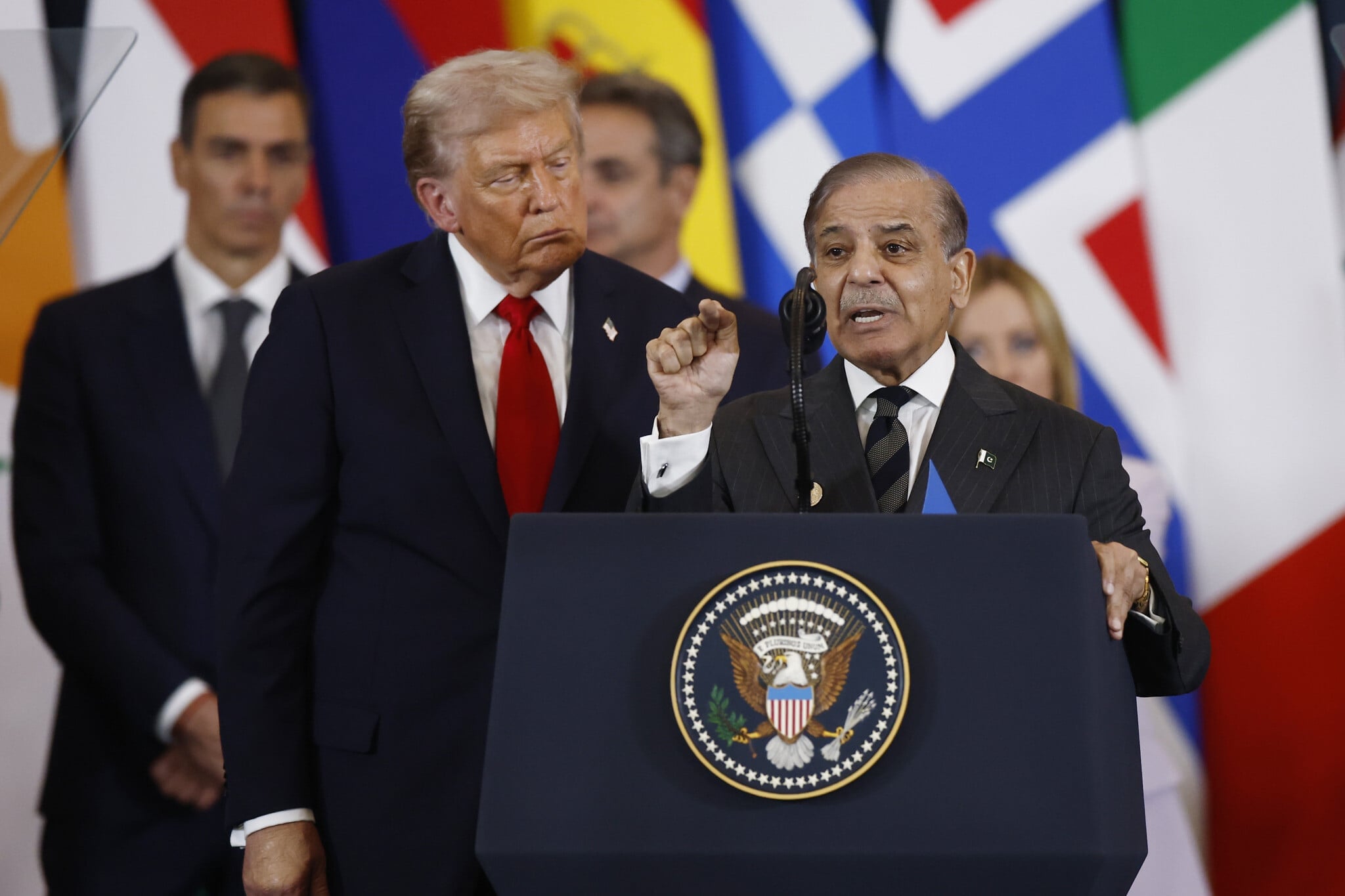
US President Donald Trump watches Pakistan's Prime Minister Shehbaz Sharif delivering a speech at the Gaza International Peace Summit, in Sharm el-Sheikh, Egypt, Monday, Oct.13 2025. (Yoan Valat, Pool photo via AP).
Oman is out as Washington’s Iran backchannel. In under six weeks, the Gulf sultanate that once hosted every quiet U.S.–Iran contact lost its seat. Talks shifted to Islamabad. The Serena Hotel hosted round one on April 11–12, 2026; twenty hours of hard bargaining produced a ceasefire that Pakistan then pushed to extend. A second round may follow within hours or days.
This was not about bias—it was about physics and power. Oman’s model—favoritism towards Iran while preaching “distance and neutrality”—collapsed under fire and humiliation. Iranian missiles hit Duqm and Salalah; oil storage burned. The self-styled “Switzerland of the Gulf” became a target the moment it doubled as U.S. logistics real estate.
Washington needed a channel outside the blast radius. It found one 1,200 miles east in a partner that can deliver short-term results.
Pakistan brings three assets Oman never had—and all three align with U.S. priorities: contain Iran and reopen Hormuz. First, proximity: a 959-kilometer border with Iran allows real-time shuttling and deconfliction. Army Chief Field Marshal Asim Munir’s shuttle diplomacy to Tehran narrowed gaps on the spot. Distance no longer shields talks from the war.
Second, nuclear weight. An arsenal of roughly 170 warheads commands Tehran’s respect and keeps Washington’s attention. President Trump has called Munir a useful bridge; in a confrontation with a nuclear-aspirant Iran, that deterrent creates leverage that diplomacy alone cannot.
Third, location. Gwadar sits about 600 kilometers from the Strait of Hormuz—the chokepoint for ~20.7 million barrels per day, about 20% of global seaborne oil. Partial Iranian closures in March pushed prices above $120 and sent shockwaves through Western-aligned Asian economies. Any durable deal must secure that artery. Pakistan sits on it.
Yes, Beijing’s $62 billion China–Pakistan Economic Corridor gives Islamabad skin in the game. More decisive are Washington’s deep, decades-old military and intelligence ties with Pakistan—ties that have repeatedly delivered on Iran since 1979. Islamabad can enforce outcomes where “neutral” goodwill failed under fire.
On the ground, 10,000 extra security personnel now blanket Islamabad ahead of potential talks. The initial two-week ceasefire holds largely because Pakistan pressed for its extension while Washington waits on a unified Iranian position. Oil volatility alone shows why the U.S. cannot tolerate disruption in Hormuz.
This is not a venue tweak; it is a wartime recalibration—results over optics. Traditional Gulf mediators took hits and went quiet. Oman’s peacetime neutrality proved brittle once missiles flew. Pakistan offers what Washington needs now: border access, nuclear leverage, proximity to the oil flow, and proven delivery channels.
Critics in Riyadh and Washington will point to Pakistan’s past. Reality does not care. The war that erupted on February 28, 2026—triggered by Iranian aggression—closed the world’s most critical energy artery. Only a nuclear-armed neighbor with direct access kept a diplomatic lane open. Round one delivered. Round two will test durability.
For now, the road to Tehran runs through Islamabad. A 959-kilometer border, a 600-kilometer reach to Hormuz, and ~170 warheads have replaced distance and declarations.
Pakistan is no long-term ally to trust blindly—its intelligence services’ history with Al-Qaeda is a permanent warning. In fact, their recent statements about Israel and the West are totally unacceptable and repulsive. But in a fight defined by Iranian-funded naval proxy networks, missiles, drones, mines, and chokepoints, Washington chose the partner that can pressure Iran and protect Western energy security.
Geography and power won—exactly as they should when U.S. interests are on the line.
Related Topics
- Anti-Zionism
- Antisemitism
- Bahrain
- Benjamin Netanyahu
- China
- Donald Trump
- Europe
- Gaza
- Gaza Strip
- Hamas
- Hezbollah
- Iran
- Iran Nuclear Deal
- Islam
- Israel At War
- Israel-Iran Conflict
- Israel-US Relations
- Israeli Foreign Policy
- Israeli Politics
- Jordan
- Lebanon
- Middle East
- Natural Gas
- Oman
- Pakistan
- Qatar
- Saudi Arabia
- Terrorism
- The Arab World
- Trump Peace Plan
- UAE - United Arab Emirates
- US Politics
- Weapons
- Yemen
Related Posts